Topic 10.5 Notes – Electric Potential
1. What Electric Potential Is
Electric potential tells you how much electric potential energy each coulomb of charge would have at a location.
- Units: volts (V)
- Scalar quantity. No direction.
If a charge moves between two points, the potential difference is
This means:
- If and it moves to lower , then .
- A battery creates a potential difference using chemical charge separation. It pushes charges internally to maintain a ΔV.
Quick reminder. Electric forces create electric potential energy. Potential just packages that energy information per coulomb so we don’t always need force vectors.
2. Electric Potential Due to Point Charges
Single Point Charge
For a point charge:
- Larger → larger
- Larger → smaller
- Sign of matches sign of source charge
Example:
A charge 2 m away gives
Positive because the source charge is positive.
Multiple Charges and Scalar Superposition
Potentials add algebraically:
No components. No trig. Just numbers with signs.
Common mistake I see on tests: students try to break potential into x and y components like electric field. Don’t. Potential is scalar.
AP limit: typically 4 or fewer charges unless symmetry makes it simple.
3. Conductors and Electric Potential
When conductors touch, electrons move until all connected parts reach the same electric potential.
In electrostatic equilibrium:
- Entire conductor surface has one constant .
- Electric field inside is zero.
- If there were ΔV inside, charges would keep moving.
That “same potential” idea shows up a lot in free response. If two metal spheres are connected by a wire, you immediately know their potentials are equal, even if their charges are different.
4. Relationship Between Electric Field and Electric Potential
Field and Potential Difference
The average electric field between two points:
For a uniform field:
Two huge ideas:
- The electric field points toward decreasing potential.
- A stronger field means potential changes more rapidly with distance.
You can think of as the “spatial slope” of potential.
Electric Field Maps and Equipotential Lines
These are two ways to represent the same situation. The diagram below shows a single positive point charge with both representations drawn together.
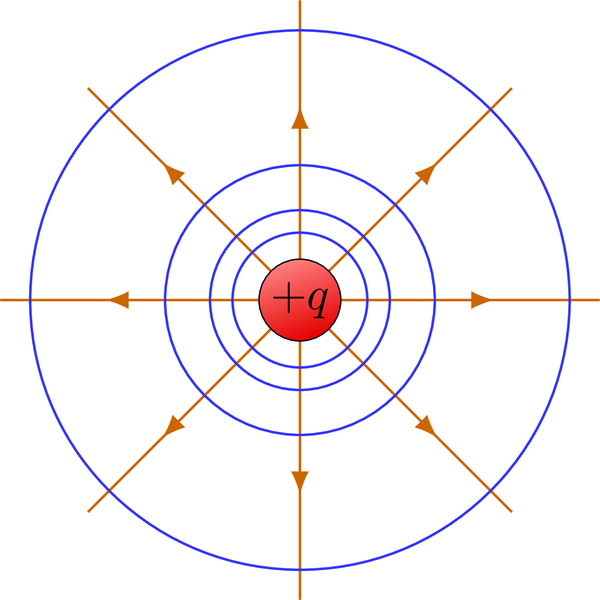
Electric field lines and equipotential circles for a positive point charge
Electric field map
- Arrows show direction of force on a positive test charge.
- Longer arrows → stronger field.
Equipotential lines (isolines)
- Connect points of equal .
- Moving along one → no work done.
- Always perpendicular to electric field.
- Closer spacing → stronger field.
From isolines, draw arrows:
- Perpendicular to lines
- Pointing from high to low
If you forget direction, remember this: a positive charge “rolls downhill” in potential.
5. Motion of Charges in Electric Potential
Energy connects everything:
If only electric forces act, use conservation of energy.
- Positive charge moves high → low potential naturally.
- Negative charge moves low → high potential.
- Decrease in becomes increase in kinetic energy.
On tests, pause and decide:
- What’s the sign of the charge?
- Which way does the field point?
- Is potential increasing or decreasing?
- What happens to energy?
That logic chain earns full credit in written explanations.
