Topic 14.2 Notes – Periodic Waves
1. What a Periodic Wave Is
A periodic wave is a repeating oscillation that moves through space or a medium. Think of a rope being shaken up and down at a steady rhythm. Each point on the rope moves in simple harmonic motion, but the pattern travels down the rope.
Here’s what that looks like in a transverse wave:
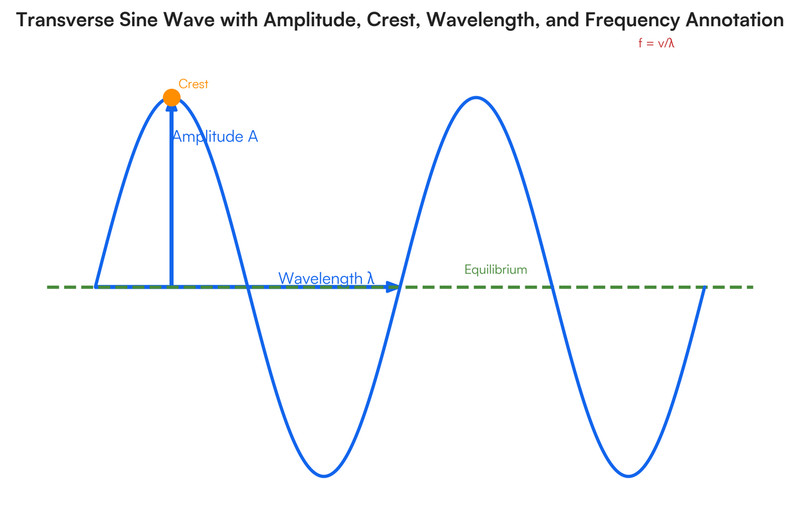
Transverse sinusoidal wave showing amplitude and wavelength
Core properties
- Period (T)
The time for one full cycle to pass a fixed point.
Units: seconds (s) - Frequency (f)
How many cycles pass per second.
Units: hertz (Hz)
They are inverses:
If the period is 0.20 s, then .
- Amplitude (A)
Maximum displacement from the equilibrium line shown in the diagram. It tells you how far particles move.
Important: Amplitude is independent of period and frequency. You can shake a rope harder (bigger A) without changing how fast you shake it (f).
- Wavelength (λ)
Distance between matching points on consecutive cycles, like crest to crest along the horizontal direction.
Units: meters (m)
Energy connections
- Larger amplitude → more energy (particles move farther from equilibrium).
- Higher frequency → more energy.
For sound:
- Frequency determines pitch (higher f → higher pitch).
- Amplitude relates to loudness.
Students often mix up pitch and loudness. On tests, if they ask why a note sounds higher, your answer must mention frequency, not amplitude.
2. The Full Set of Wave Quantities and How They Relate
Now connect time and space descriptions.
The five main quantities:
- Amplitude
- Period
- Frequency
- Wavelength
- Wave speed
The central relationship is:
And from that:
What this means physically
- If speed stays constant and frequency increases → wavelength must decrease.
- If frequency stays constant and speed increases → wavelength increases.
In a given medium, wave speed depends on the medium, not on amplitude or frequency.
When a wave enters a new medium:
- Frequency stays the same.
- Speed changes.
- Wavelength changes to satisfy .
That “frequency stays the same” idea shows up constantly in conceptual questions. If you miss that, the rest falls apart.
Quick example:
A water wave has and .
Then .
3. Sinusoidal Wave Equations
Periodic waves are often sinusoidal, meaning they follow sine or cosine functions.
Displacement as a function of time (one location)
This tells you how a single particle moves:
or
where:
- = amplitude
- = frequency
- = angular frequency
This is just simple harmonic motion. Each point on the wave oscillates like a mass on a spring.
Displacement as a function of position (one instant)
This tells you the shape of the wave in space:
Now you’re describing how displacement changes along the string at one moment in time.
On FRQs, they sometimes ask what happens to the equation if frequency increases. If stays constant, then decreases, which makes the spatial wave “squished” closer together.
4. Energy and Frequency in Periodic Waves
Two ideas to keep straight:
- Increasing amplitude increases energy.
- Increasing frequency increases energy.
For sound:
- Higher frequency → higher pitch.
- Greater amplitude → louder sound.
For electromagnetic waves:
- Higher frequency → greater energy per photon.
Conceptual reasoning you should be able to say out loud:
- Larger amplitude means particles move farther from equilibrium, storing more energy.
- Higher frequency means more oscillations per second, increasing energy transfer.
If a question says the amplitude doubles, don’t automatically change frequency or speed. Those are independent unless the problem explicitly links them.
