Topic 10.2 Notes – Conservation of Electric Charge and the Process of Charging
Conservation of Electric Charge
The core rule: electric charge is never created or destroyed. It only moves from one system to another.
For an isolated system,
If one object gains , something else must gain . On the AP level, the moving particles are almost always electrons. Protons stay bound in nuclei.
What counts as a system?
A “system” can be:
- One object
- Two objects touching
- An object plus Earth
- Any group you choose and clearly define
The rule is simple:
- Net charge changes only if charge crosses the system boundary.
- If electrons don’t enter or leave → net charge stays constant, even if charges shift around inside.
This shows up a lot in FRQs. If your explanation doesn’t account for where electrons came from or went to, it’s incomplete.
Charging by Friction and Contact
Both of these involve electron transfer, which changes net charge.
Charging by Friction
When two materials rub together, electrons transfer from one to the other.
- The object that gains electrons → negative
- The object that loses electrons → positive
- Total charge of the two-object system stays constant
You’re separating charge, not creating it.
A classic example is rubbing a balloon on a sweater. Electrons move onto the balloon, leaving the sweater positive.
Charging by Contact (Conduction)
When a charged object touches another object, electrons can flow between them.
- If a negative rod touches a neutral metal sphere → electrons flow onto the sphere.
- If two identical metal spheres touch → excess charge usually splits evenly.
What’s happening physically? Electrons repel each other and spread out until they reach electrostatic equilibrium.
On tests, they may give you numbers. Always:
- Add up total initial charge.
- Redistribute based on symmetry or equal sharing.
- Make sure total final charge matches the initial total.
Induced Charge Separation and Polarization
Now things get more subtle. Induction does not require contact.
When a charged object is brought near another object, it creates an electric force that rearranges charge inside that object.
This is called induced charge separation, or polarization.
Conductor near a charged object
The figure below shows two common induction situations. Focus on the bottom panel for a conductor.
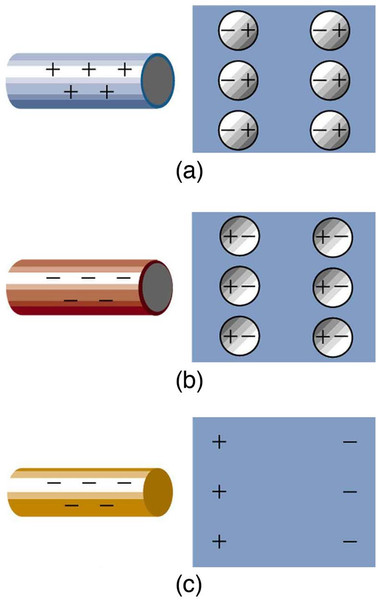
What’s happening in the conductor case:
- Electrons inside the conductor can move freely.
- A nearby negative rod repels electrons to the far side.
- The near side becomes effectively positive.
- The object is still net neutral.
Important: Polarization can happen in neutral objects.
Net charge does not change unless electrons actually leave or enter the object.
Insulators
In insulators, charges can’t move freely across the object. Look at the top panels of the figure.
- Electron clouds shift slightly within atoms or molecules.
- You still get polarization.
- Analysis is qualitative only on the AP exam.
So remember:
- Electron transfer → net charge changes.
- Charge rearrangement only → net charge stays the same.
Grounding
Grounding means connecting an object to Earth, which acts as a huge neutral charge reservoir.
In the sequence below, a positively charged rod is brought near a neutral metal sphere. Watch how grounding allows electrons to move between the sphere and Earth.
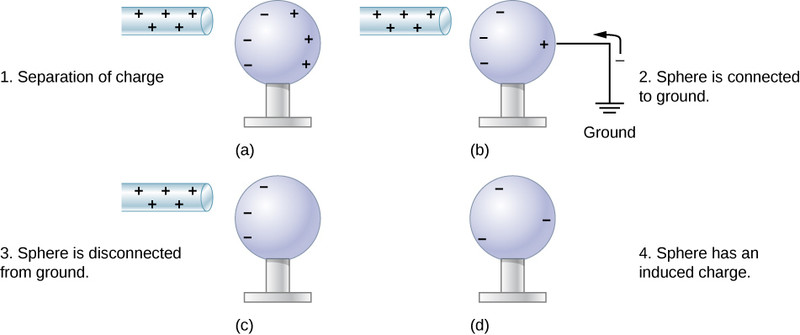
Charging a conductor by induction with grounding
Earth can:
- Supply electrons
- Absorb electrons
- Remain effectively neutral because it’s so large
Induction with grounding sequence
Order matters here:
- Bring charged object near → polarization.
- Connect object to ground → electrons flow to or from Earth.
- Remove the ground connection while the external charge is still nearby.
- Remove the external charge.
If done correctly, the object is left with a net charge opposite the nearby charged object.
Students often mix up the order. If you remove the charged rod before removing the ground, the object won’t stay charged.
