Topic 14.1 Notes – Properties of Wave Pulses and Waves
1. What a Wave Is
A wave is a way to transfer energy from one place to another without transferring matter overall.
Picture people doing “the wave” in a stadium. The motion travels around the stadium, but each person only moves up and down around their seat. That’s the model.
Wave pulse vs continuous wave
- Wave pulse
A single, non-repeating disturbance.
Example: one quick flick of a rope. - Continuous wave
A repeating, periodic disturbance.
It has:- Wavelength = distance between repeating points (crest to crest).
- Frequency = cycles per second (Hz).
- Period = time for one cycle, with
For AP questions, if particles end up permanently displaced, that is not just a wave. A wave oscillates around equilibrium.
2. Mechanical vs Electromagnetic Waves
The big difference is whether a medium is required.
Mechanical waves
- Require a medium (solid, liquid, or gas).
- Energy transfers through particle interactions.
- If there’s no medium, the wave cannot travel.
- Examples:
- Sound in air
- Water waves
- Waves on a string
If you remove the air, you remove sound.
Electromagnetic waves
- Do not require a medium.
- Made of oscillating electric and magnetic fields.
- Travel through vacuum.
All electromagnetic waves in vacuum move at:
That includes radio, visible light, X-rays, all of it.
In materials, EM waves travel slower than . That’s a common conceptual question: same wave, different speed depending on medium.
3. Transverse vs Longitudinal Waves
This classification is about how particles move compared to wave travel.
Transverse waves
Particle motion is perpendicular to wave direction.
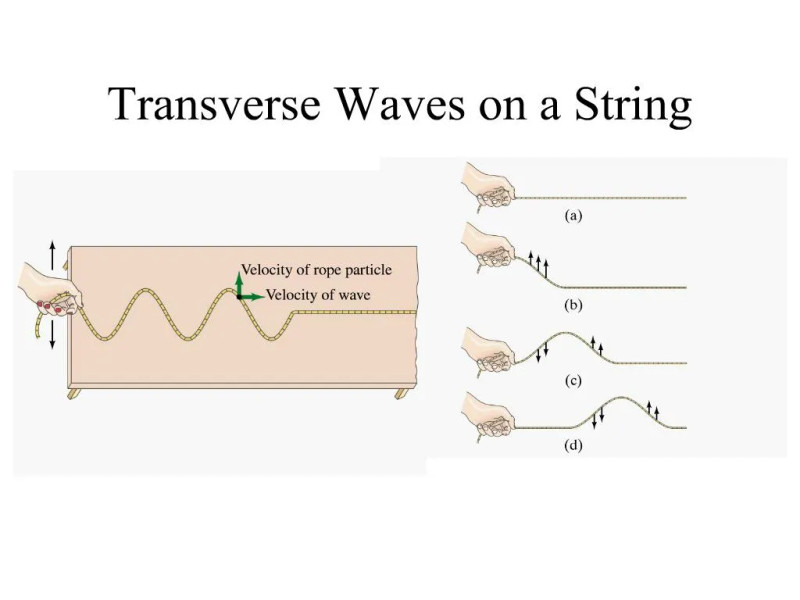
Transverse wave on a string
- Wave moves right → particles move up/down.
- Electromagnetic waves are transverse.
- Amplitude = maximum vertical displacement from equilibrium.
In the string example above, the rope travels horizontally, but each bit of the rope moves vertically. If motion is sideways relative to travel direction, it’s transverse.
Longitudinal waves
Particle motion is parallel to wave direction.
- Wave moves right → particles move left/right.
- Regions:
- Compression = high pressure
- Rarefaction = low pressure
- Sound waves are modeled as mechanical longitudinal waves.
In the diagram above, notice how the particles bunch together in compressions and spread out in rarefactions as the wave moves to the right.
For sound, amplitude can be described as the maximum pressure variation from equilibrium pressure.
On tests, if particle motion is in the same direction as propagation, it’s longitudinal.
4. Wave Speed and What Affects It
Wave speed depends on the medium and wave type, not on amplitude.
Electromagnetic waves
In vacuum:
All EM waves have this same speed in vacuum.
Waves on a string
Speed depends on:
- Tension
- Mass per unit length
Important trends:
- Greater tension → faster wave.
- Greater mass per length → slower wave.
- Changing amplitude does not change speed.
If a string is pulled tighter, waves travel faster. If it’s heavier, they travel slower.
Sound waves
In a given medium:
- Higher temperature → higher speed.
Warmer air means molecules move faster, so disturbances pass along more quickly.
On conceptual questions, compare temperature if the medium is the same.
5. Amplitude and Energy
What amplitude means
- Amplitude = maximum displacement from equilibrium.
- Transverse wave → maximum height.
- Longitudinal sound wave → maximum pressure change.
Energy and amplitude
Wave energy increases with amplitude:
If amplitude doubles, energy becomes four times as large.
If amplitude triples, energy becomes nine times as large.
That squared relationship shows up in reasoning questions.
Amplitude and loudness
For sound:
- Larger amplitude → larger pressure variation → louder sound.
- Loudness depends on amplitude.
- Frequency determines pitch, not loudness.
Students often mix that up under time pressure.
