Topic 11.8 Notes – Resistor-Capacitor (RC) Circuits
1. Equivalent Capacitance
When multiple capacitors appear in a circuit, you can replace them with a single equivalent capacitance . This simplifies the circuit so you can analyze it like any other.
Series vs Parallel
| Property | Series | Parallel |
|---|---|---|
| Connection | End-to-end (single path for charge) | Across same two nodes |
| Equivalent capacitance | ||
| Relative size | Less than the smallest capacitor | Greater than any individual capacitor |
| Charge | Same on each capacitor | Total charge adds: |
| Voltage | Voltages add: | Same voltage across each |
Why series capacitors have the same charge
Because of conservation of charge, charge cannot pile up in the wire between capacitors. The charge that leaves one plate must appear on the next. So each capacitor in series ends up with the same magnitude of charge , even if their voltages differ.
This is a common quiz trap. Students try to split charge in series the way they split voltage for resistors. Don’t.
Physically:
- Parallel increases total plate area → more charge stored per volt.
- Series effectively increases plate separation → harder to store charge → smaller .
Once you reduce to one capacitor, you can move on to how it behaves with a resistor.
2. The Time Constant
In an RC circuit, the key quantity is the time constant:
- Units: seconds (since )
- Larger → current flows more slowly
- Larger → more charge needed
- So larger → slower charging/discharging
What one time constant means
- Charging: after time , charge reaches about 63% of its final value.
- Discharging: after time , charge drops to about 37% of its initial value.
After about 5τ, the process is essentially complete.
You are not expected to use exponential equations on the AP exam. You should know initial behavior, one-time-constant behavior, and long-time behavior.
3. Charging a Capacitor
Imagine a battery, resistor, and uncharged capacitor in series. When the switch closes at , the circuit below begins charging.
At
- Capacitor is uncharged.
- It behaves like a wire.
- .
- Current is maximum (limited only by the resistor).
As time passes
Charge builds up on the plates.
- increases.
- The increasing capacitor voltage opposes the battery.
- Current decreases.
- Stored energy increases:
So over time:
- Charge ↑
- Capacitor voltage ↑
- Current ↓
- Energy stored ↑
After a long time
- Capacitor is fully charged.
- .
- Current = 0.
- The capacitor behaves like an open circuit.
On tests, you’ll often be asked to redraw the circuit at long time. Just remove the branch current through the capacitor.
4. Discharging a Capacitor
Now disconnect the battery and let the charged capacitor discharge through a resistor.
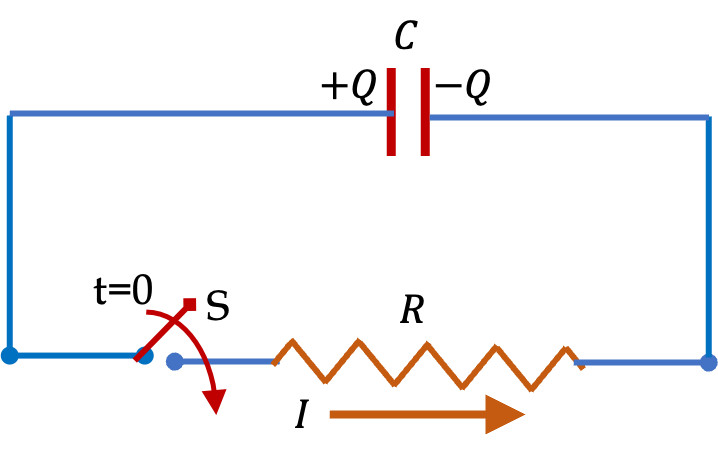
RC circuit during capacitor discharge
At the moment discharge begins
- Maximum charge and voltage across the capacitor.
- Current flows through the resistor in the direction shown.
- Charge and energy start decreasing immediately.
As time passes
- Charge ↓
- Voltage ↓
- Current ↓
- Energy ↓
All approach zero asymptotically.
After a long time
- Capacitor fully discharged.
- Voltage = 0.
- Current = 0.
- No stored energy.
5. Steady-State Modeling
For times much greater than :
- Charging circuit: replace capacitor with an open circuit.
- Discharging circuit: treat capacitor as fully discharged (no voltage).
A very common FRQ move is asking you to compare current right after a switch closes and long after. Your explanation should mention how the capacitor’s changing voltage affects current in the branch.
