Topic 14.6 Notes – Wave Interference and Standing Waves
1. How Wave Interference Works
When two or more waves are in the same place at the same time, they interfere. The key idea is that waves pass through each other, not bounce like solid objects. After overlapping, each wave keeps its original speed, frequency, and shape.
The Principle of Superposition
The three snapshots below show two upward pulses moving toward each other, overlapping to form a taller pulse, and then continuing on unchanged.
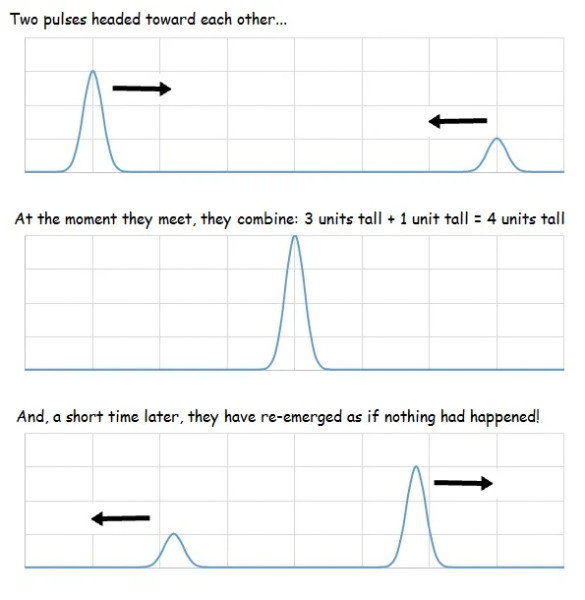
Constructive interference of two pulses
At the instant of overlap:
Add them algebraically. Upward positive, downward negative.
- Water waves → heights add
- Sound waves → pressure variations add
- EM waves → electric fields add (vector sum)
If one pulse is +3 cm and the other is −2 cm at a point, the net displacement is +1 cm. That’s what you’d sketch on a quiz.
Interference only changes the wave during overlap. Once they separate, nothing permanent happened.
2. Types of Interference
Whether the amplitude increases or decreases depends on relative phase.
Constructive Interference
- Waves are in phase (crest with crest).
- Displacements are in the same direction.
- Amplitudes add → larger wave.
If two identical 4 cm pulses line up perfectly, the result is 8 cm at that instant. In sound, this means louder. In light, brighter.
Destructive Interference
- Waves are out of phase (crest with trough).
- Displacements are opposite.
- Amplitudes subtract.
If identical and 180° out of phase, they cancel completely at that moment. Noise-canceling headphones rely on this.
Amplitude Variations
If phase difference changes over space or time, the amplitude of the resulting wave changes. That’s why interference can create regions of strong and weak sound or light.
The graph below shows two sine waves with a phase difference and their sum. Notice how the resulting green curve sometimes has a larger amplitude and sometimes a smaller one, depending on how the individual waves line up at each instant.
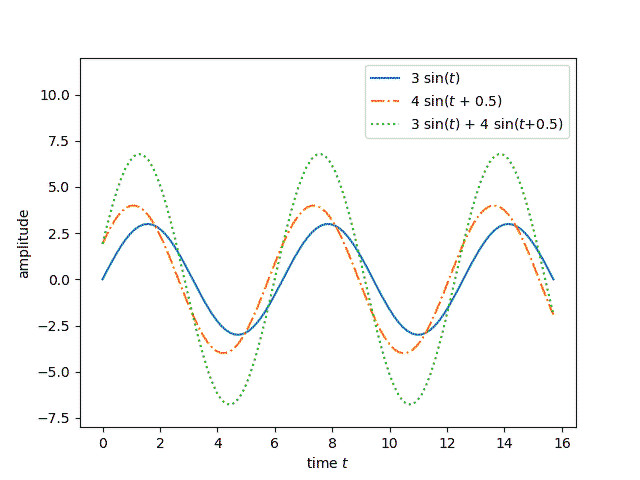
Superposition of two phase-shifted sine waves
On free-response questions, they often give you two snapshots and ask for the resulting shape. Add point by point. Don’t guess the overall pattern.
3. Beats and Beat Frequency
Beats happen when two waves have slightly different frequencies.
Because their frequencies differ, the waves drift in and out of phase:
- In phase → constructive → loud
- Out of phase → destructive → quiet
This produces a pulsing sound.
Example: 500 Hz and 506 Hz tuning forks produce 6 beats per second.
Tuning forks are commonly used to demonstrate this. Musicians tune instruments by adjusting until the beats disappear, meaning the frequencies match.
Conceptually, the beat frequency is how fast the waves move from aligned to misaligned and back again.
4. What Standing Waves Are
A standing wave forms when two identical waves:
- Have the same frequency and amplitude
- Travel in opposite directions
- Are confined to a region (string, pipe)
They interfere continuously, creating a pattern that looks stationary. Energy oscillates locally; it does not travel down the medium.
This usually happens because a wave reflects off a boundary and overlaps with itself.
5. Nodes, Antinodes, and Harmonics
Nodes and Antinodes
For a string fixed at both ends, only certain standing-wave patterns are allowed. The first three harmonics are shown below.

First three harmonics of a string fixed at both ends
- Node → displacement always zero
- Antinode → maximum oscillation
- Distance between adjacent nodes =
- Same for adjacent antinodes
These positions stay fixed.
Boundary Conditions
The allowed wavelengths depend on how the ends behave.
String fixed at both ends (or pipe open at both ends)
Ends are nodes (string) or antinodes (open pipe).
All harmonics allowed,
Pipe closed at one end
Closed end = node
Open end = antinode
Only odd harmonics appear.
Fundamental and Harmonics
- Fundamental (1st harmonic) → longest wavelength, lowest frequency
- Higher harmonics → shorter wavelength, higher frequency
- Always connect frequency and wavelength with
On tests, identify the boundary condition first. That determines everything else.
