Topic 12.2 Notes – Magnetism and Moving Charges
1. Magnetic Fields Created by Moving Charges
A moving electric charge produces a magnetic field. A charge sitting still only creates an electric field. Motion is what adds magnetism.
Even a single moving particle creates a magnetic field at every point around it.
Shape and Direction of the Field
The magnetic field forms circular loops around the direction of motion, as shown below for a positive charge moving to the right.
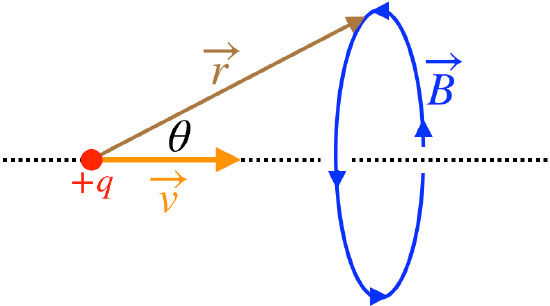
Magnetic field produced by a single moving positive charge
Key geometry at any point in space:
- The magnetic field depends on:
- Magnitude of the charge
- Speed
- Distance from the charge (farther → weaker field)
- Angle between the velocity vector and the position vector to the point
- The direction of B at a point is perpendicular to both:
- The velocity vector
- The position vector from the charge to that point
The field is:
- Maximum when the velocity is perpendicular to the position vector
- Zero along the line of motion (directly in front of or behind the charge)
Right-Hand Rule for Magnetic Field
For a positive charge:
- Thumb → direction of velocity
- Fingers curl → direction of magnetic field lines
For a negative charge, flip the direction.
A common quiz move is giving you a point in space and asking for the direction of B there. You have to visualize the circular field and apply the right-hand rule carefully.
2. Magnetic Force on a Moving Charge
A magnetic field can exert a force on a moving charge. No motion means no magnetic force.
The magnitude of that force is:
Where:
- = charge
- = speed
- = magnetic field strength
- = angle between and
What Controls the Force
- Larger → larger force
- Faster speed → larger force
- Stronger field → larger force
- Angle matters through
AP limit for calculations:
- or →
- → (maximum)
Other angles are tested conceptually, not numerically.
Direction of the Magnetic Force
The force is always perpendicular to both and .
Right-hand rule for force on a positive charge:
- Fingers → velocity
- Curl toward magnetic field
- Thumb → force
Negative charge → reverse the result.
Because the force is perpendicular to velocity, it changes direction, not speed. That is huge. On FRQs, you should say clearly that magnetic forces do no work since they are perpendicular to motion.
3. Electric and Magnetic Forces Together
In a region with both fields, a charge feels two independent forces.
Electric force:
- Acts in direction of (for positive charge)
- Does not require motion
Magnetic force:
- Requires motion
- Perpendicular to both and
You calculate each force separately and then use vector addition to find the net force.
A classic setup has electric and magnetic forces pointing in opposite directions. If they balance, net force is zero and the particle moves straight through. You’ll often need to explain in words why the forces cancel, not just set magnitudes equal.
4. The Hall Effect
The Hall effect shows magnetic force inside a current-carrying conductor.
Imagine a strip with current flowing to the right, placed in a magnetic field perpendicular to the strip.
In the diagram, the magnetic field is shown coming out of the page (dots). The current is to the right, so the electrons drift to the left.
What happens:
- Charges move because of the current.
- Magnetic force pushes them sideways.
- Charges accumulate on one side.
- This separation creates an internal electric field.
- Electric force grows until it balances magnetic force.
At equilibrium:
That sideways electric field creates a measurable Hall voltage, perpendicular to both the current and the magnetic field.
Why it matters:
- Confirms that current is moving charge.
- Reveals whether charge carriers are positive or negative.
- Used in magnetic field sensors.
On tests, you’re often asked which side becomes positive. Track the charge sign carefully. In this example, electrons are pushed downward, so the bottom becomes negative and the top becomes positive.
