Topic 9.3 Notes – Thermal Energy Transfer and Equilibrium
1. Thermal Energy Transfer Between Systems
Two systems are in thermal contact if energy can move between them by thermal processes. They don’t have to touch. A cup of coffee and the surrounding air are in thermal contact through air and radiation.
- Heating = energy transferred into a system by thermal processes.
- Cooling = energy transferred out of a system by thermal processes.
Energy transfer happens because of a temperature difference.
Spontaneous direction
Thermal energy flows from higher temperature to lower temperature on its own. The reverse does not happen unless external work is done. This is a Second Law idea.
On the microscopic level:
- Higher temperature → particles have greater average kinetic energy.
- When fast (hot) particles collide with slower (cold) particles, energy is more likely to transfer from the fast ones to the slow ones.
- After many collisions, the most probable state is equal temperature.
That “most probable state” language shows up in AP explanations. They want you to connect randomness and collisions to the final equal temperature.
2. The Three Mechanisms of Thermal Energy Transfer
Conduction
Conduction is energy transfer through particle-to-particle collisions inside matter.
In a solid, the atoms stay in fixed positions and vibrate. When one region is hotter, those atoms vibrate more and transfer energy to neighboring atoms through collisions.
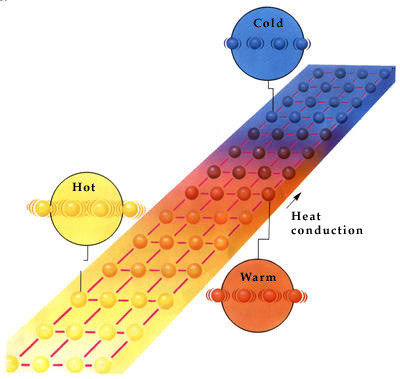
Heat conduction through a solid lattice
- Dominant in solids, especially metals.
- No bulk motion of the material. The atoms vibrate in place.
- Faster in materials with high thermal conductivity .
The rate is given by Fourier’s Law:
For a uniform slab of thickness :
- = cross-sectional area
- = temperature difference
- = thickness
If you double , the rate doubles.
If you double , the rate is cut in half.
Bigger temperature difference → faster energy transfer.
On tests, they love ratio reasoning. If one wall is twice as thick, you don’t re-derive anything. You scale from the equation.
Convection
Convection is energy transfer by the motion of a fluid (liquid or gas).
Heating from below makes the lower fluid warmer and less dense, so it rises. Cooler, denser fluid sinks and sets up a circulating current.
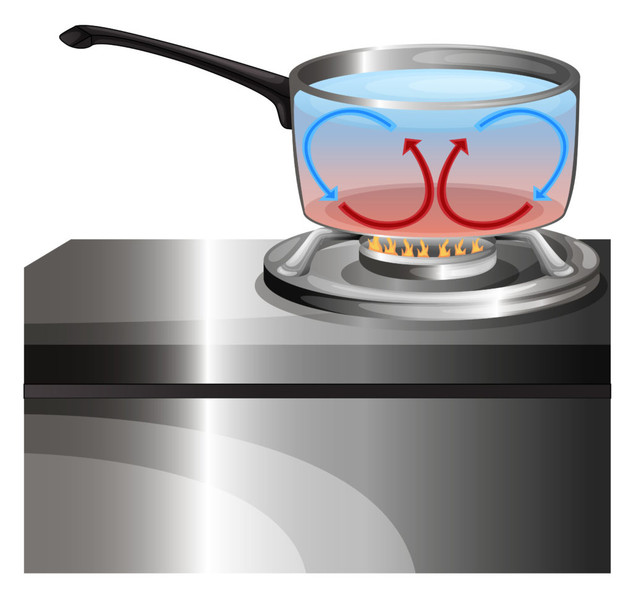
Convection currents in heated water
- Warm fluid expands → density decreases → rises.
- Cooler fluid sinks.
- The energy moves because the matter itself moves.
Only happens in fluids. If you see a solid, convection is not the answer.
Radiation
Radiation transfers energy by electromagnetic waves.
- No matter required.
- Works through a vacuum.
- All objects emit radiation; hotter objects emit more energy per second.
Sunlight warming your skin is radiation, not conduction or convection.
3. Thermal Equilibrium
Thermal equilibrium occurs when two systems in thermal contact have no net energy transfer between them.
Condition:
Equal temperature does not mean equal thermal energy. A bathtub and a cup of water at the same temperature have very different total internal energies because mass and specific heat matter.
What happens when objects are placed in contact
- Initial temperature difference.
- Energy flows hot → cold.
- Both temperatures change.
- They reach a common final temperature.
- Net heat transfer becomes zero.
On FRQs, explain it like this: “Energy is transferred from the higher-temperature object to the lower-temperature object due to particle collisions until both reach the same temperature, at which point the net energy transfer is zero.”
That phrase “net energy transfer is zero” is the scoring language.
4. Thermal Conductivity and Rate of Heat Flow
From :
Heat transfer rate increases if:
- increases (copper vs. wood)
- increases
- increases
Heat transfer rate decreases if:
- increases
Insulation works by using materials with very small and often trapping air, which is a poor conductor.
Be careful with the negative sign in the full version of Fourier’s law. It just shows direction from hot to cold. For magnitude questions, you usually use the positive form.
5. Thermal Expansion
Heating increases particle vibration. The average spacing increases, so the object expands.
Linear expansion
- = linear expansion coefficient
- Depends on material
- Larger → larger expansion for same
Volumetric expansion
For many solids, .
Expansion depends on temperature change, not the starting temperature. A 10°C increase causes the same expansion whether you started at 0°C or 50°C.
Real-world connections they like:
- Gaps in bridges and railroad tracks prevent buckling.
- Bimetallic strips bend because the two metals have different .
