Topic 10.3 Notes – Electric Fields
1. What an Electric Field Is
An electric field tells you how much electric force a charge would feel at a particular point in space.
- = electric force on a test charge
- = magnitude of the test charge
- Units: N/C
So if you know the field at a point and place a charge there, you can find the force with .
Test charge
A test charge is:
- A tiny positive point charge
- Small enough that it does not disturb the existing field
Field direction is defined as the direction of the force on a positive test charge.
That leads to the core direction rules:
- Fields point away from positive charges
- Fields point toward negative charges
- A positive charge feels force in the same direction as
- A negative charge feels force opposite
Electric fields are created by charged objects and exist even if no test charge is there. The test charge just helps us measure what’s already present.
2. Electric Field of a Point Charge
For a single point charge:
- = source charge
- = distance from the charge
Direction:
- Positive source → radially outward
- Negative source → radially inward
The dependence is huge. If distance triples, field becomes as strong.
Notice what’s missing: no test charge in the formula. The field depends only on the source charge and distance.
If you’re asked for field at a point 0.40 m from a −2.0 μC charge, you’d plug into the formula for magnitude, then say direction is toward the charge.
3. Superposition and Field Maps
Superposition Principle
When multiple charges are present, fields add as vectors:
On AP Physics 2, you’ll usually see four or fewer charges unless there’s strong symmetry.
Work these in a clean order:
- Find distance from each charge to the point.
- Compute each .
- Determine direction of each field.
- Break into components if needed.
- Add components.
Students often forget that opposite charges don’t automatically cancel. The direction at the specific point determines cancellation, not just the signs of the charges.
Field Maps and Field Lines
Here’s what those representations look like for single point charges:
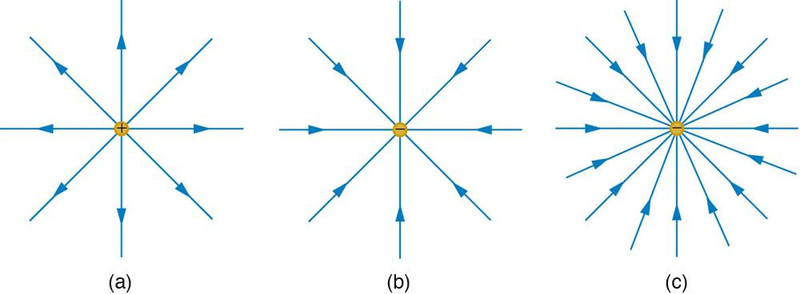
Electric field patterns for positive and negative point charges
In the left panel, field lines point away from a positive charge. In the middle and right panels, they point toward negative charges. The rightmost charge has more densely packed lines, indicating a stronger field.
Two common representations:
Vector field maps
- Arrows drawn at many points
- Arrow direction → direction of
- Arrow length → relative magnitude
Field line diagrams
- Lines start on positive charges
- End on negative charges
- Never cross
- Closer lines = stronger field
At any point, the electric field direction is tangent to the line.
On conceptual questions, they love asking where the field is strongest. Look at line density.
4. Electric Fields in Conductors
All of this changes inside a conductor in electrostatic equilibrium.
Key facts:
- Excess charge resides on the surface.
- Electric field inside is zero.
- At the surface, is perpendicular to the surface.
Why is inside?
If there were a field, free electrons would move. They rearrange until the internal field cancels. Equilibrium means no more motion.
Charged Spherical Conductor
Special but very testable case:
- Outside the sphere: behaves like a point charge at the center
Use . - Inside the sphere: .
This is true even if the surface charge isn’t perfectly uniform.
A common multiple-choice trap is asking for the field halfway inside a metal sphere. The answer is still zero.
5. Electric Fields in Insulators
Insulators behave differently because charges cannot move freely.
In electrostatic equilibrium:
- Excess charge is distributed throughout the volume and on the surface
- The electric field inside can be nonzero
You are only expected to reason qualitatively here. No heavy calculations inside solid insulators.
Here’s the clean contrast:
| Property | Conductor | Insulator |
|---|---|---|
| Charge motion | Free to move | Fixed in place |
| Excess charge location | Surface only | Volume + surface |
| Field inside (equilibrium) | Zero | Can be nonzero |
When you explain this in writing, mention electron mobility. That’s usually the missing reasoning step.
