Topic 12.3 Notes – Magnetism and Current-Carrying Wires
1. Magnetic Fields from Current-Carrying Wires
An electric current is moving charge. Since moving charges create magnetic fields, any current-carrying wire produces a magnetic field around it.
Long, Straight Wire
Picture a long, straight wire with current flowing through it. The magnetic field forms concentric circles around the wire.
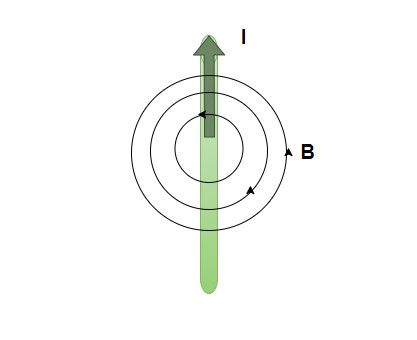
Magnetic field around a long, straight current-carrying wire
Key features you need to know:
- Field lines are circles centered on the wire.
- At any point, the magnetic field vector is tangent to the circle.
- The field has:
- No radial component (not toward or away from the wire)
- No component parallel to the wire
- The field gets weaker as you move farther away.
The magnitude is given by:
- is the current
- is the perpendicular distance from the wire
Proportional reasoning shows up a lot on tests:
- Double → double
- Double → half
Be careful. The distance is from the wire’s axis, not along the wire.
Current Loop Field at the Center
Now bend the wire into a circle. At the center of a circular loop, the magnetic field points along the axis of the loop, perpendicular to its plane.
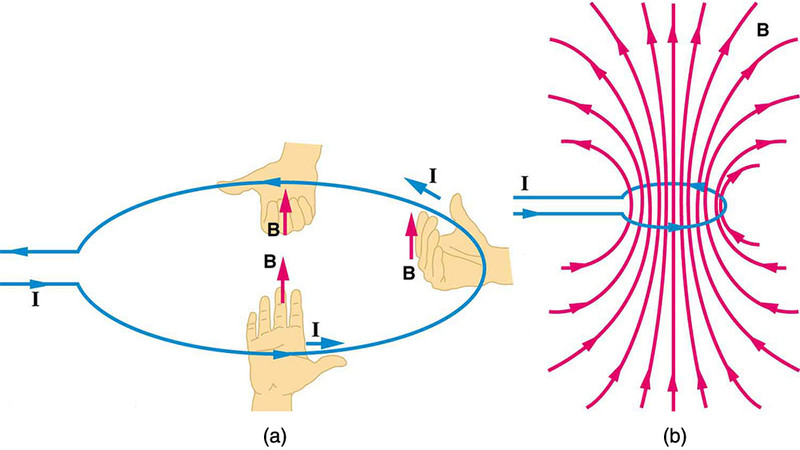
Magnetic field at the center of a current loop
Important ideas:
- The field is perpendicular to the loop.
- Direction depends on current direction.
- Increasing current or adding more loops increases the field strength at the center (qualitatively for AP 2).
2. Right-Hand Rules
These are direction tools. Most mistakes on quizzes are direction mistakes, not math mistakes.
Field Around a Straight Wire
- Thumb → direction of conventional current
- Fingers curl → direction of magnetic field
If current is upward, your fingers wrap around the wire in the field direction.
Field at the Center of a Loop
- Curl fingers in direction of current around the loop.
- Thumb points in direction of magnetic field through the center.
Counterclockwise current → field out of the page.
Clockwise current → field into the page.
Force on a Current-Carrying Wire
This applies when a wire is placed in an external magnetic field.
- Fingers → direction of current
- Palm → direction of magnetic field
- Thumb → direction of force
The three directions are perpendicular in the maximum-force case.
If you reverse either the current or the magnetic field, the force flips direction.
3. Superposition of Magnetic Fields
When multiple wires are present, each produces its own magnetic field. The net field is found by vector addition.
Work through it like this:
- Use a right-hand rule to find the direction of each field at the point.
- Compare magnitudes using .
- Add or subtract based on direction.
Typical situations:
- Fields in the same direction → add.
- Opposite directions → subtract.
- Equal and opposite → net field is zero.
Midpoint questions are common. If two wires carry equal currents in opposite directions, the fields between them add, not cancel. That one surprises people.
4. Force on a Current-Carrying Wire in a Magnetic Field
A magnetic field exerts a force only if current is flowing.
Magnitude:
- is the length of wire inside the field
- is the angle between current and magnetic field
What changes the force?
- Bigger current → bigger force
- Longer segment in the field → bigger force
- Stronger magnetic field → bigger force
- Angle matters:
- → maximum force
- or → zero force
This is the wire version of . Current is many moving charges, so the effects add up.
