Topic 1.1 Notes – Introducing Statistics: What Can We Learn from Data?
What a Statistical Study Is
A statistical study uses data from a sample to answer a question about a larger group.
Here’s the basic flow:
The diagram below shows that same idea as a cycle from population to data to inference.
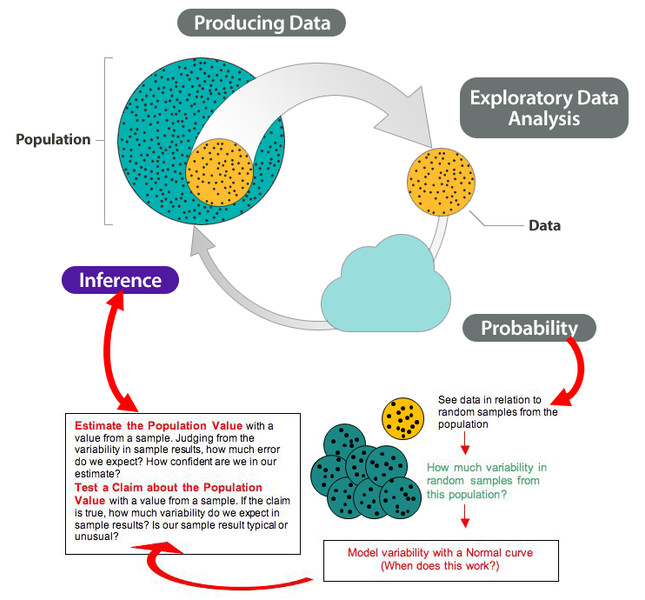
Population, sample, and inference cycle
That last word, possible, matters. The sample gives direct information about the people or items actually observed. It may also give evidence about the population, but it does not guarantee the truth for the whole population.
Why not just measure everyone with a census?
- The population may be too large.
- It may take too much time or cost too much.
- Some members are hard to reach.
- Measuring may destroy the item being tested.
- The population may change while data are being collected.
Parts of a Statistical Study
Every study has pieces you need to identify clearly.
Investigative question
The investigative question is what the study is trying to answer. It has to be decided before looking at results, and it should point to a real population.
Example: “What proportion of students at this school get at least 7 hours of sleep on school nights?”
Population
The population is the full group the study cares about. Population size is .
Be careful here. The population is defined by the purpose of the study, not by whoever was easiest to ask.
- “Students at this school” is a different population from “teenagers in this city.”
- Scope includes who/what, where, and sometimes when.
Sample
The sample is the part of the population actually observed. Sample size is .
If you survey 120 students from a school, then:
- population = all students at that school
- sample = the 120 surveyed students
The sample is not the same as one subgroup inside it, like “the 48 students who said yes.”
Datum and data set
A datum is one recorded value for one individual or item.
A data set is the whole collection of values.
Examples:
- one sleep report from one student = one datum
- all 120 sleep reports = the data set
Data can be numerical or nonnumerical.
Sample result and population conclusion
A sample result summarizes what happened in the sample, like “42% of the sampled students said they get at least 7 hours of sleep.”
A population conclusion goes farther, such as “the data suggest that about 42% of students at this school get at least 7 hours of sleep.” That is an inference, not a guaranteed fact.
Investigative Questions That Work
A question is statistical if:
- you answer it by collecting data
- you expect variation among individuals or items
- it is not just one fixed fact
A good investigative question is also usable:
- it has a clear purpose
- the group of interest is clear
- the wording is measurable
Examples:
| Prompt | Statistical? | Why |
|---|---|---|
| “What proportion of students at this school ride the bus?” | Yes | Needs data and responses vary |
| “What time does first period start?” | No | One fixed fact |
| “Student transportation” | No | Topic only, not a question |
If you discover something interesting after collecting data, that can become a new study. You do not rewrite the original question afterward.
Interpreting Results in Context
On the AP exam, numbers by themselves are never enough. You have to say what they mean in the real situation.
Use this quick procedure:
- Identify the population
- Identify the sample
- Identify the datum/data set
- Identify the sample result
- Write a full sentence in context
Example:
- 80 of 200 sampled students prefer later start times
- descriptive statement = “In the sample of 200 students, 40% preferred later start times.”
- inferential statement = “The sample data suggest that about 40% of students at this school may prefer later start times.”
Common mistakes:
- calling the sample the population
- making the population too broad
- treating a sample percent as the exact population percent
- giving a number with no context
What Data Can and Cannot Tell You
Data can directly describe the sample. They can sometimes support a conclusion about the population.
Data cannot:
- automatically prove a population claim
- fix a bad sample just because there is more of it
- justify conclusions beyond the stated population
- show cause and effect from association alone
A great AP Stats habit is asking two questions every time:
- About whom were data collected?
- About whom is the claim being made?
Key Takeaways
Statistical Study
A study in which data are collected from a sample to answer an investigative question about a larger population
Population
The entire group of items or individuals of interest in a study
Population Size (N)
The number of items or individuals in the population; denoted by N
Sample
A subset of the population from which data are obtained
Sample Size (n)
The number of items or individuals in the sample; denoted by n
Datum
One piece of information about a single item or individual
Data Set
The collection of all data obtained in the study
Census
Collecting data from every member of the population
In Context
Identifying a statistical result with the corresponding part of the real-world study
Descriptive Statistics
Organizing, displaying, and summarizing the data that were collected; applies directly to the data set summarized
Inferential Statistics
Using sample data as evidence for a conclusion about a larger population
Variation
Differences in values across individuals, items, places, or times that make statistical questions meaningful
Investigative Question (Statistical Question)
The question a statistical study is designed to answer; it has a defined purpose, is answerable by collecting and analyzing data, and anticipates variation
Notes
Statistical Study
A study in which data are collected from a sample to answer an investigative question about a larger population
Population
The entire group of items or individuals of interest in a study
Population Size (N)
The number of items or individuals in the population; denoted by N
Sample
A subset of the population from which data are obtained
Sample Size (n)
The number of items or individuals in the sample; denoted by n
Datum
One piece of information about a single item or individual
Data Set
The collection of all data obtained in the study
Census
Collecting data from every member of the population
In Context
Identifying a statistical result with the corresponding part of the real-world study
Descriptive Statistics
Organizing, displaying, and summarizing the data that were collected; applies directly to the data set summarized
Inferential Statistics
Using sample data as evidence for a conclusion about a larger population
Variation
Differences in values across individuals, items, places, or times that make statistical questions meaningful
Investigative Question (Statistical Question)
The question a statistical study is designed to answer; it has a defined purpose, is answerable by collecting and analyzing data, and anticipates variation
