Topic 1.10 Notes – The Investigative Question Revisited and Data Collection
What an Investigative Question Must Specify
A good investigative question locks in three things before data are collected.
- Variables
- You need the variable or variables measured on each observational unit. That just means the individual or item being measured.
- If it’s a relationship question, identify the explanatory variable and response variable.
- The variables must be operationalized clearly. “Success” is vague. “Final exam score” or “whether the student passed” is usable.
- Parameter or relationship
- This tells you what analysis makes sense.
- A hypothesis test asks whether the data support a claim.
- A confidence interval asks for an estimate of a parameter with a range of plausible values.
- Population and intended conclusion
- The question should name who the conclusion is about.
- If it asks a causal question, the design must be an experiment with random assignment or that causal wording is not justified.
Wording that signals the analysis
For hypothesis tests, the question must show the parameter and the direction of the alternative:
- not equal to
- greater than
- less than
- associated
- not independent
Example
“Do students using planner reminders submit more assignments than students without reminders?”
That points to a one-sided alternative.
For confidence intervals, the question names the parameter being estimated.
Example
“What is the difference in the mean number of assignments submitted...?”
A common mistake is choosing the direction from the sample results. The direction has to come from the question, not from what the data happen to show.
Census, Sample, and What the Data Actually Cover
A population is the full group of interest. A sample is the part you actually collect data from.
A census records information from every member of the population. If some people never respond, it was only an attempted census.
- “Sent to everyone” does not mean census
- You need actual data from everyone
- A census can still have measurement error, missing data, or inaccurate responses
This also trips people up on tests. Census vs. sample is separate from experiment vs. observational study. You can have a sample in either kind of study.
Experiment or Observational Study
The split is simple.
- Experiment means the researcher imposes treatments
- Observational study means the researcher only records what naturally happens
Experiments
A randomized experiment usually looks like this.
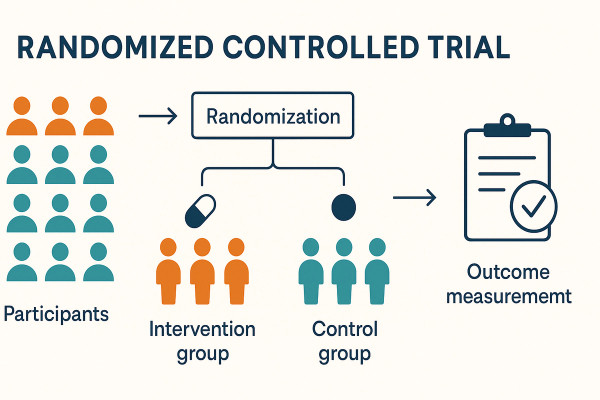
Randomized controlled trial
In an experiment:
- The experimental unit gets the treatment
- The explanatory variable is a factor
- Its categories are levels
- With one factor, the levels are the treatments
- With multiple factors, treatments are combinations of levels
- The response variable is measured after treatment
If students are assigned to daily reminders or no reminders, that’s an experiment.
Observational studies
If students choose for themselves whether to use reminders, that’s observational. You can talk about association, not causation.
Types you should recognize:
- Survey: standard set of questions given to people
- Prospective study: select units now, collect data now and in the future
- Retrospective study: select units now, gather past data
Confounding
A confounding variable must be related to both:
- the explanatory variable
- the response variable
It gives another explanation for the association. If students who drink more energy drinks also have heavier workloads, and workload also affects sleep, workload is a confounder.
Random Selection, Random Assignment, and What Conclusions Are Justified
These are different ideas and AP loves to test that.
| Study feature | What it supports |
|---|---|
| Random selection | Generalizing to the population |
| Random assignment | Cause-and-effect conclusion |
The four combinations:
- Both random selection and random assignment
You can generalize to the population and make a causal claim. - Random selection only
You can generalize, but only about association. - Random assignment only
You can make a causal claim for the experimental units or similar individuals, but not broadly generalize. - Neither
No broad generalization and no causation.
A convenience sample or voluntary response sample is not random. A huge sample size does not fix selection bias.
How to Classify a Study Fast
When you read a study description, work through it in this order:
- Identify the units and variables
- Decide whether it’s a census or sample
- Ask whether the researcher imposed treatments
- If yes, name the experimental units, factor(s), levels/treatments, and response
- If no, call it observational and note survey, prospective, or retrospective if it fits
- Check for confounding
- Ask two separate questions
- Were units randomly selected?
- Were treatments randomly assigned?
- Match the conclusion to the design and write it in context
Key Takeaways
Investigative Question Components
1) variables and data collection, 2) parameter or relationship and analysis, 3) population and type of conclusion
First Component of an Investigative Question
States the variable(s) of interest and what will be measured on each observational unit; guides data collection
Second Component of an Investigative Question
States the population parameter or relationship of interest and guides the choice of analysis
Third Component of an Investigative Question
States the population to which the conclusion is intended to apply and the type of conclusion sought, such as association or cause-and-effect
Hypothesis-Test Investigative Question
An investigative question that makes clear the parameter or relationship of interest and the direction of the alternative hypothesis
Confidence-Interval Investigative Question
An investigative question that identifies the parameter or relationship of interest and asks for an estimate in a range of plausible values
Census
Recording information from every individual or item in the population
Experiment
A study in which the researcher assigns treatments to experimental units to investigate their effects
Experimental Unit
The observational unit to which a treatment is assigned; when people, often called subjects or participants
Explanatory Variable or Factor
The variable that may explain or predict changes in the response; in an experiment, a factor is an explanatory variable whose levels are imposed on experimental units
Treatment
A condition imposed on experimental units; with one factor, the treatments are the factor's levels; with more than one factor, the treatments are combinations of factor levels
Response Variable
The outcome measured or recorded on each unit; in an experiment, it is measured after the treatment is administered
Observational Study
A study in which treatments are not imposed and the researcher records variables as they naturally occur
Prospective Study
An observational study in which units are selected at a point in time and data are gathered then and into the future
Retrospective Study
An observational study in which units are selected at a point in time and information from the past is gathered
Survey
An observational study that collects data from people using a standard set of questions
Confounding Variable
A variable associated with both the explanatory and response variables that provides an alternative explanation for an observed relationship
Random Sample
A sample in which all observational or experimental units are selected from the population using a random mechanism
Nonrandom Sample
A sample in which units are deliberately chosen or volunteer themselves rather than being selected by a random mechanism
Random Selection and Generalization
When units are randomly selected from a population, it is appropriate to generalize results to that population
Nonrandom Selection and Generalization
If units are not randomly selected, conclusions should be limited to the study units or similar individuals, not the whole population
Random Assignment
Using a random mechanism to assign treatments to experimental units; in a well-designed experiment, it supports a cause-and-effect conclusion
Random Selection vs. Random Assignment
Random selection chooses units from a population and supports generalization to that population; random assignment assigns treatments to experimental units and supports cause-and-effect conclusions
Sample
A subset of the population from which data are obtained
Population
All individuals or items of interest in the study
Observational Unit
The individual or item on which data are recorded
Notes
Investigative Question Components
1) variables and data collection, 2) parameter or relationship and analysis, 3) population and type of conclusion
First Component of an Investigative Question
States the variable(s) of interest and what will be measured on each observational unit; guides data collection
Second Component of an Investigative Question
States the population parameter or relationship of interest and guides the choice of analysis
Third Component of an Investigative Question
States the population to which the conclusion is intended to apply and the type of conclusion sought, such as association or cause-and-effect
Hypothesis-Test Investigative Question
An investigative question that makes clear the parameter or relationship of interest and the direction of the alternative hypothesis
Confidence-Interval Investigative Question
An investigative question that identifies the parameter or relationship of interest and asks for an estimate in a range of plausible values
Census
Recording information from every individual or item in the population
Experiment
A study in which the researcher assigns treatments to experimental units to investigate their effects
Experimental Unit
The observational unit to which a treatment is assigned; when people, often called subjects or participants
Explanatory Variable or Factor
The variable that may explain or predict changes in the response; in an experiment, a factor is an explanatory variable whose levels are imposed on experimental units
Treatment
A condition imposed on experimental units; with one factor, the treatments are the factor's levels; with more than one factor, the treatments are combinations of factor levels
Response Variable
The outcome measured or recorded on each unit; in an experiment, it is measured after the treatment is administered
Observational Study
A study in which treatments are not imposed and the researcher records variables as they naturally occur
Prospective Study
An observational study in which units are selected at a point in time and data are gathered then and into the future
Retrospective Study
An observational study in which units are selected at a point in time and information from the past is gathered
Survey
An observational study that collects data from people using a standard set of questions
Confounding Variable
A variable associated with both the explanatory and response variables that provides an alternative explanation for an observed relationship
Random Sample
A sample in which all observational or experimental units are selected from the population using a random mechanism
Nonrandom Sample
A sample in which units are deliberately chosen or volunteer themselves rather than being selected by a random mechanism
Random Selection and Generalization
When units are randomly selected from a population, it is appropriate to generalize results to that population
Nonrandom Selection and Generalization
If units are not randomly selected, conclusions should be limited to the study units or similar individuals, not the whole population
Random Assignment
Using a random mechanism to assign treatments to experimental units; in a well-designed experiment, it supports a cause-and-effect conclusion
Random Selection vs. Random Assignment
Random selection chooses units from a population and supports generalization to that population; random assignment assigns treatments to experimental units and supports cause-and-effect conclusions
Sample
A subset of the population from which data are obtained
Population
All individuals or items of interest in the study
Observational Unit
The individual or item on which data are recorded
