Topic 2.6 Notes – Conditional Probability
What Conditional Probability Is
A conditional probability is the probability of event given that event has happened. It is written .
A few reminders help this make sense:
- The bar means “given.”
- The event after the bar is the condition.
- means both and happen.
The whole idea is that the condition changes your sample space. If you know occurred, then outcomes outside are no longer possible. You only look inside . In the Venn diagram, that means focusing on circle and asking what part of it overlaps with .
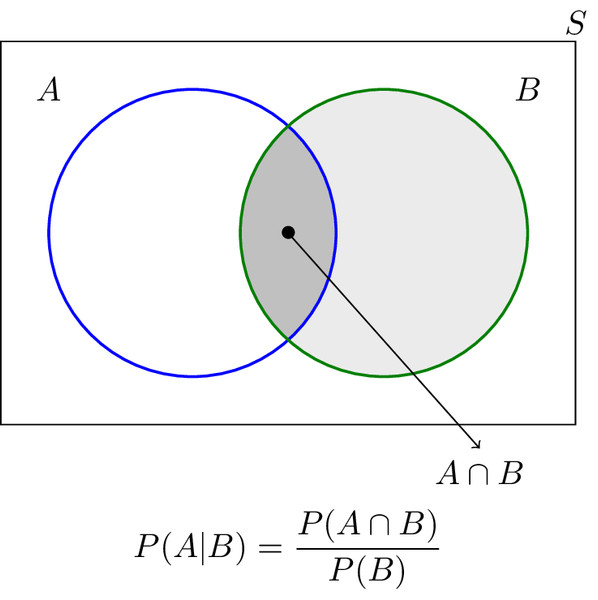
Conditional probability with a Venn diagram
This works as long as .
Read it like this:
- numerator = probability of being in both events
- denominator = probability of the condition
- meaning = among the outcomes in , what proportion are also in ?
If , then is undefined because you would be dividing by 0.
How to Find Conditional Probability
Most mistakes come from using the wrong denominator. The condition tells you the denominator.
- Identify the condition.
- In , the condition is .
- That means your reference group is only outcomes in .
- Find the overlap.
- The numerator is , the outcomes in both events.
- Divide overlap by condition.
From probabilities,
From counts,
Suppose a table shows 80 bus riders, and 24 of them were late. Then
That means among bus riders, 30\% were late.
In a two-way table:
- use the cell for “both” as the numerator
- use the row or column total for the condition as the denominator
Words that usually signal conditional probability:
- given
- among
- of those
- restricted to
The General Multiplication Rule
If you rearrange the conditional probability formula, you get the general multiplication rule:
You can also write
This is how you find the probability that both events happen when one probability is conditional on the other.
Example:
Then
So 21% of the whole population is in both and .
This rule does not assume independence. That matters a lot on AP Stats.
Tree Diagrams and Sequential Events
A tree diagram helps when events happen in stages, especially when later probabilities change based on earlier outcomes.
- Each branch shows a possible next outcome.
- Branches from the same node add to 1.
- To get the probability of a full path, multiply along the path.
That path product is just the multiplication rule in picture form.
Without replacement is the classic case. If you draw two cards and the first is an ace, then the second-draw probabilities change. This tree shows all four possible two-draw paths and the product for each one.
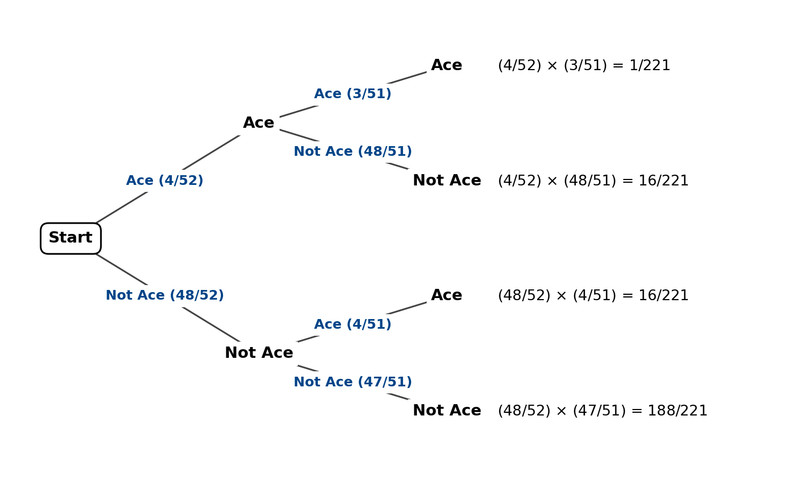
Two-card tree diagram without replacement
For two aces in a row, follow the Ace → Ace path:
A common AP mistake is putting original probabilities on second-stage branches. Those second branches should usually be conditional probabilities.
What Students Mix Up
- and use the same overlap but different denominators, so they usually are not equal.
- is joint probability. It uses the whole sample space.
- is conditional probability. It uses only the condition as the reference group.
- If the problem says “given,” “among,” or “of those,” do not divide by the grand total.
- Do not replace with unless independence is given or proven later.
- “Given” means known information, not necessarily something that happened first.
- Conditional probability does not show causation.
Key Takeaways
Conditional Probability
Probability of A given that B has occurred; P(A|B) = P(A ∩ B) / P(B), provided P(B) > 0
Conditional Probability From Counts
From equally weighted counts, P(A|B) = n(A ∩ B) / n(B)
General Multiplication Rule
P(A ∩ B) = P(A)P(B|A), or equivalently P(A ∩ B) = P(B)P(A|B)
Conditional Probability Vs. Reverse Conditional Probability
P(A|B) and P(B|A) are different conditional probabilities; they use different conditions and usually different denominators, so they are not generally equal
Probability Tree
Diagram for a multistage process; branch probabilities are conditional on earlier outcomes, and probabilities along a path are multiplied
P(A|B)
The probability of A given B; the event after the bar is the condition, so attention is restricted to B and the denominator is P(B)
Conditional Relative Frequency
A proportion within the group named by the condition; from counts, P(A|B) = n(A ∩ B) / n(B)
Notes
Conditional Probability
Probability of A given that B has occurred; P(A|B) = P(A ∩ B) / P(B), provided P(B) > 0
Conditional Probability From Counts
From equally weighted counts, P(A|B) = n(A ∩ B) / n(B)
General Multiplication Rule
P(A ∩ B) = P(A)P(B|A), or equivalently P(A ∩ B) = P(B)P(A|B)
Conditional Probability Vs. Reverse Conditional Probability
P(A|B) and P(B|A) are different conditional probabilities; they use different conditions and usually different denominators, so they are not generally equal
Probability Tree
Diagram for a multistage process; branch probabilities are conditional on earlier outcomes, and probabilities along a path are multiplied
P(A|B)
The probability of A given B; the event after the bar is the condition, so attention is restricted to B and the denominator is P(B)
Conditional Relative Frequency
A proportion within the group named by the condition; from counts, P(A|B) = n(A ∩ B) / n(B)
