Topic 1.13 Notes – Experimental Design
What an Experiment Is
In an experiment, the researcher assigns treatments to experimental units and measures a response variable. That assignment piece is what makes experiments different from observational studies.
- Observational study
- Researchers observe what already happens. You can find association, but causation is shaky because of possible confounding.
- Experiment
- Researchers impose conditions. With good design, this can support cause-and-effect.
The pieces you need to identify:
- Experimental units are the individuals or objects getting the treatment. For humans, people often say subjects or participants.
- The factor is the explanatory variable being imposed.
- Levels are the values/categories of that factor.
- Treatments are the actual imposed conditions.
- With one factor, treatments are just the factor levels.
- With multiple factors, treatments are the combinations of levels.
- The response variable is what gets measured after treatment.
One very testable detail is this. The experimental unit is the level where random assignment happens. If whole classrooms are assigned a teaching method, the classroom is the experimental unit, even if you measure student test scores.
Treatments also need to be specific enough to copy later. “Give more water” is too vague. “Give 100 mL daily” is a real treatment.
A simple experiment often looks like this. Subjects are randomly assigned to an experimental group or a control group, measured before treatment, and then measured again after.
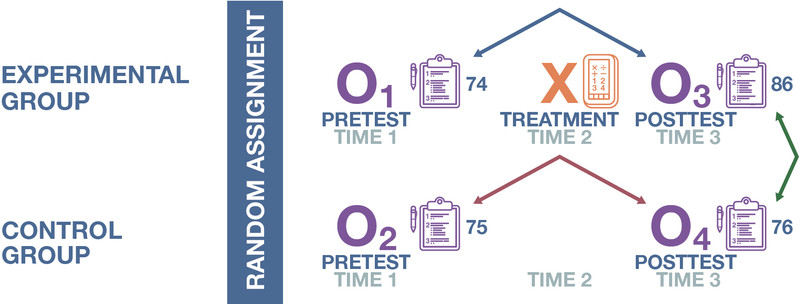
Basic randomized pretest-posttest experiment
Principles of a Well-Designed Experiment
There are four things AP Stats wants you to check first.
- Comparison means at least two treatment groups.
- You need something to compare against.
- A control group gives a baseline. It might get no treatment, a placebo, the standard treatment, or another comparison condition.
- Random assignment uses chance to assign treatments.
- Its job is to make groups similar on extraneous variables, which are outside variables that affect the response.
- This reduces confounding, where an outside variable is tangled with treatment assignment.
- Do not mix this up with random selection. Assignment is for causation, selection is for generalizing.
- Replication means more than one experimental unit per treatment.
- Repeated measurements on one subject are not replication.
- Replication helps average out natural variability and unusual units.
- Direct control means holding known outside variables constant when possible.
- Same room, same time, same measuring method, same dose schedule, and so on.
- Control fixes variables. Randomization balances variables.
Placebos and blinding
A placebo is an inactive treatment that looks like the real one. The placebo effect is the difference between the average placebo response and the average no-treatment response.
Blinding helps after assignment:
- Single-blind means participants or the researchers interacting with them do not know who got which treatment.
- Double-blind means neither group knows.
Students often blend these ideas together. Keep them separate. Randomization fights confounding before responses happen. Blinding fights bias after treatments are assigned.
The Main Experimental Designs
Completely randomized design
All experimental units are assigned to treatments completely at random. Equal group sizes are common, but not required. This works well when units are already fairly similar.
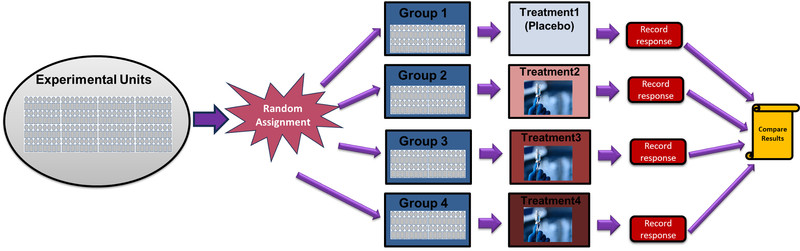
Completely randomized design
Randomized block design
You first group units into blocks based on a variable related to the response, then randomize treatments within each block.
The point is precision. If the block variable matters, comparing treatments inside each block removes some extra noise.
Huge AP trap: every treatment must appear in every block. If one block gets only one treatment, that is confounding, not blocking.
Matched pairs design
This is a special randomized block design with exactly two treatments.
Two forms show up:
- Match two similar units and randomly assign one treatment to each.
- Give both treatments to the same unit in random order.
This is great when close matching is possible or when one subject can receive both treatments. In repeated measures, watch for carryover effects.
How to Describe or Set Up the Design
A full design description usually includes:
- the experimental units
- the factor or factors
- all treatments
- the response variable
- the comparison/control group
- the random assignment method with actual mechanics
Example: “Label subjects 01 to 40 and use a random number generator to assign 20 to treatment and 20 to control.” - replication by stating how many units get each treatment
- any direct controls
- any blocking or matching and why that variable matters
- any placebo or blinding details
“Subjects were randomly divided” is too vague for a strong answer.
Choosing the Right Design and What Conclusions You Can Make
- Use completely randomized when units are fairly homogeneous and no strong block variable stands out.
- Use randomized block when a known outside variable strongly affects the response.
- Use matched pairs when there are exactly two treatments and pairing or repeated measures will cut variability.
Your conclusion depends on assignment versus selection:
| Situation | What you can conclude |
|---|---|
| Random assignment + random selection | causation and generalization |
| Random assignment only | causation, limited generalization to similar volunteers |
| Random selection only | generalization, not causation |
Key Takeaways
Experiment
A study that imposes treatments on experimental units and measures a response
Experimental Unit
The individual or object to which a treatment is assigned; determined by the level of random assignment
Treatment
A specific condition imposed on experimental units; with multiple factors, a treatment is a combination of factor levels
Response Variable
The outcome measured after the treatment is administered
Control Group
A collection of experimental units created for comparison; may receive no treatment, a placebo, a standard treatment, or another treatment
Placebo
An inactive treatment designed to resemble an active treatment
Placebo Effect
The difference between the average response to a placebo and the average response to no treatment
Single-Blind or Single-Masked Experiment
An experiment in which one relevant side does not know which treatment is being administered; usually the participants or the researchers who interact with them
Double-Blind or Double-Masked Experiment
An experiment in which neither participants nor the researchers who interact with them know treatment assignments
Extraneous Variable or Extraneous Source of Variation
A variable known or believed to affect the response but not studied as an explanatory variable
Confounding Variable
A variable related to the explanatory variable so their effects on the response cannot be separated
Completely Randomized Design
An experimental design in which treatments are assigned to all experimental units completely at random, with no blocks
Blocking Variable
An extraneous variable believed to affect the response and used to form blocks
Randomized Block Design
A design that first groups units into similar blocks based on a blocking variable, then randomly assigns treatments within each block so every treatment appears in every block
Purpose of Blocking
To separate variation due to the blocking variable from other variation, making treatment comparisons more precise
Matched Pairs Design
A randomized block design with exactly two treatments, using pairs of similar units or one unit receiving both treatments in random order
Random Assignment vs Random Selection
Random assignment determines which treatment units receive and supports cause-and-effect conclusions; random selection determines which individuals enter the sample and supports generalization to the population
Principles of a Well-Designed Experiment
Comparison, random assignment, replication, and direct control of potential extraneous variation
Comparison
Use of at least two treatment groups so a treatment effect can be evaluated relative to another condition
Factor or Explanatory Variable
The variable whose levels or categories are imposed by the researcher
Notes
Experiment
A study that imposes treatments on experimental units and measures a response
Experimental Unit
The individual or object to which a treatment is assigned; determined by the level of random assignment
Treatment
A specific condition imposed on experimental units; with multiple factors, a treatment is a combination of factor levels
Response Variable
The outcome measured after the treatment is administered
Control Group
A collection of experimental units created for comparison; may receive no treatment, a placebo, a standard treatment, or another treatment
Placebo
An inactive treatment designed to resemble an active treatment
Placebo Effect
The difference between the average response to a placebo and the average response to no treatment
Single-Blind or Single-Masked Experiment
An experiment in which one relevant side does not know which treatment is being administered; usually the participants or the researchers who interact with them
Double-Blind or Double-Masked Experiment
An experiment in which neither participants nor the researchers who interact with them know treatment assignments
Extraneous Variable or Extraneous Source of Variation
A variable known or believed to affect the response but not studied as an explanatory variable
Confounding Variable
A variable related to the explanatory variable so their effects on the response cannot be separated
Completely Randomized Design
An experimental design in which treatments are assigned to all experimental units completely at random, with no blocks
Blocking Variable
An extraneous variable believed to affect the response and used to form blocks
Randomized Block Design
A design that first groups units into similar blocks based on a blocking variable, then randomly assigns treatments within each block so every treatment appears in every block
Purpose of Blocking
To separate variation due to the blocking variable from other variation, making treatment comparisons more precise
Matched Pairs Design
A randomized block design with exactly two treatments, using pairs of similar units or one unit receiving both treatments in random order
Random Assignment vs Random Selection
Random assignment determines which treatment units receive and supports cause-and-effect conclusions; random selection determines which individuals enter the sample and supports generalization to the population
Principles of a Well-Designed Experiment
Comparison, random assignment, replication, and direct control of potential extraneous variation
Comparison
Use of at least two treatment groups so a treatment effect can be evaluated relative to another condition
Factor or Explanatory Variable
The variable whose levels or categories are imposed by the researcher
