Topic 1.11 Notes – Random Sampling
What Random Sampling Is
A population is the whole group you want information about. A sample is the smaller group you actually collect data from. A sampling frame is the list or source you use to select people or items, like a school roster or customer database.
Random sampling means selection happens by a defined chance process. That could be a random number generator, random digits, or a lottery method. It is not convenience, volunteering, or picking people who “seem typical.”
A few things AP loves to test here:
- Random selection supports generalization to the population represented by the sampling process.
- Random does not mean messy or haphazard. You should be able to describe exactly how the sample was chosen.
- A census includes everyone, so it is not a sampling method.
- A random sample can still turn out a little unbalanced just by chance.
- Random selection and random assignment do different jobs:
- random selection → generalize to a population
- random assignment → show cause and effect
The diagram below connects those two ideas. It starts with random sampling from a population, then shows random allocation into groups for different treatments.
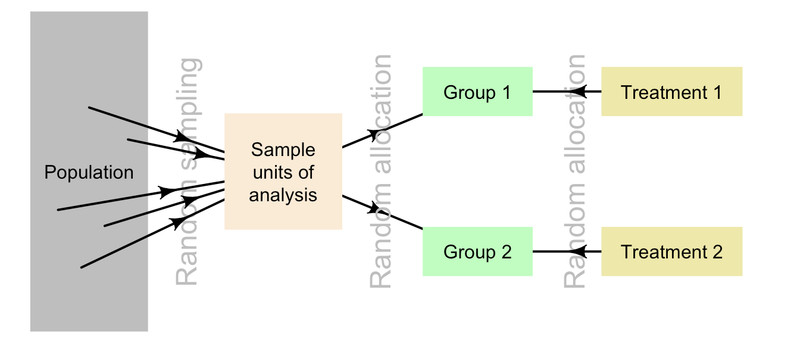
Random sampling and random allocation
Sampling With and Without Replacement
This part is simple once you ask one question. Can the same unit appear again later?
Without replacement
A selected unit is not returned. It can only be chosen once.
- This is the usual setup for surveying distinct people.
- If random numbers repeat, repeats are ignored and new ones are generated.
With replacement
A selected unit is returned before the next draw.
- The same unit can be selected more than once.
- The population available on each draw stays the same.
The common trap is thinking repeated random numbers automatically mean the sample is with replacement. In AP Stats, many sampling procedures use random numbers but still sample without replacement, because duplicate labels are skipped.
The Four Random Sampling Methods
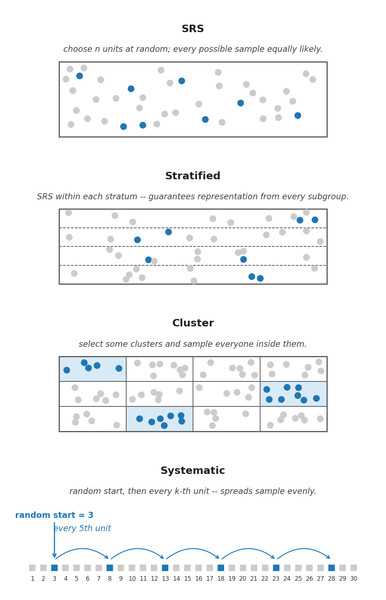
Keep this picture in mind as you read. It puts all four methods side by side, which makes the differences easier to spot.
Simple random sample
An SRS of size means every possible sample of size has the same chance to be chosen. That is stronger than “every individual has an equal chance.”
A typical SRS procedure:
- Label all units.
- Use a random number generator.
- Pick labels until you have different units.
- Ignore repeats if sampling without replacement.
Use SRS when you have a full list and do not need guaranteed subgroup representation.
Stratified random sample
You divide the population into nonoverlapping strata, then take an SRS from every stratum.
- Strata should be similar within on a characteristic related to the variable you care about.
- This guarantees every stratum appears in the final sample.
- It is great for subgroup comparisons.
If sampling proportionally, use
Cluster random sample
You divide the population into clusters, randomly choose some clusters, then sample everyone in those chosen clusters.
- Clusters should ideally be diverse within and similar to each other.
- This is useful when natural groups already exist and sampling whole groups saves time or money.
Systematic random sample
You choose a random start, then take every th unit from a list or stream.
Example: if and , then . If the random start is 7, you take 7, 17, 27, and so on.
This spreads the sample out nicely, but it usually is not an SRS because only evenly spaced samples are possible.
Stratified Versus Cluster Sampling
These two get confused constantly because both split the population into groups. The difference is what happens after the split.
- Stratified means some from all groups
- sample individuals from every group
- all strata appear
- groups are similar within
- Cluster means all from some groups
- sample whole groups
- only selected clusters appear
- groups are diverse within
That fast test works on MCQs and FRQs almost every time.
Choosing the Right Method and Justifying It
A strong justification always does three things:
- names the method
- identifies the population or group structure in context
- explains why it fits the goal or logistics
Good matches:
- SRS when a full sampling frame exists
- Stratified when subgroups should all be represented or compared
- Cluster when natural groups make data collection easier
- Systematic when units are already ordered and there is no bad periodic pattern
Weak justifications sound like “more representative” or “easier” with no explanation. Also, never claim random sampling proves causation, and never generalize beyond the population actually represented by the sampling frame.
Key Takeaways
Sampling Without Replacement
Selected units are not returned before later selections, so a unit can be chosen only once
Sampling With Replacement
Selected units are returned before later selections, so the same unit can be chosen more than once
Simple Random Sample (SRS)
A sample of size n selected so every possible sample of n distinct population units has the same chance of being chosen
Stratified Random Sample
Divide the population into nonoverlapping strata, take a random sample from each stratum, and combine the selected units
Cluster Random Sample
Divide the population into clusters, randomly select some clusters, and collect data from every observational unit in the selected clusters
Systematic Random Sample
Choose a random starting point, then select every kth unit using a fixed interval
Stratified vs. Cluster Sampling
Stratified: sample individuals from every stratum; strata are ideally homogeneous within. Cluster: randomly select some clusters and include everyone in them; clusters are ideally heterogeneous within and similar to one another
Notes
Sampling Without Replacement
Selected units are not returned before later selections, so a unit can be chosen only once
Sampling With Replacement
Selected units are returned before later selections, so the same unit can be chosen more than once
Simple Random Sample (SRS)
A sample of size n selected so every possible sample of n distinct population units has the same chance of being chosen
Stratified Random Sample
Divide the population into nonoverlapping strata, take a random sample from each stratum, and combine the selected units
Cluster Random Sample
Divide the population into clusters, randomly select some clusters, and collect data from every observational unit in the selected clusters
Systematic Random Sample
Choose a random starting point, then select every kth unit using a fixed interval
Stratified vs. Cluster Sampling
Stratified: sample individuals from every stratum; strata are ideally homogeneous within. Cluster: randomly select some clusters and include everyone in them; clusters are ideally heterogeneous within and similar to one another
