Topic 2.5 Notes – Mutually Exclusive Events
What Mutually Exclusive Events Are
In probability, an event is a set of outcomes from one random process. So before anything else, you need one clearly defined trial. For one roll of a die, an outcome is a single number. For “flip a coin then roll a die,” one outcome is the whole pair.
The key idea is the intersection. This is the set of outcomes that are in both events.
That matches the word and:
The probability of that overlap is the joint probability:
You may also see .
This Venn diagram shows that overlap as the shared middle region.
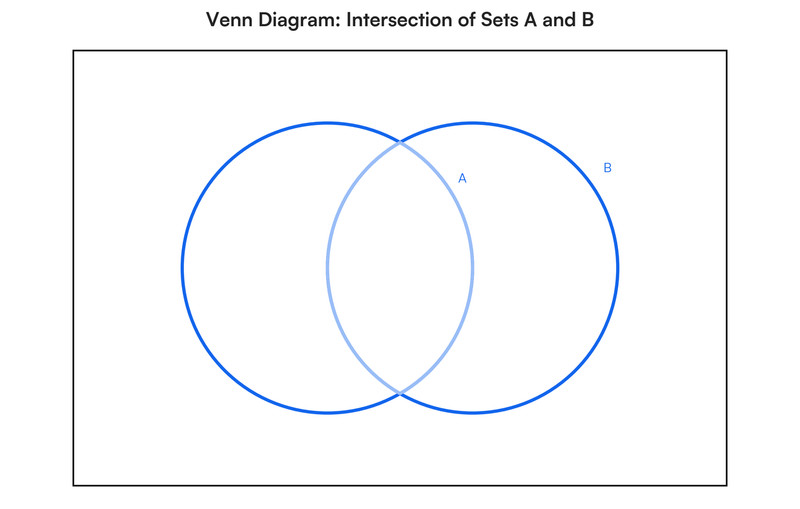
Intersection of events and
Two events are mutually exclusive (or disjoint) when they cannot occur in the same trial. In this unit’s finite sample-space settings, that means
If , then the events are not mutually exclusive.
One detail students miss a lot: “cannot happen at the same time” means cannot be part of the same complete outcome. If one trial is “flip a coin and roll a die,” then “get heads” and “roll a 6” can both happen in that one trial.
How to Decide Whether Events Are Mutually Exclusive
This is the thought process AP Stats wants.
Identify one trial
- What counts as one complete outcome?
State the two events
- What does event mean?
- What does event mean?
Imagine both happening
- What would one outcome have to look like to satisfy both?
Find the intersection
- Sample space given? List shared outcomes.
- Two-way table given? Look at the matching body cell.
- Probabilities given? Use the stated or calculated .
Conclude in context
- No shared outcomes and , so mutually exclusive.
- Shared outcomes with positive probability not mutually exclusive.
Example with one die roll:
Then . A single die roll cannot be both less than 3 and greater than 4, so . Therefore, the events are mutually exclusive.
Ways AP Stats Shows This
From a sample space or list of outcomes
You compare the event sets directly.
- If and , there is no overlap.
- If and , the shared outcome 3 means they are not mutually exclusive.
Even one overlapping outcome is enough.
From a two-way table
A body cell is a joint event.
If that cell count is positive, the events are not mutually exclusive.
In this table, the highlighted cell represents students who are both sophomores and brought lunch.
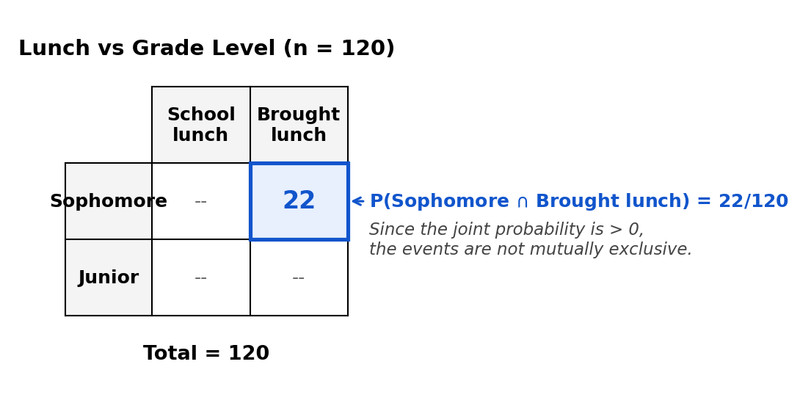
Two-way table with a joint event highlighted
If 22 students are both sophomores and brought lunch, then
That is positive, so those events are not mutually exclusive.
Categories of the same variable often are mutually exclusive, like sophomore vs junior, because one student fits exactly one grade level. But if people can choose multiple responses, categories can overlap.
From given probabilities
- If a problem gives , that supports mutual exclusivity in this course.
- If it gives , then both can occur, so they are not mutually exclusive.
Complements and Other Important Relationships
An event and its complement always have no overlap:
They also cover the whole sample space together. That is why complements are stronger than just “mutually exclusive.”
Mutually exclusive events do not have to be complements. “Roll a 1” and “roll a 2” are disjoint, but they do not cover every outcome.
Also keep independence separate. Mutual exclusivity asks whether both can happen together. Independence asks whether one changes the probability of the other.
What Students Miss
- “Different events” does not prove disjointness.
- This topic is about and, so check , not “or.”
- You must know what one trial is before judging overlap.
- Sequential actions can still be part of one outcome.
- Categories are only disjoint if one observation cannot be in both.
- AP explanations need the reason, not just the verdict.
Key Takeaways
Intersection
The event of all outcomes that belong to both A and B; written A ∩ B.
Joint Probability
The probability of the intersection of A and B—the probability that both occur; P(A ∩ B), sometimes written P(AB)
Mutually Exclusive or Disjoint Events
Two events that cannot both occur in the same trial; they have no outcomes in common, so P(A ∩ B) = 0
Criterion for Not Mutually Exclusive Events
If P(A ∩ B) > 0, the events are not mutually exclusive
Joint Probability in a Two-Way Table
The probability of both categories occurring together; in a two-way table, cell count divided by total count
Complement and Mutual Exclusivity
An event and its complement are always mutually exclusive: P(A ∩ A^c) = 0
Mutually Exclusive vs. Complements
Complements are disjoint and together include all outcomes; mutually exclusive events only have to have no overlap
Mutually Exclusive vs. Independent
Mutually exclusive means the events cannot both occur in the same trial; independent means one event occurring does not change the probability of the other
Structural vs. Numerical Justification
Structural: use the event definitions and context to show no outcome can satisfy both events. Numerical: use the joint probability; in this topic, P(A ∩ B) = 0 supports mutually exclusive and P(A ∩ B) > 0 shows not mutually exclusive
Notes
Intersection
The event of all outcomes that belong to both A and B; written A ∩ B.
Joint Probability
The probability of the intersection of A and B—the probability that both occur; P(A ∩ B), sometimes written P(AB)
Mutually Exclusive or Disjoint Events
Two events that cannot both occur in the same trial; they have no outcomes in common, so P(A ∩ B) = 0
Criterion for Not Mutually Exclusive Events
If P(A ∩ B) > 0, the events are not mutually exclusive
Joint Probability in a Two-Way Table
The probability of both categories occurring together; in a two-way table, cell count divided by total count
Complement and Mutual Exclusivity
An event and its complement are always mutually exclusive: P(A ∩ A^c) = 0
Mutually Exclusive vs. Complements
Complements are disjoint and together include all outcomes; mutually exclusive events only have to have no overlap
Mutually Exclusive vs. Independent
Mutually exclusive means the events cannot both occur in the same trial; independent means one event occurring does not change the probability of the other
Structural vs. Numerical Justification
Structural: use the event definitions and context to show no outcome can satisfy both events. Numerical: use the joint probability; in this topic, P(A ∩ B) = 0 supports mutually exclusive and P(A ∩ B) > 0 shows not mutually exclusive
