Topic 2.7 Notes – Independent Events and Unions of Events
What Independence and Union Mean
A quick symbol refresher helps a lot here:
- means both events happen.
- means or or both.
- means not .
This Venn diagram is a good picture of union and intersection.
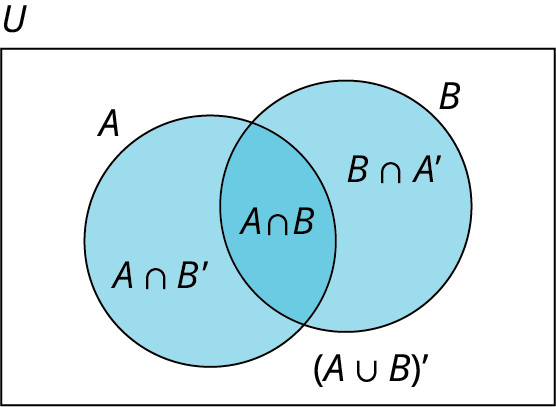
Venn diagram for and
Independence is about whether probabilities change. If knowing happened does not change the chance of , then the events are independent.
Equivalent ways to show independence:
A union is different. It just combines outcomes. It asks for the probability that at least one event occurs. So keep the ideas separate in your head:
- independence = relationship between events
- union = event made by combining outcomes
The Probability Rules You Need
For any two events, the addition rule is
That subtraction matters because the overlap gets counted twice if you just add.
Example. If , , and , then
If events are independent, the intersection can be found by multiplying:
Only do that if independence is given or proven.
A few special cases get tested a lot:
- Mutually exclusive
- They cannot happen together, so
- Then
- Neither event
- Exactly one event
- equivalent form is
If events are independent, you can plug the product into the addition rule:
How to Choose the Right Rule
The wording tells you the event. The relationship tells you the formula.
- Translate the words.
- both
- or / either / at least one
- neither
- exactly one union without overlap
- Decide what relationship you know.
- independent use multiplication for the intersection
- mutually exclusive intersection is
- neither given do not assume
For “at least one” with independent events, the complement is often cleaner:
Example. If and , then
On an FRQ, show the event, the rule, the substitution, and the final probability in context.
How to Check Independence in Problems
You may need to prove independence instead of being told.
Given probabilities
Check either of these:
Equally likely outcomes
On one die roll, let and .
Since , the events are independent.
Two-way table
Use:
- marginal proportion for and
- joint proportion for
- conditional proportion for
Use exact counts when possible. Rounding can fake a mismatch.
Separate trials are often independent. Without replacement usually makes events dependent.
What Students Mix Up
The biggest trap is independent vs. mutually exclusive.
- Mutually exclusive means they cannot both happen.
- Independent means one does not affect the other.
If both events have positive probability, they cannot be both mutually exclusive and independent.
Other common misses:
- using when events overlap
- multiplying without knowing independence
- forgetting that “or” includes the overlap
- treating “at least one” and “exactly one” as the same
- assuming same experiment means dependent, or sequence means independent
Key Takeaways
Independent Events
Events where knowing whether one occurs does not change the probability of the other; equivalently, when defined, P(A|B)=P(A) or P(B|A)=P(B), and P(A ∩ B)=P(A)P(B)
Union of Events
A ∪ B; the event that A or B or both occur
General Addition Rule
P(A ∪ B) = P(A) + P(B) − P(A ∩ B)
Multiplication Rule for Independent Events
If A and B are independent, then P(A ∩ B) = P(A)P(B)
Mutually Exclusive Events
Events that cannot occur together, so P(A ∩ B) = 0
Neither A nor B
The complement of the union: (A ∪ B)^c, so P(neither) = 1 − P(A ∪ B)
Exactly One of A and B
A or B but not both; P(exactly one) = P(A ∪ B) − P(A ∩ B) = P(A) + P(B) − 2P(A ∩ B)
At Least One
For events A and B, means A ∪ B; P(at least one) = P(A ∪ B) = 1 − P(A^c ∩ B^c); if A and B are independent, P(at least one) = 1 − [1 − P(A)][1 − P(B)]
Independent Events Versus Mutually Exclusive Events
Independent means P(A ∩ B)=P(A)P(B); mutually exclusive means P(A ∩ B)=0; if both events have positive probability, they cannot be both
Intersection of Events
A ∩ B; the event that both A and B occur
Notes
Independent Events
Events where knowing whether one occurs does not change the probability of the other; equivalently, when defined, P(A|B)=P(A) or P(B|A)=P(B), and P(A ∩ B)=P(A)P(B)
Union of Events
A ∪ B; the event that A or B or both occur
General Addition Rule
P(A ∪ B) = P(A) + P(B) − P(A ∩ B)
Multiplication Rule for Independent Events
If A and B are independent, then P(A ∩ B) = P(A)P(B)
Mutually Exclusive Events
Events that cannot occur together, so P(A ∩ B) = 0
Neither A nor B
The complement of the union: (A ∪ B)^c, so P(neither) = 1 − P(A ∪ B)
Exactly One of A and B
A or B but not both; P(exactly one) = P(A ∪ B) − P(A ∩ B) = P(A) + P(B) − 2P(A ∩ B)
At Least One
For events A and B, means A ∪ B; P(at least one) = P(A ∪ B) = 1 − P(A^c ∩ B^c); if A and B are independent, P(at least one) = 1 − [1 − P(A)][1 − P(B)]
Independent Events Versus Mutually Exclusive Events
Independent means P(A ∩ B)=P(A)P(B); mutually exclusive means P(A ∩ B)=0; if both events have positive probability, they cannot be both
Intersection of Events
A ∩ B; the event that both A and B occur
