Topic 2.4 Notes – Introduction to Probability
What Probability Is
A random process is something you can repeat where the result of one trial is uncertain, even though the possible results are known ahead of time. A coin toss, a die roll, or classifying a trip as delayed or not delayed all fit.
- An outcome is one result of one trial.
- The sample space is the full set of all possible outcomes.
- An event is any collection of outcomes from that sample space.
For probability models, two facts always have to hold:
That means:
- probability 0 = impossible
- probability 1 = certain
- every trial ends in one and only one sample-space outcome
- a valid model has outcome probabilities that are nonnegative and add to 1
This sounds simple, but a lot of mistakes later come from building the sample space badly.
Building the Sample Space and Event
Your sample space has to be exhaustive and nonoverlapping.
- Exhaustive means every possible result is listed.
- Nonoverlapping means one trial can’t land in two listed outcomes at once.
If you toss a coin twice and care about order, the sample space is:
A tree diagram is a quick way to see all four ordered outcomes.
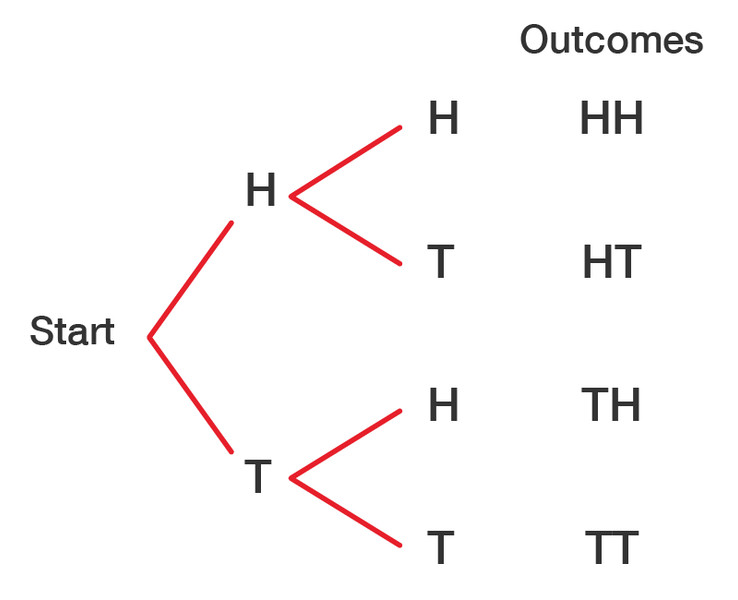
Why are and separate? Because they are different ordered outcomes.
If the event is “exactly one head,” then
A few things to keep straight:
- a single outcome could be
- a whole event could contain several outcomes, like
- an impossible event contains no outcomes at all
Common traps:
- Using labels like “even” and “greater than 3” as sample-space outcomes for a die roll. Those overlap.
- Naming categories and acting like they must be equally likely. They might not be.
Finding Probabilities from a Model
The first question is whether the outcomes are equally likely.
If they are, use theoretical probability:
For “exactly one head” in two fair tosses:
- favorable outcomes = so 2
- total outcomes = so 4
If outcomes are not equally likely, you add the probabilities of the outcomes in the event.
Example. Suppose trip status has probabilities:
- no delay = 0.72
- moderate delay = 0.21
- severe delay = ?
Since probabilities in the sample space add to 1,
Then “some delay” means moderate or severe:
The big mistake here is dividing by the number of categories just because you listed categories. Getting a number between 0 and 1 does not prove your method was right.
Complements and Not E
The complement of means “not .” You may see , , or .
In the diagram, focus on the top row. One panel shows the event , and the other shows everything outside that event, which is the complement.
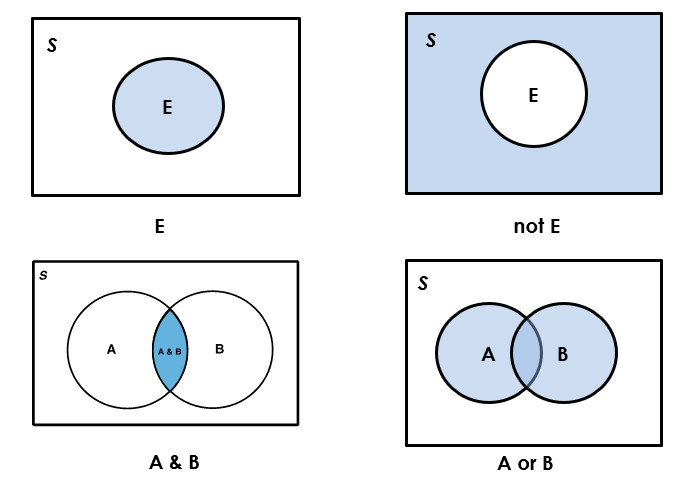
Event and complement
This is useful when “not ” is easier to count.
Example. In two fair tosses, let = “at least one head.”
Its complement is “no heads,” which is just .
Translate wording carefully:
- “at least one” ↔ none
- “at least ” ↔ fewer than
- “more than ” ↔ at most
- “at most ” ↔ more than
Boundary trap students miss all the time: the complement of “at most 4” is “greater than 4,” not “at least 4.”
Interpreting Probability in Context
Probability means long-run relative frequency. If a model says , that means over many trips under the same conditions, about 28% would have some delay.
It does not mean exactly 28 of the next 100 trips will be delayed. Short runs can bounce around a lot.
Also separate these two ideas:
- theoretical probability comes from a model
- empirical relative frequency comes from actual data or simulation
On the exam, write the event clearly, show the setup, give the probability, and if asked, interpret it in context.
Key Takeaways
Random Process
A repeatable process whose individual result is determined at least partly by chance
Outcome
The result of one trial of a random process
Sample Space
The set of all possible nonoverlapping outcomes of a random process, commonly denoted S; P(S) = 1
Event
A collection of outcomes from the sample space; an event occurs when the observed outcome is in that collection
Probability Model
A description of a random process that lists possible outcomes and assigns probabilities to them
P(E)
Notation for the probability that event E occurs
Valid Probability Model
A model that assigns probabilities with 0 ≤ P(E) ≤ 1 for every event E and P(S) = 1
Theoretical Probability
When outcomes in a finite sample space are equally likely, P(E) = number of outcomes in E divided by total number of outcomes in S
Equally Likely Outcomes
Outcomes that all have the same probability; only then can probability be found by counting outcomes
Complement Rule
P(E^C) = 1 − P(E), equivalently P(E) + P(E^C) = 1
Long-Run Relative Frequency Interpretation
For many independent repetitions of a random process under the same conditions, the proportion of times E occurs approaches P(E)
Complement of an Event
The event that E does not occur; all outcomes in the sample space not in E; written E′, Ē, or E^C
Notes
Random Process
A repeatable process whose individual result is determined at least partly by chance
Outcome
The result of one trial of a random process
Sample Space
The set of all possible nonoverlapping outcomes of a random process, commonly denoted S; P(S) = 1
Event
A collection of outcomes from the sample space; an event occurs when the observed outcome is in that collection
Probability Model
A description of a random process that lists possible outcomes and assigns probabilities to them
P(E)
Notation for the probability that event E occurs
Valid Probability Model
A model that assigns probabilities with 0 ≤ P(E) ≤ 1 for every event E and P(S) = 1
Theoretical Probability
When outcomes in a finite sample space are equally likely, P(E) = number of outcomes in E divided by total number of outcomes in S
Equally Likely Outcomes
Outcomes that all have the same probability; only then can probability be found by counting outcomes
Complement Rule
P(E^C) = 1 − P(E), equivalently P(E) + P(E^C) = 1
Long-Run Relative Frequency Interpretation
For many independent repetitions of a random process under the same conditions, the proportion of times E occurs approaches P(E)
Complement of an Event
The event that E does not occur; all outcomes in the sample space not in E; written E′, Ē, or E^C
