Topic 1.5 Notes – Ratification of the U.S. Constitution
Ratification as Compromise
The Constitution came out of two negotiations. First, delegates had to agree at the Constitutional Convention. Then the states had to approve it through ratifying conventions. That is why this topic keeps circling back to the same pattern: conflict → compromise → constitutional structure.
In 1787, delegates met in Philadelphia to revise the Articles of Confederation, which had made the national government too weak to tax effectively, regulate commerce, or enforce laws. Instead of patching the Articles, they wrote a new Constitution with a much stronger national government.
- George Washington presided over the convention, which gave it legitimacy.
- James Madison was a leading architect of the new plan.
- Rhode Island did not send delegates.
- Article VII said the Constitution would take effect when 9 of 13 state conventions ratified it. That mattered because the Articles had required unanimous approval by state legislatures for changes.
The tension running through everything was the same. How much power should belong to the people, and how much should be restrained? How much should belong to the nation, and how much to the states?
The Major Compromises
Great Compromise
Large and small states were fighting over representation. The basic split is simple and worth locking in before you move on.
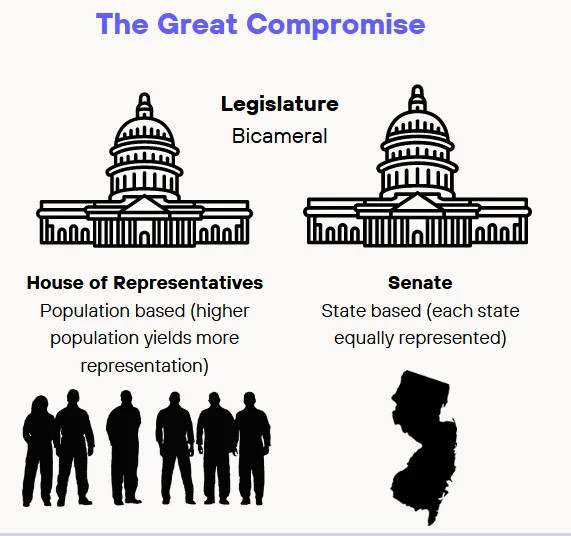
The Great Compromise
- Virginia Plan favored large states because representation would be based on population.
- New Jersey Plan favored small states because each state would have equal representation.
- The Connecticut or Great Compromise created a bicameral Congress.
- House of Representatives = based on population
- Senate = 2 senators per state
One chamber represents people. One chamber represents states. That split still shapes lawmaking.
Electoral College
Delegates did not agree on direct popular election or letting Congress choose the president, so they built a middle system.
- Each state gets electors equal to its House seats + 2 senators.
- That mixes population with state equality.
- It also preserves a strong state role in choosing the president.
- A modern result is that a candidate can win the presidency while losing the national popular vote.
Three-Fifths Compromise
This was about representation and taxation, not rights.
- Enslaved people would count as three-fifths of a person for House apportionment and direct taxation.
- Enslaved people still had no political voice or rights.
- The compromise increased the House power and Electoral College power of slaveholding states.
Slave Trade Compromise
Southern delegates wanted protection for slavery-related interests.
- Congress could not ban the importation of enslaved persons before 1808.
- This protected the international slave trade long enough to keep Southern support.
- Congress banned importation effective 1808, but slavery continued.
Bill of Rights Compromise
Ratification itself required another bargain.
- Anti-Federalists objected that the Constitution lacked explicit protections for liberty.
- In states like Massachusetts, the deal became ratify now, recommend amendments later.
- Madison proposed amendments in the First Congress.
- The Bill of Rights was added in 1791.
Federalists and Anti-Federalists
The ratification debate was about whether the new government would solve national problems or threaten liberty.
| Group | What they believed |
|---|---|
| Federalists | Supported ratification and a stronger national government because the Articles were too weak to keep order, regulate commerce, provide defense, or enforce laws. |
| Anti-Federalists | Opposed ratification or wanted changes because they feared centralized power, weak states, a standing army, and loss of liberty. |
Anti-Federalists especially disliked the Necessary and Proper Clause, Supremacy Clause, and the lack of a Bill of Rights.
- Federalist No. 10 by James Madison argued that a large republic controls factions because many competing interests prevent one group from dominating.
- Brutus No. 1 argued that a large republic would become too distant from the people and the national government would overpower the states.
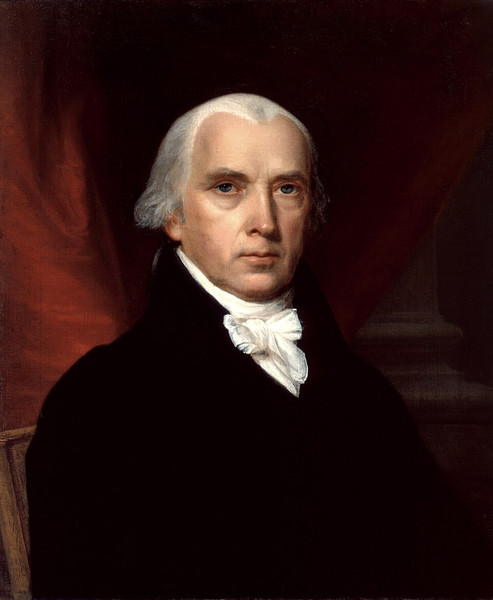
James Madison
Federalists won ratification, but Anti-Federalist pressure helped produce the Bill of Rights.
Article V and Constitutional Change
The framers wanted the Constitution to be changeable, but much harder to change than an ordinary law. This flowchart is a good quick way to remember the two proposal paths and the two ratification paths in Article V.
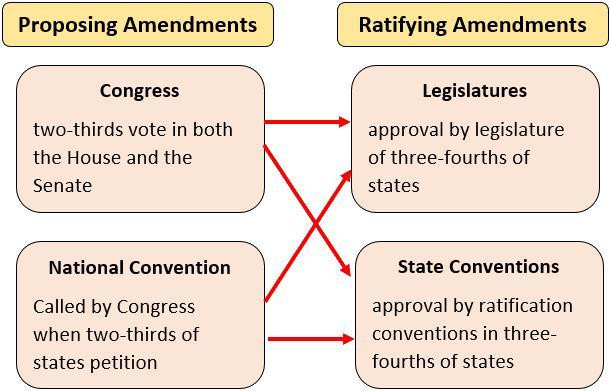
Article V amendment process
- An amendment is proposed by either:
- two-thirds of both houses of Congress, or
- a national convention called after two-thirds of state legislatures request one
- An amendment is ratified by either:
- three-fourths of state legislatures, or
- three-fourths of state ratifying conventions
A few must-know facts:
- The president has no formal role in amendments.
- All 27 amendments were proposed by Congress, not by convention.
- The Bill of Rights is the classic Article V example.
This process balances stability with flexibility, but it also makes change difficult.
What the Compromises Left Unresolved
The Constitution solved enough problems to be adopted, but it did not settle the deepest arguments.
- Small states still have major power in the Senate and Electoral College.
- Slavery’s legacy is built into early constitutional compromises.
- Tension between national power and individual liberty never disappeared.
- Tension between federal power and state/local control still drives policy fights.
You can see those old debates in modern issues:
- Government surveillance after 9/11 shows the conflict between security and liberty.
- Public school policy shows the conflict between national action and state or local control.
Key Takeaways
Constitutional Convention
The 1787 Philadelphia meeting where delegates abandoned revising the Articles of Confederation and drafted a new Constitution with a stronger national government
Virginia Plan
Large-state proposal for a strong national government and a bicameral legislature with representation based on population or financial contribution
New Jersey Plan
Small-state proposal retaining equal state representation in a unicameral national legislature similar to that under the Articles of Confederation
Great Compromise (Connecticut Compromise)
Created a bicameral Congress with population-based representation in the House and equal state representation in the Senate
Electoral College
Compromise system in which state-appointed electors formally choose the president; each state receives electors equal to its House seats plus two senators
Three-Fifths Compromise
Counted three-fifths of a state’s enslaved population when apportioning House seats and direct taxes, increasing slaveholding states’ congressional and electoral power
1808 Slave Trade Compromise
Prevented Congress from banning the international importation of enslaved people before 1808, after which Congress could prohibit it
Article VII Ratification Process
Required specially elected conventions in nine of thirteen states to ratify the Constitution, bypassing state legislatures and the Articles’ unanimity rule
Federalists
Supporters of ratification who argued that the nation needed a stronger but constitutionally limited national government
Anti-Federalists
Opponents or critics of ratification who feared centralized power, loss of state authority, and threats to liberty, especially without a bill of rights
Bill of Rights Compromise (Massachusetts Compromise)
Arrangement under which states ratified the Constitution while recommending that amendments protecting individual rights be considered afterward
Bill of Rights
The first ten amendments, ratified in 1791 to protect individual liberties and fulfill a major promise made during ratification
Article V Amendment Process
Amendments are proposed by two-thirds of both houses of Congress or a convention called after applications from two-thirds of state legislatures, then ratified by three-fourths of states through legislatures or conventions
Notes
Constitutional Convention
The 1787 Philadelphia meeting where delegates abandoned revising the Articles of Confederation and drafted a new Constitution with a stronger national government
Virginia Plan
Large-state proposal for a strong national government and a bicameral legislature with representation based on population or financial contribution
New Jersey Plan
Small-state proposal retaining equal state representation in a unicameral national legislature similar to that under the Articles of Confederation
Great Compromise (Connecticut Compromise)
Created a bicameral Congress with population-based representation in the House and equal state representation in the Senate
Electoral College
Compromise system in which state-appointed electors formally choose the president; each state receives electors equal to its House seats plus two senators
Three-Fifths Compromise
Counted three-fifths of a state’s enslaved population when apportioning House seats and direct taxes, increasing slaveholding states’ congressional and electoral power
1808 Slave Trade Compromise
Prevented Congress from banning the international importation of enslaved people before 1808, after which Congress could prohibit it
Article VII Ratification Process
Required specially elected conventions in nine of thirteen states to ratify the Constitution, bypassing state legislatures and the Articles’ unanimity rule
Federalists
Supporters of ratification who argued that the nation needed a stronger but constitutionally limited national government
Anti-Federalists
Opponents or critics of ratification who feared centralized power, loss of state authority, and threats to liberty, especially without a bill of rights
Bill of Rights Compromise (Massachusetts Compromise)
Arrangement under which states ratified the Constitution while recommending that amendments protecting individual rights be considered afterward
Bill of Rights
The first ten amendments, ratified in 1791 to protect individual liberties and fulfill a major promise made during ratification
Article V Amendment Process
Amendments are proposed by two-thirds of both houses of Congress or a convention called after applications from two-thirds of state legislatures, then ratified by three-fourths of states through legislatures or conventions
