Topic 1.8 Notes – Constitutional Interpretations of Federalism
Federalism and the Four Clauses That Move the Balance
Federalism means power is divided between the national and state governments. The Constitution sets that up, but it does not draw every boundary clearly, so the Court ends up deciding a lot of the real limits.
The Tenth Amendment gives the background rule. Powers not delegated to the national government are reserved to the states or the people. That does not erase national powers that the Constitution actually gives.
One useful way to picture that division is to sort powers into federal, concurrent, and state powers.
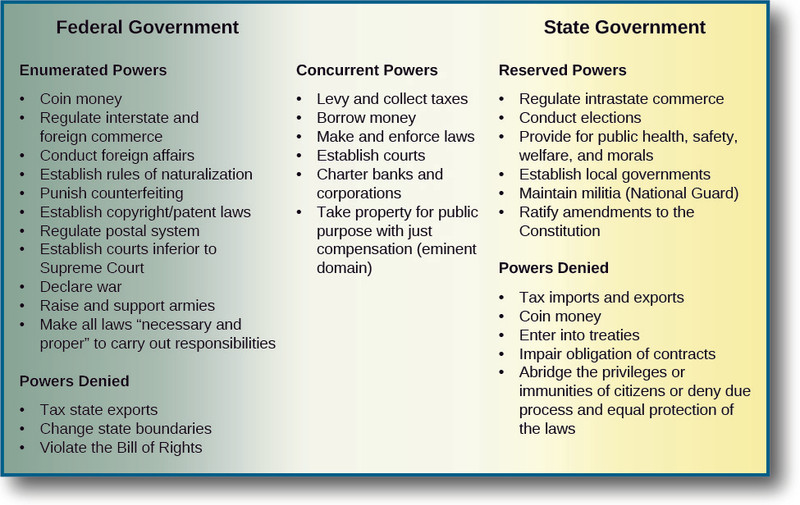
Federal, concurrent, and reserved powers
These four clauses help explain why that balance shifts over time:
- Commerce Clause
Congress can regulate interstate commerce, meaning commerce among the states. The fight is usually over how far that reaches. Does it cover only things crossing state lines, or also local activity that affects a national market?
- Necessary and Proper Clause
Congress can use implied powers to carry out enumerated powers. “Necessary” here means useful or appropriate, not absolutely required.
- Supremacy Clause
Valid federal law beats conflicting state law. The key word is valid. Federal law is supreme only when it is made in pursuance of the Constitution.
- Fourteenth Amendment
The Due Process and Equal Protection Clauses limit what states can do and let the national government and courts protect people from unconstitutional state laws.
Broad readings of these clauses usually expand national power. Narrow readings usually leave more room for the states.
McCulloch v. Maryland and Broad National Power
This is the required case for implied powers and federal supremacy.
- Congress created the Second Bank of the United States.
- Maryland taxed the bank.
- McCulloch refused to pay.
The Court answered two questions:
- Can Congress create a bank even though the Constitution does not list that power?
Yes. - Can a state tax a valid national institution?
No.
The reasoning matters more than the facts:
- The bank was a reasonable way to carry out enumerated powers like taxing, borrowing, and spending.
- The Necessary and Proper Clause allows implied powers.
- “Necessary” does not mean indispensable.
- Maryland could not tax the bank because the power to tax involves the power to destroy.
- Under the Supremacy Clause, states cannot obstruct valid national action.
This case expanded national power and established that constitutional federal laws are supreme.
Commerce Clause Expansion and Limits
Once the Court accepted broad national power, the Commerce Clause became a major tool for federal action.
Congress can regulate three categories:
- Channels of interstate commerce like highways, waterways, and air routes
- Instrumentalities, persons, or things in interstate commerce like trains, planes, shipments, or travelers
- Intrastate activity with a substantial effect on interstate commerce
Broad interpretation after the New Deal
- Wickard v. Filburn (1942)
A farmer grew extra wheat for personal use. The Court still upheld regulation because many farmers doing that would affect the national wheat market. That is the aggregate effects idea.
- Heart of Atlanta Motel v. United States (1964)
The Court upheld part of the Civil Rights Act of 1964. A motel serving interstate travelers affected interstate commerce, so Congress could regulate discrimination there.
Congress still does not have a general police power. Crime, education, and public safety usually stay mainly with the states unless Congress can tie action to a real constitutional power.
Lopez and Morrison as the Modern Boundary
These cases show the Court putting limits back on national power.
United States v. Lopez
The Gun-Free School Zones Act made gun possession near schools a federal crime. The Court struck it down because gun possession in a school zone was local, non-economic activity with too weak a connection to interstate commerce.
This was the first major post-New Deal Commerce Clause limit.
United States v. Morrison
The Court struck down part of the Violence Against Women Act of 1994.
- The Commerce Clause argument failed because gender-motivated violence was non-economic criminal conduct.
- The Fourteenth Amendment argument failed because that amendment targets state action, not purely private conduct.
The pattern is simple. Congress can regulate economic activity with substantial interstate effects. It cannot federalize every local problem by tracing indirect economic consequences.
Fourteenth Amendment, State Laws, and Modern Federalism
The Fourteenth Amendment shifts power toward the national government by limiting state action.
- Brown v. Board of Education (1954)
State-mandated school segregation violated Equal Protection. Even education, usually a state area, must follow the Constitution.
- Defense of Marriage Act of 1996 led to major marriage cases.
United States v. Windsor (2013) struck down the federal definition of marriage in DOMA.
Obergefell v. Hodges (2015) required states to license and recognize same-sex marriage under the Fourteenth Amendment. - No Child Left Behind Act of 2001
Education is mostly state-controlled, but the national government gained influence through federal funding conditions.
On an FRQ or MCQ, run the same chain every time. What clause gives national power? How did the Court interpret it? Is the federal law valid? Does it conflict with state law? Does the Fourteenth Amendment limit the state action?
Key Takeaways
Commerce Clause
Congress’s power to regulate interstate commerce, including its channels, instrumentalities, and intrastate economic activity that substantially affects interstate commerce
Necessary and Proper Clause / Elastic Clause
Allows Congress to use appropriate, constitutionally permitted means to carry out its enumerated powers
Implied Powers
Congressional powers not expressly listed in the Constitution but reasonably connected to carrying out enumerated powers
Supremacy Clause
Makes the Constitution, constitutional federal laws, and treaties superior to conflicting state law
Preemption
The displacement of state law by valid federal law when Congress expressly requires it, federal regulation occupies the field, or state law conflicts with or obstructs federal law
Fourteenth Amendment Due Process Clause
Prohibits states from depriving any person of life, liberty, or property without due process of law and protects certain fundamental liberties
Equal Protection Clause
Requires states to provide equal protection of the laws and permits national intervention against discriminatory state policies
Section 5 of the Fourteenth Amendment
Authorizes Congress to enforce the Fourteenth Amendment against unconstitutional state action through appropriate legislation
McCulloch v. Maryland (1819)
Held that Congress could create a national bank through implied powers and that Maryland could not tax or obstruct that valid national institution
United States v. Lopez (1995)
Held that Congress exceeded the Commerce Clause by banning local, non-economic gun possession near schools without a sufficient connection to interstate commerce
United States v. Morrison (2000)
Invalidated a federal civil remedy for private gender-motivated violence because non-economic private conduct exceeded both the Commerce Clause and Fourteenth Amendment enforcement power
Notes
Commerce Clause
Congress’s power to regulate interstate commerce, including its channels, instrumentalities, and intrastate economic activity that substantially affects interstate commerce
Necessary and Proper Clause / Elastic Clause
Allows Congress to use appropriate, constitutionally permitted means to carry out its enumerated powers
Implied Powers
Congressional powers not expressly listed in the Constitution but reasonably connected to carrying out enumerated powers
Supremacy Clause
Makes the Constitution, constitutional federal laws, and treaties superior to conflicting state law
Preemption
The displacement of state law by valid federal law when Congress expressly requires it, federal regulation occupies the field, or state law conflicts with or obstructs federal law
Fourteenth Amendment Due Process Clause
Prohibits states from depriving any person of life, liberty, or property without due process of law and protects certain fundamental liberties
Equal Protection Clause
Requires states to provide equal protection of the laws and permits national intervention against discriminatory state policies
Section 5 of the Fourteenth Amendment
Authorizes Congress to enforce the Fourteenth Amendment against unconstitutional state action through appropriate legislation
McCulloch v. Maryland (1819)
Held that Congress could create a national bank through implied powers and that Maryland could not tax or obstruct that valid national institution
United States v. Lopez (1995)
Held that Congress exceeded the Commerce Clause by banning local, non-economic gun possession near schools without a sufficient connection to interstate commerce
United States v. Morrison (2000)
Invalidated a federal civil remedy for private gender-motivated violence because non-economic private conduct exceeded both the Commerce Clause and Fourteenth Amendment enforcement power
