Topic 5.9 Notes – Congressional Elections
How Congressional Elections Work
Voters directly elect members of Congress. There is no Electoral College for House or Senate races. Regular elections happen in November of even-numbered years.
Every congressional election has two stages:
- Nomination contest picks each party’s candidate.
- General election picks the officeholder.
House elections
The House is built for frequent, local accountability.
- All 435 seats are up every two years.
- Representatives run in single-member districts, so each district elects one House member.
- These races are district-based. National issues matter, but your local district voters are the ones deciding.
This map shows how states are divided into congressional districts for House elections, with a few smaller states electing one at-large representative.
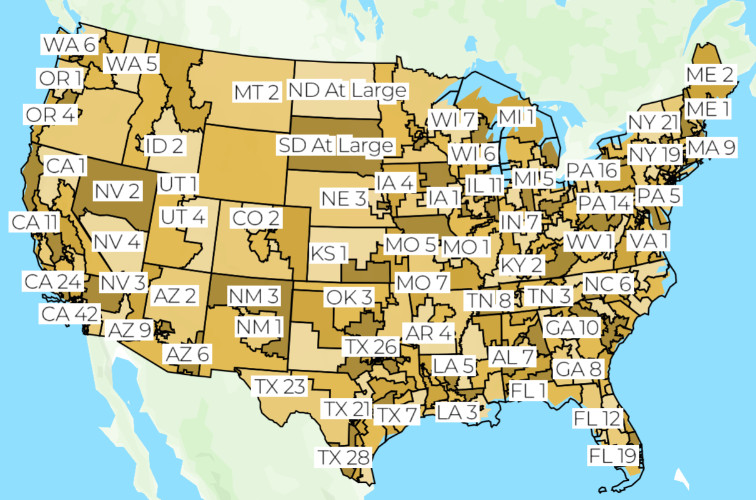
U.S. House congressional districts
Senate elections
The Senate has more continuity than the House.
- There are 100 senators total, with 2 per state.
- Senators serve six-year terms.
- Terms are staggered, so about one-third of the Senate is up every two years.
- Senators are elected statewide.
- The Seventeenth Amendment created direct election of senators. Before that, state legislatures chose them.
Terms that show up together
- Incumbent means the current officeholder running again.
- Challenger means someone running against the incumbent.
- Open seat means no incumbent is running.
Primaries and Caucuses
Before voters choose the officeholder, parties choose who represents them. That nomination stage can shape the whole race.
Primaries
A primary is a state-run election to choose a party nominee.
- A House primary happens within the district.
- A Senate primary happens statewide.
Open primary
An open primary lets voters participate without registering with that party in advance.
- This can include independents and sometimes crossover voters.
- Candidates may need broader appeal, not just support from the party base.
Closed primary
A closed primary allows only registered party members to vote in that party’s primary.
- This gives loyal party voters more control.
- It can reward candidates who strongly appeal to ideological party members.
Caucuses
A caucus is a party-run meeting, not a regular ballot election.
- People must show up at a specific time and participate directly.
- Turnout is usually lower.
- Participants are often more committed activists than average voters.
- Do not confuse a nominating caucus with a congressional party caucus in Congress.
Safe seats
A safe seat is a district or state where one party is very likely to win the general election. In those places, the real fight may be in the dominant party’s primary.
A great example is Eric Cantor in 2014. He was the Republican House Majority Leader, but he lost his Virginia primary to Dave Brat. That shows incumbents can lose before the general election even happens.
General Elections in Presidential Years and Midterms
The general election chooses among party nominees and any qualifying independents or third-party candidates. Most congressional races are single-member, winner-take-all contests.
Presidential years
When the presidency is on the ballot:
- Turnout is usually higher.
- A popular presidential candidate can create a coattail effect and help same-party congressional candidates.
- Voters can still split tickets and choose different parties for different offices.
Midterms
A midterm election happens halfway through a president’s term.
- Turnout is usually lower than in presidential years.
- Midterms often act like a referendum on the sitting president.
- The president’s party usually loses seats, but this is not automatic.
Important exceptions:
- 1998 under Bill Clinton
- 2002 under George W. Bush
The classic example is 2010, when Republicans gained 63 House seats and 6 Senate seats in Obama’s first midterm. That was a wave election, meaning a large seat shift across many races.
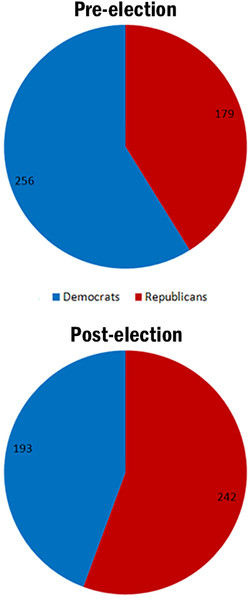
House control before and after the 2010 midterm election
The Incumbency Advantage
Incumbency advantage means current officeholders have built-in benefits when running for reelection. This is especially strong in House races, where reelection rates often rise above 90 percent for incumbents who run again.
Main sources of the advantage:
- Name recognition because voters already know them.
- Casework and constituent service, like helping people deal with federal agencies.
- Franking privilege, which helps them send official communications to constituents.
- Credit claiming for laws, grants, projects, and services.
- Fundraising networks, including PAC support.
- Existing staff, endorsements, voter data, and campaign organization.
- Deterring strong challengers who would rather wait for an open seat.
This advantage gets weaker with scandal, unpopular votes, strong challengers, redistricting, demographic change, wave elections, or primary challenges.
House incumbents usually have a stronger edge than Senate incumbents because House districts are smaller and more local. Senate races are statewide, more visible, and often more competitive.
Why Congressional Elections Matter
Congressional elections are a linkage institution. They connect citizens to government by letting voters choose, keep, or remove representatives.
They also create accountability, since members must face voters regularly. Still, accountability can be limited when incumbents dominate or when seats are safe.
Election outcomes also decide partisan control of Congress, which affects:
- committee leadership
- agenda setting
- oversight
- confirmations
- how easily a president can govern
Key Takeaways
House vs. Senate Election Cycles
All 435 district-based House seats are elected every two years; senators are elected statewide to six-year staggered terms, with about one-third elected every two years
Seventeenth Amendment
The 1913 amendment establishing direct popular election of senators instead of selection by state legislatures
Primary Election
A state-administered election in which voters choose a political party’s nominee for the general election
Open Primary
A primary in which voters need not be registered with a party in advance and may choose one party’s nomination contest in which to vote
Closed Primary
A primary in which only voters registered with a political party may vote in that party’s nomination contest
Caucus
A party-run meeting where eligible members gather at a designated time and place to discuss and select candidates under party rules
Open-Seat Election
An election in which no incumbent is running, usually making the contest more competitive because no candidate has the full incumbency advantage
Safe Seat
A seat where one party has such a durable advantage that its nominee is highly likely to win, often making that party’s primary the decisive contest
General Election
The election in which the broader electorate chooses the officeholder from party nominees and qualifying independent or third-party candidates
Single-Member, Winner-Take-All Constituency
An electoral system in which one candidate wins the constituency’s single seat, usually by receiving more votes than any opponent even without an absolute majority
Presidential-Year Congressional Election
A congressional election held when the presidency is also on the ballot, ordinarily producing higher turnout and possible presidential coattail effects
Midterm Election
A congressional election halfway through a president’s term, with no presidential race, all House seats, and about one-third of Senate seats on the ballot
Coattail Effect
The boost same-party congressional candidates receive when a popular presidential candidate attracts and mobilizes supportive voters
Midterm Penalty
The strong but not absolute tendency for the sitting president’s party to lose congressional seats in a midterm election
Wave Election
A nationally driven election in which one party gains many seats across numerous constituencies, sometimes defeating normally secure incumbents
Incumbency Advantage
The electoral benefits current officeholders possess when seeking reelection, including visibility, constituent service, official communication, fundraising networks, and established organization
Constituent Service and Casework
Official assistance members and their staffs provide constituents dealing with federal agencies, which can build personal support for the incumbent
Franking Privilege
The privilege allowing members of Congress to send certain official mail to constituents without personally paying ordinary postage
Credit Claiming
An incumbent’s effort to gain electoral support by emphasizing legislation, programs, projects, or services that benefit the state or district
Notes
House vs. Senate Election Cycles
All 435 district-based House seats are elected every two years; senators are elected statewide to six-year staggered terms, with about one-third elected every two years
Seventeenth Amendment
The 1913 amendment establishing direct popular election of senators instead of selection by state legislatures
Primary Election
A state-administered election in which voters choose a political party’s nominee for the general election
Open Primary
A primary in which voters need not be registered with a party in advance and may choose one party’s nomination contest in which to vote
Closed Primary
A primary in which only voters registered with a political party may vote in that party’s nomination contest
Caucus
A party-run meeting where eligible members gather at a designated time and place to discuss and select candidates under party rules
Open-Seat Election
An election in which no incumbent is running, usually making the contest more competitive because no candidate has the full incumbency advantage
Safe Seat
A seat where one party has such a durable advantage that its nominee is highly likely to win, often making that party’s primary the decisive contest
General Election
The election in which the broader electorate chooses the officeholder from party nominees and qualifying independent or third-party candidates
Single-Member, Winner-Take-All Constituency
An electoral system in which one candidate wins the constituency’s single seat, usually by receiving more votes than any opponent even without an absolute majority
Presidential-Year Congressional Election
A congressional election held when the presidency is also on the ballot, ordinarily producing higher turnout and possible presidential coattail effects
Midterm Election
A congressional election halfway through a president’s term, with no presidential race, all House seats, and about one-third of Senate seats on the ballot
Coattail Effect
The boost same-party congressional candidates receive when a popular presidential candidate attracts and mobilizes supportive voters
Midterm Penalty
The strong but not absolute tendency for the sitting president’s party to lose congressional seats in a midterm election
Wave Election
A nationally driven election in which one party gains many seats across numerous constituencies, sometimes defeating normally secure incumbents
Incumbency Advantage
The electoral benefits current officeholders possess when seeking reelection, including visibility, constituent service, official communication, fundraising networks, and established organization
Constituent Service and Casework
Official assistance members and their staffs provide constituents dealing with federal agencies, which can build personal support for the incumbent
Franking Privilege
The privilege allowing members of Congress to send certain official mail to constituents without personally paying ordinary postage
Credit Claiming
An incumbent’s effort to gain electoral support by emphasizing legislation, programs, projects, or services that benefit the state or district
