Topic 1.7 Notes – Relationship Between the States and National Government
What Federalism Is
Federalism means the Constitution splits power between the national government and state governments, and both act directly on the people. You pay federal taxes and state taxes. You follow federal law and state law.
That makes the U.S. different from:
- a unitary system, where the central government holds ultimate power
- the Articles of Confederation, where the states held most power and the national government was weak
Federalism is part of limited government. Separation of powers divides power horizontally among branches. Federalism divides power vertically between levels of government.
A simple way to picture this is as overlapping powers. Some belong to the national government, some to the states, and some are shared.
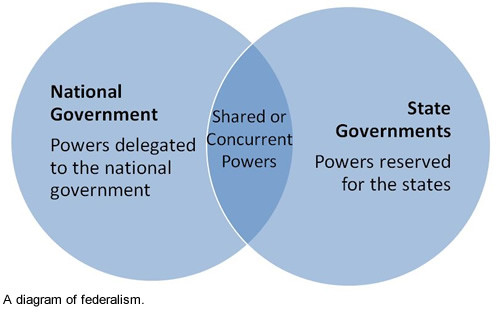
Federalism as divided and shared powers
Federalist No. 39
Madison said the Constitution is partly national and partly federal.
| Federal features | National features | Mixed feature |
|---|---|---|
| Ratification happened through state conventions | House representation is based on population | Electoral College blends state and population ideas |
| Senate gives equal representation to each state | National laws act directly on individuals | |
| National government has limited delegated powers | ||
| States help ratify amendments |
This matters because dividing power helps prevent any one government from becoming too strong, and it gives people multiple access points to influence policy.
National, State, and Shared Powers
The Constitution creates three buckets of power.
Exclusive national powers
These belong only to the national government. They include:
- coin money
- declare war
- raise armies
- conduct foreign policy
- make treaties
- regulate interstate and foreign commerce
- set uniform naturalization rules
These powers need one national rule, not 50 separate ones.
Enumerated powers
Enumerated powers are written in the Constitution, mainly in Article I, Section 8.
Examples include the power to:
- tax
- borrow money
- regulate commerce
- declare war
- create lower federal courts
- establish post offices
Implied powers
Implied powers are not listed word-for-word, but Congress can infer them from its enumerated powers through the Necessary and Proper Clause, also called the Elastic Clause.
A classic example is the national bank. The Constitution never says “create a bank,” but Congress argued a bank helps carry out taxing, borrowing, and spending powers.
Reserved state powers
The Tenth Amendment says powers not given to the national government and not denied to the states are reserved to the states.
State police powers cover health, safety, welfare, and morals. Examples include:
- public education
- marriage and family law
- most criminal law
- election administration
- professional licensing
- land use
- creating local governments
Local governments are creatures of the states, not a separate constitutional level.
Concurrent powers
Concurrent powers are shared by both levels.
Examples:
- tax
- borrow money
- spend
- make and enforce laws
- establish courts
- build roads
Overlap is normal in federalism.
When National and State Power Collide
Because powers overlap, conflict is built in. The Supremacy Clause says valid national law beats conflicting state law.
Colorado and Washington legalized marijuana in 2012 under state law. They removed state penalties and set up regulation. Federal law under the Controlled Substances Act still banned marijuana.
That means something can be legal under state law but illegal under federal law. States cannot cancel valid federal law, but they do control their own police powers and enforcement priorities.
This is the logic you use on test questions. Figure out which level has authority, then explain how overlap changes the result.
Fiscal Federalism and Mandates
Power is not just about laws. It is also about money. Fiscal federalism means the national government influences states through funding.
| Tool | What it does |
|---|---|
| Categorical grants | Money for a narrow purpose, with lots of restrictions |
| Block grants | Money for a broad area, with fewer restrictions |
| Revenue sharing | Money with almost no restrictions; least used |
| Mandates | Requirements imposed on states or localities |
Categorical grants give the national government the most control.
Block grants give states more discretion and were central to Reagan’s devolution revolution in the 1980s.
Revenue sharing gives states and localities the most freedom.
Mandates require action. An unfunded mandate forces states to do something without giving enough money to cover the cost.
The National Minimum Drinking Age Act of 1984 is a favorite AP example. Congress did not directly order every state to set the drinking age at 21. It threatened to withhold highway funds from states that refused. That is conditional spending, not a direct mandate.
How Federalism Affects Society
Federalism shapes real life because the allocation of power affects who makes policy, how uniform it is, and who gets blamed or credited.
- States can act as laboratories of democracy. Different states try different policies.
- That variation can also create unequal outcomes depending on where you live.
- Citizens and interest groups get multiple access points. They can push policy at the state level, national level, or both.
- Federalism creates a constant tradeoff between national uniformity and state responsiveness to local needs.
Shared problems show both cooperation and conflict. During Hurricanes Katrina and Sandy, local, state, and national governments all had roles. The benefit was pooled resources. The downside was confusion, delay, and blame-shifting.
The National Industrial Recovery Act of 1933 showed national expansion during the Great Depression. It reflected how a crisis can push more power toward the national government.
Key Takeaways
Federalism
Constitutional system in which the national and state governments divide and share governing authority, with each acting directly on the people
Federalist No. 39
Madison’s argument that the Constitution is partly national and partly federal, combining representation of the people with state-based features and divided authority
Delegated Powers
Powers granted by the Constitution to the national government, including enumerated and implied powers
Exclusive Powers
Powers that only one level of government may exercise, such as the national powers to coin money, declare war, and make treaties
Enumerated Powers
Powers expressly written in the Constitution, including many congressional powers listed in Article I, Section 8
Implied Powers
Powers not expressly listed but reasonably inferred as means of carrying out constitutionally delegated powers
Necessary and Proper Clause / Elastic Clause
Clause authorizing Congress to make laws needed to carry out its enumerated powers and other powers vested in the national government
Reserved Powers
Powers belonging to the states or the people because they are neither delegated to the national government nor prohibited to the states
Tenth Amendment
Reserves to the states or the people powers the Constitution neither delegates to the United States nor prohibits to the states
State Police Powers
States’ broad authority to legislate for their residents’ health, safety, welfare, and morals
Concurrent Powers
Powers exercised by both national and state governments, such as taxing, borrowing, making laws, establishing courts, and building roads
Supremacy Clause
Makes the Constitution, valid federal laws, and treaties the supreme law of the land when they conflict with state law
Dual Sovereignty
The principle that national and state governments possess separate legal authority, so each may maintain and enforce its own laws
Fiscal Federalism
National influence over state and local policy through the collection and distribution of government funds
Categorical Grants
Federal funds for narrowly defined purposes that carry extensive restrictions and give the national government substantial control
Block Grants
Federal funds for broad policy areas that have fewer restrictions and give state and local governments greater spending flexibility
Revenue Sharing
Federal funding provided to state and local governments with almost no restrictions, giving recipients the greatest discretion; the least-used funding form
Conditional Grants / Conditional Spending
Offers of federal money that require recipient states to follow specified national conditions while formally allowing them to reject the funds
Mandate
A national requirement directing state or local governments to act or comply with a national standard
Unfunded Mandate
A national requirement imposed on state or local governments without enough federal funding to cover compliance costs
National Minimum Drinking Age Act of 1984
Law withholding part of federal highway funding from states without a minimum drinking age of 21, leading every state to adopt that age
National Industrial Recovery Act of 1933
New Deal law that expanded national economic regulation through industry codes before the Supreme Court invalidated its central provisions in 1935
Devolution
Transfer of policy authority or administrative responsibility from the national government to state or local governments
Devolution Revolution
The 1980s movement, especially under Reagan, to return discretion to states, often by replacing categorical programs with block grants
States as Policy Laboratories
The federalism-based ability of states to test different policies that other states or the national government may later adopt
Notes
Federalism
Constitutional system in which the national and state governments divide and share governing authority, with each acting directly on the people
Federalist No. 39
Madison’s argument that the Constitution is partly national and partly federal, combining representation of the people with state-based features and divided authority
Delegated Powers
Powers granted by the Constitution to the national government, including enumerated and implied powers
Exclusive Powers
Powers that only one level of government may exercise, such as the national powers to coin money, declare war, and make treaties
Enumerated Powers
Powers expressly written in the Constitution, including many congressional powers listed in Article I, Section 8
Implied Powers
Powers not expressly listed but reasonably inferred as means of carrying out constitutionally delegated powers
Necessary and Proper Clause / Elastic Clause
Clause authorizing Congress to make laws needed to carry out its enumerated powers and other powers vested in the national government
Reserved Powers
Powers belonging to the states or the people because they are neither delegated to the national government nor prohibited to the states
Tenth Amendment
Reserves to the states or the people powers the Constitution neither delegates to the United States nor prohibits to the states
State Police Powers
States’ broad authority to legislate for their residents’ health, safety, welfare, and morals
Concurrent Powers
Powers exercised by both national and state governments, such as taxing, borrowing, making laws, establishing courts, and building roads
Supremacy Clause
Makes the Constitution, valid federal laws, and treaties the supreme law of the land when they conflict with state law
Dual Sovereignty
The principle that national and state governments possess separate legal authority, so each may maintain and enforce its own laws
Fiscal Federalism
National influence over state and local policy through the collection and distribution of government funds
Categorical Grants
Federal funds for narrowly defined purposes that carry extensive restrictions and give the national government substantial control
Block Grants
Federal funds for broad policy areas that have fewer restrictions and give state and local governments greater spending flexibility
Revenue Sharing
Federal funding provided to state and local governments with almost no restrictions, giving recipients the greatest discretion; the least-used funding form
Conditional Grants / Conditional Spending
Offers of federal money that require recipient states to follow specified national conditions while formally allowing them to reject the funds
Mandate
A national requirement directing state or local governments to act or comply with a national standard
Unfunded Mandate
A national requirement imposed on state or local governments without enough federal funding to cover compliance costs
National Minimum Drinking Age Act of 1984
Law withholding part of federal highway funding from states without a minimum drinking age of 21, leading every state to adopt that age
National Industrial Recovery Act of 1933
New Deal law that expanded national economic regulation through industry codes before the Supreme Court invalidated its central provisions in 1935
Devolution
Transfer of policy authority or administrative responsibility from the national government to state or local governments
Devolution Revolution
The 1980s movement, especially under Reagan, to return discretion to states, often by replacing categorical programs with block grants
States as Policy Laboratories
The federalism-based ability of states to test different policies that other states or the national government may later adopt
