Topic 3.2 Notes – First Amendment: Freedom of Religion
The Religion Clauses and Religious Liberty
The First Amendment says Congress can make no law “respecting an establishment of religion, or prohibiting the free exercise thereof.” Those are the two religion clauses.
- The establishment clause limits government promotion, sponsorship, endorsement, or favoritism toward religion.
- The free exercise clause limits government interference with religious belief and religious practice.
This creates a constant tension. Government has to avoid controlling religion, but it also cannot treat religion with hostility. Religious liberty protects believers, minority faiths, and nonbelievers.
A detail teachers love to test is who these clauses apply to.
- Through selective incorporation under the Fourteenth Amendment, these protections apply to state and local governments, not just Congress.
- These clauses restrict government action, not purely private conduct. A public school is bound by the First Amendment. A private person usually is not.
A quick way to lock it in:
- Establishment clause = government is too involved with religion
- Free exercise clause = government burdens or targets religion
Establishment Clause and School Prayer
Public schools matter here because they are government institutions and students are under official authority.
- Government may not create an official religion
- Government may not favor one religion over another
- Government may not write official prayers
- Government may not coerce participation in religious exercises
- Government may not use public institutions to promote religion
The key school distinction is easy to miss:
- Private prayer in public school is protected
- School-sponsored prayer is unconstitutional
Engel v. Vitale
New York Regents wrote a short, nondenominational prayer for public schools. Students could opt out, but the prayer was still part of the school program.
The Court held that this violated the establishment clause. Justice Hugo Black wrote the majority opinion. The problem was state sponsorship of prayer. “Voluntary” and “nondenominational” did not save it.
This case often gets tested with a trap. Students think Engel was about forced participation. It was not. The prayer was unconstitutional because the government wrote and promoted it.
U.S. Supreme Court
Santa Fe Independent School District v. Doe
This case helps you compare facts. Student-led prayer before football games still violated the establishment clause because it happened through school policy, school equipment, and a school-sponsored event. Student delivery did not make it private speech.
Lemon v. Kurtzman
The Lemon test asked whether a law had:
- a secular purpose
- a primary effect that neither advanced nor inhibited religion
- no excessive government entanglement with religion
AP Gov cares less about memorizing every doctrinal shift and more about the lasting rule. Government cannot sponsor, endorse, coerce, or improperly favor religion.
Free Exercise Clause and Religious Exemptions
The free exercise clause protects belief most strongly. Government cannot punish people just for what they believe. Conduct gets protection too, but not total immunity from laws.
Here’s the pattern the Court uses:
- Laws targeting religion are highly suspect
- Discrimination among religions is highly suspect
- Neutral, generally applicable laws are usually upheld even if they burden religion incidentally
- Sometimes a severe burden on sincere religious exercise outweighs the government’s interest
Reynolds v. United States
This case drew the classic belief versus conduct line. Religious belief was protected, but polygamy could still be banned by general criminal law.
Wisconsin v. Yoder
Amish families refused to send children to school past eighth grade because high school conflicted with Amish religious life. The Court said Wisconsin could not force two more years of formal schooling. Chief Justice Warren Burger wrote the majority.
Why Yoder was narrow:
- the beliefs were sincere and deeply rooted
- the burden on religious life was serious
- the Amish accepted education through eighth grade
- vocational and community preparation existed
Limits on free exercise claims
In Employment Division v. Smith, a neutral drug law could be enforced even though it burdened peyote use in a Native American ceremony.
In Church of Lukumi Babalu Aye v. City of Hialeah, laws targeting Santería animal sacrifice were unconstitutional because they singled out religion.
How to Analyze Religion Clause Questions
Start by asking whether this is government action.
If it is not, the First Amendment usually does not apply. If it is, use this quick split to decide whether the question is mainly about the establishment clause or the free exercise clause.
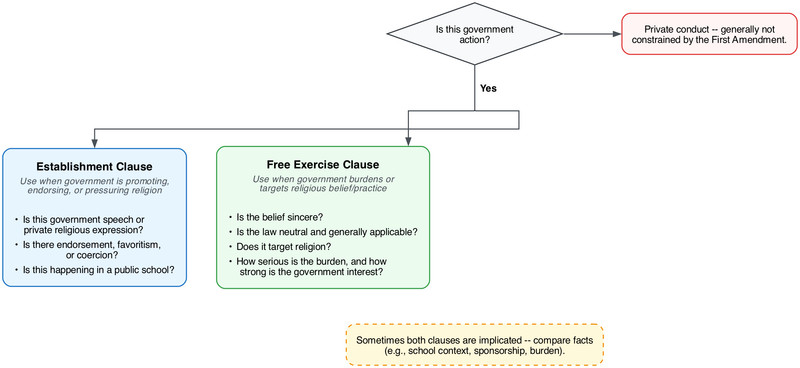
Religion Clause analysis flowchart
If government is promoting, organizing, endorsing, or pressuring religion, think establishment clause. If government is burdening religious belief or practice, think free exercise clause.
Ask on establishment questions:
- Is this government speech or private religious expression?
- Is there endorsement, favoritism, or coercion?
- Is this happening in a public school?
Ask on free exercise questions:
- Is the belief sincere?
- Is the law neutral and generally applicable?
- Does it target religion?
- How serious is the burden, and how strong is the government interest?
Key Takeaways
Establishment Clause
First Amendment bar on government establishing an official religion or sponsoring, directing, favoring, or coercing participation in religious activity
Free Exercise Clause
First Amendment protection against government interference with religious belief and unjustified burdens or discrimination against religious practice
Separation of Church and State
Common description of establishment-clause principles, associated with Jefferson’s “wall of separation” but not stated in the Constitution
Religious Neutrality
Government may not sponsor or discriminate for or against religion, but may include religious individuals and organizations in generally available programs on neutral terms
Lemon Test
Former test requiring a secular purpose, an effect that neither advances nor inhibits religion, and no excessive government entanglement with religion
Engel v. Vitale (1962)
Held that public schools may not sponsor an official prayer, even if it is nondenominational and participation is formally voluntary
Belief–Conduct Distinction
Religious belief receives extremely strong protection, while religiously motivated conduct may be regulated and does not always receive an exemption
Neutral and Generally Applicable Law
A law that neither targets religion nor selectively prohibits religious conduct while permitting comparable secular conduct; incidental religious burdens are ordinarily allowed
Religious Accommodation
A government exemption, adjustment, or neutral inclusion that eases a burden on religious exercise without necessarily establishing religion
Wisconsin v. Yoder (1972)
Held that Wisconsin could not require Amish children to attend school beyond eighth grade because the severe religious burden outweighed the state’s insufficiently justified interest
Notes
Establishment Clause
First Amendment bar on government establishing an official religion or sponsoring, directing, favoring, or coercing participation in religious activity
Free Exercise Clause
First Amendment protection against government interference with religious belief and unjustified burdens or discrimination against religious practice
Separation of Church and State
Common description of establishment-clause principles, associated with Jefferson’s “wall of separation” but not stated in the Constitution
Religious Neutrality
Government may not sponsor or discriminate for or against religion, but may include religious individuals and organizations in generally available programs on neutral terms
Lemon Test
Former test requiring a secular purpose, an effect that neither advances nor inhibits religion, and no excessive government entanglement with religion
Engel v. Vitale (1962)
Held that public schools may not sponsor an official prayer, even if it is nondenominational and participation is formally voluntary
Belief–Conduct Distinction
Religious belief receives extremely strong protection, while religiously motivated conduct may be regulated and does not always receive an exemption
Neutral and Generally Applicable Law
A law that neither targets religion nor selectively prohibits religious conduct while permitting comparable secular conduct; incidental religious burdens are ordinarily allowed
Religious Accommodation
A government exemption, adjustment, or neutral inclusion that eases a burden on religious exercise without necessarily establishing religion
Wisconsin v. Yoder (1972)
Held that Wisconsin could not require Amish children to attend school beyond eighth grade because the severe religious burden outweighed the state’s insufficiently justified interest
