Topic 1.6 Notes – Principles of American Government
Separation of Powers and Checks and Balances
The Constitution spreads national power across three branches so no single institution controls everything.
- Separation of powers means each branch has its own main job.
- Article I gives legislative power to Congress.
- Article II gives executive power to the president.
- Article III gives judicial power to the courts.
- Checks and balances means those branches are not sealed off from each other. Each one gets tools to block, limit, or influence the others.
This diagram gives you the big picture before you look at the specific powers branch by branch.
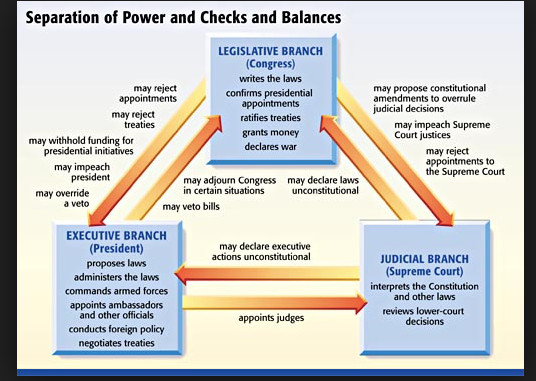
Separation of powers and checks and balances
Montesquieu shaped this idea. He argued that liberty is in danger when legislative, executive, and judicial power are all in the same hands. Madison agreed, but he also knew government still had to function. His goal was a government strong enough to govern, but built to control itself.
The Main Checks Each Branch Has
The branches are separate, but governing requires constant interaction.
Executive checks on Congress
- Veto lets the president reject a bill passed by Congress.
- Congress can override only with a two-thirds vote in both houses, so the veto is a serious obstacle.
- The president can recommend legislation and use public attention to pressure Congress.
- The vice president can break a tied Senate vote, which gives the executive branch a small but real role in lawmaking.
Congressional checks on the president
- Congress can override a veto with two-thirds in the House and Senate.
- The Senate confirms appointments such as Cabinet officials, ambassadors, and federal judges.
- The Senate ratifies treaties by a two-thirds vote.
- Power of the purse means Congress funds, limits, or defunds executive programs.
- Oversight includes hearings, subpoenas, investigations, and questioning officials.
- War powers are split. The president is commander in chief, but Congress declares war and funds the military.
- Impeachment starts in the House; trial and possible removal happen in the Senate.
Judicial checks on Congress and the president
- Judicial review allows courts to strike down laws or executive actions that violate the Constitution.
- Marbury v. Madison established this power.
- Courts only act through actual cases, not advisory opinions. That’s a common test point.
Checks on the judiciary
- The president nominates judges.
- The Senate confirms or rejects nominees.
- Congress creates lower federal courts and can shape their jurisdiction.
- Congress can impeach and remove judges.
- Constitutional amendments can overturn Supreme Court constitutional interpretations.
- Congress can rewrite a statute after the Court interprets it, as long as the new law is constitutional.
- Presidential pardons can reduce the effect of federal criminal convictions, except in impeachment cases.
Federalist No. 51
Federalist 51 explains why this system exists.
- Madison says, “If men were angels,” government would not be necessary. Since people are not angels, government is needed.
- But government officials are also not angels, so government needs internal restraints too.
- His famous line, “Ambition must be made to counteract ambition,” means each branch will defend its own power against the others.
- Elections are the primary control, but the Constitution adds auxiliary precautions like separated branches and checks.
- Madison worried about majority tyranny. A temporary majority might control one institution, but the system makes it hard to dominate all of government at once.
- He expected the legislative branch to be strongest, so bicameralism and the veto help check Congress.
Effects on Policymaking and Multiple Access Points
Because power is shared, policymaking moves through lots of decision points. Congress writes laws, the president signs or vetoes, agencies implement, and courts may review.
That creates a few consistent effects:
- Bargaining and compromise are normal because no branch can usually act alone.
- Gridlock happens when institutions disagree, especially in divided government.
- Policy stability follows from that same difficulty. Hard to pass, hard to undo.
- Multiple access points let groups influence policy in many places:
- lobbying Congress
- congressional hearings
- appropriations and bill language
- presidential elections and executive agencies
- administrative rulemaking
- lawsuits and judicial review
- public pressure campaigns across branches
Two standard examples show this clearly:
- The Religious Freedom Restoration Act of 1993 (RFRA) was passed after Employment Division v. Smith, then City of Boerne v. Flores limited Congress’s action.
- Obama’s immigration actions like DACA showed executive initiative during congressional gridlock, followed by judicial and congressional pushback.
Impeachment and Removal
This is one of the most tested distinctions in the unit.
- Impeachment means the House formally charges an official.
- Removal happens only if the Senate convicts.
The Constitution allows impeachment for “Treason, Bribery, or other high Crimes and Misdemeanors.” That includes serious abuse of power or betrayal of public trust, not just ordinary crimes.
- The House votes on articles of impeachment by simple majority.
- The Senate holds a trial. Conviction and removal require a two-thirds vote.
- When the president is tried, the chief justice presides.
- The Senate may also disqualify the person from future office.
Key examples:
- Andrew Johnson was impeached by the House but not removed.
- Richard Nixon resigned after the House Judiciary Committee approved articles. The full House never impeached him.
- Bill Clinton was impeached by the House and acquitted by the Senate.
Key Takeaways
Separation of Powers
Division of legislative, executive, and judicial authority among Congress, the president, and the federal courts
Checks and Balances
Constitutional powers that allow each branch to restrain, modify, or review actions of the other branches
Advice and Consent
The Senate may approve or reject presidential appointments and treaties; treaties require approval by two-thirds of senators present
Power of the Purse (Appropriations Power)
Congress’s authority to fund, limit, condition, or refuse funding for federal programs and executive actions
Congressional Oversight
Congressional monitoring and investigation of the executive branch through hearings, records requests, questioning, and subpoenas
War Powers
Military authority divided between the president as commander in chief and Congress, which declares war, funds the military, and regulates the armed forces
Judicial Review
The judiciary’s authority to invalidate legislative or executive actions that violate the Constitution, established in Marbury v. Madison
Presidential Pardon Power
The president may grant reprieves and pardons for federal offenses, except in cases of impeachment
Federalist No. 51
Madison’s argument that separation of powers and checks and balances make “ambition counteract ambition” and provide safeguards beyond elections
Multiple Access Points
The many avenues created by divided authority through which stakeholders can influence policy, including Congress, the executive branch, agencies, and courts
Stakeholder
A person, group, government, business, or organization with an interest in a policy outcome
Gridlock
A condition in which political institutions cannot agree on policy, causing government action to stall
Divided Government
Control of the presidency and at least one house of Congress by different political parties
High Crimes and Misdemeanors
Serious abuses of official power, violations of public trust, or grave misconduct that may justify impeachment, even without an ordinary criminal conviction
Presidential Veto
The president’s rejection of a bill passed by Congress, returning it with objections
Veto Override
Congress enacts a vetoed bill without presidential approval by a two-thirds vote in each chamber
Impeachment
The House’s formal accusation of a federal official, approved by a simple majority; it does not itself remove the official
Removal
Loss of office following conviction by two-thirds of senators present at a Senate impeachment trial
Notes
Separation of Powers
Division of legislative, executive, and judicial authority among Congress, the president, and the federal courts
Checks and Balances
Constitutional powers that allow each branch to restrain, modify, or review actions of the other branches
Advice and Consent
The Senate may approve or reject presidential appointments and treaties; treaties require approval by two-thirds of senators present
Power of the Purse (Appropriations Power)
Congress’s authority to fund, limit, condition, or refuse funding for federal programs and executive actions
Congressional Oversight
Congressional monitoring and investigation of the executive branch through hearings, records requests, questioning, and subpoenas
War Powers
Military authority divided between the president as commander in chief and Congress, which declares war, funds the military, and regulates the armed forces
Judicial Review
The judiciary’s authority to invalidate legislative or executive actions that violate the Constitution, established in Marbury v. Madison
Presidential Pardon Power
The president may grant reprieves and pardons for federal offenses, except in cases of impeachment
Federalist No. 51
Madison’s argument that separation of powers and checks and balances make “ambition counteract ambition” and provide safeguards beyond elections
Multiple Access Points
The many avenues created by divided authority through which stakeholders can influence policy, including Congress, the executive branch, agencies, and courts
Stakeholder
A person, group, government, business, or organization with an interest in a policy outcome
Gridlock
A condition in which political institutions cannot agree on policy, causing government action to stall
Divided Government
Control of the presidency and at least one house of Congress by different political parties
High Crimes and Misdemeanors
Serious abuses of official power, violations of public trust, or grave misconduct that may justify impeachment, even without an ordinary criminal conviction
Presidential Veto
The president’s rejection of a bill passed by Congress, returning it with objections
Veto Override
Congress enacts a vetoed bill without presidential approval by a two-thirds vote in each chamber
Impeachment
The House’s formal accusation of a federal official, approved by a simple majority; it does not itself remove the official
Removal
Loss of office following conviction by two-thirds of senators present at a Senate impeachment trial
