Topic 3.12 Notes – Balancing Minority and Majority Rights
Majority Rule, Civil Rights, and Equal Protection
In the U.S., majorities usually win elections and make policy. But a constitutional democracy puts limits on that power. A state cannot deny people equal treatment just because most voters support it.
- Civil rights protect people from discrimination by government. In this topic, race is the main focus.
- The Equal Protection Clause of the Fourteenth Amendment says states cannot deny any person equal protection of the laws.
- That word person matters. Equal protection belongs to individuals, so both minority-group members and majority-group members can bring claims.
- The state action requirement matters too. The Fourteenth Amendment applies to government action, like a law, school policy, or district map. Private prejudice by itself is not a Fourteenth Amendment violation.
When government classifies people by race, the Court uses strict scrutiny, the toughest test.
- Compelling governmental interest means the government needs an extremely strong reason.
- Narrowly tailored means the policy must fit that goal closely and not go farther than necessary.
This whole topic follows one pattern. Government has sometimes restricted minority rights and sometimes protected them.
From Slavery to Segregation
The story starts with slavery’s end, then moves into the rise of legal segregation.
Emancipation Proclamation
- In 1863, Lincoln issued the Emancipation Proclamation as a wartime action using his power as commander in chief.
- It freed enslaved people only in the states rebelling against the Union.
- It did not free enslaved people in border states, and it only worked where the Union could enforce it.
- Its biggest significance was political and moral. Emancipation became an official Union goal.
Thirteenth Amendment
- Ratified in 1865, the Thirteenth Amendment abolished slavery nationwide.
- This was stronger than the proclamation because an amendment is permanent constitutional law, not a temporary wartime order.
- It marked a major shift toward civil rights for formerly enslaved people.
Jim Crow and Plessy v. Ferguson
After Reconstruction, Southern governments built Jim Crow systems of de jure segregation, which means segregation required by law.
- Common targets included schools, transportation, restaurants, and hotels.
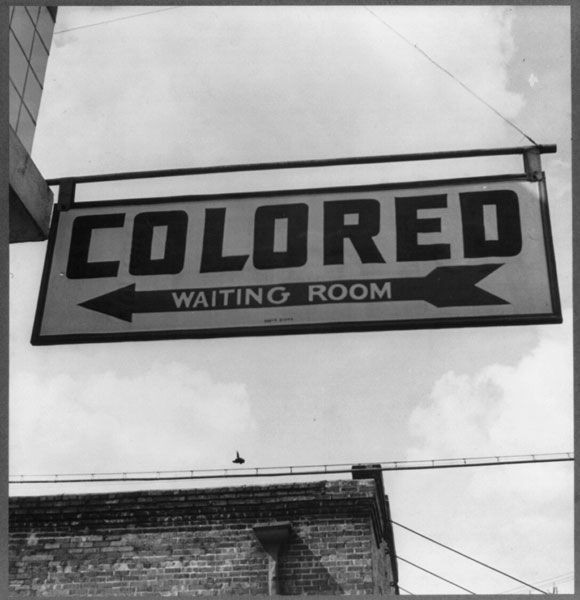
Jim Crow segregation sign
In Plessy v. Ferguson (1896), the Court upheld Louisiana’s Separate Car Act.
- The law required separate railroad cars by race.
- The Court said segregation was allowed under “separate but equal.”
- The majority treated legal separation as constitutional if the facilities were supposedly equal.
- The effect was huge. It let governments restrict African American civil rights for decades.
- Justice Harlan’s dissent argued that the Constitution is “color-blind.”
Brown v. Board of Education
Brown is the required case that shows the Court protecting minority rights.
The photo below shows Linda Brown outside Sumner School in Topeka, the setting tied to the case.
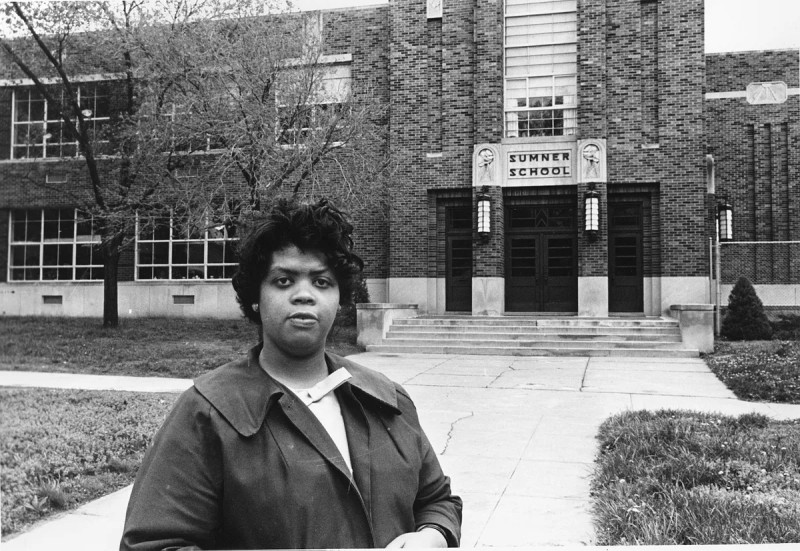
Linda Brown at Sumner School
- Facts: Linda Brown was denied access to a white public school in Topeka, Kansas. Brown combined school segregation cases from several states.
- Question: Does state-mandated school segregation violate the Equal Protection Clause?
- Holding: Yes. In 1954, a unanimous Court led by Chief Justice Earl Warren said that “separate educational facilities are inherently unequal.”
- Reasoning:
- Public education is central to citizenship and opportunity.
- Segregation itself creates inequality, even if buildings or books seem similar.
- Separation causes intangible harm by branding Black children as inferior.
- Significance:
- Brown overturned Plessy’s logic in public education.
- It struck down de jure school segregation.
- Brown II called for desegregation with “all deliberate speed,” which shows the Court could declare a right but still depended on other institutions to enforce it.
Plessy and Brown Compared
These cases are often paired because they ask the same equal protection question and answer it in opposite ways.
| Case | Facts | Holding | Reasoning |
|---|---|---|---|
| Plessy | Segregated railroad cars | Segregation allowed under “separate but equal” | Focused on formal legal equality |
| Brown | Segregated public schools | Segregated schools are inherently unequal | Focused on real effects, stigma, and unequal opportunity |
The exam trap here is simple. Do not just summarize both cases. Explain how the Court’s idea of equality changed.
Majority-Minority Districts and Shaw v. Reno
A majority-minority district is a district where a racial or ethnic minority makes up a majority of the population or electorate. These districts can help minority voters elect candidates of choice.
Race can be considered in redistricting, but it cannot be the main factor without strong constitutional justification.
Shaw v. Reno
North Carolina’s 12th Congressional District became a famous example because of its unusually long, narrow shape.
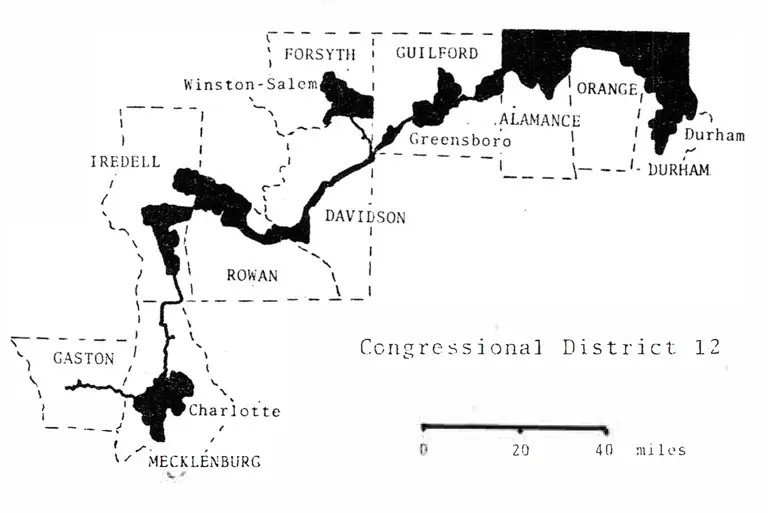
North Carolina’s 12th Congressional District
- After the 1990 census, North Carolina drew a very irregular majority-Black district.
- White voters challenged it as racial gerrymandering.
- The Court held in 1993 that they had a valid equal protection claim.
- If race is the predominant factor in drawing a district, strict scrutiny applies.
- The Court said the district’s strange shape suggested voters were being sorted mainly by race.
- The Court also worried that this reinforces stereotypes and changes representation into race-based representation.
Significance
- Majority-minority districts are not automatically unconstitutional.
- States may try to follow the Voting Rights Act.
- But if race dominates district design, the map must be narrowly tailored to serve a compelling interest.
Key Takeaways
Emancipation Proclamation
Lincoln’s 1863 wartime order freeing enslaved people in areas still rebelling against the United States; it made emancipation a Union war aim but did not abolish slavery nationwide
Thirteenth Amendment
The 1865 amendment that permanently abolished slavery and involuntary servitude nationwide, except as punishment for a crime, and authorized congressional enforcement
Fourteenth Amendment
The 1868 amendment establishing citizenship, due process, and equal protection guarantees against state action
Equal Protection Clause
The Fourteenth Amendment guarantee that no state may deny any person within its jurisdiction the equal protection of the laws
State Action
Government involvement required for an Equal Protection Clause claim; private prejudice alone does not violate the Fourteenth Amendment
Strict Scrutiny
The most demanding judicial review, requiring a racial classification to serve a compelling governmental interest and be narrowly tailored to achieve it
Jim Crow Laws
State and local laws that imposed racial segregation in schools, transportation, businesses, and other areas of public life after Reconstruction
De Jure Segregation vs. De Facto Segregation
De jure segregation is required or enforced by law; de facto segregation results from residential, economic, or private patterns without an identified government requirement
Plessy v. Ferguson (1896)
The Supreme Court upheld state-required racial segregation under “separate but equal,” permitting Louisiana to mandate separate railroad accommodations by race
Separate but Equal Doctrine
The doctrine that government-mandated racial separation could satisfy equal protection if purportedly equal facilities were provided
Brown v. Board of Education (1954)
The unanimous Supreme Court decision holding that state-mandated public-school segregation violates the Equal Protection Clause because separate educational facilities are inherently unequal
Majority-Minority District
An electoral district in which a racial or ethnic minority makes up a majority of the relevant population or electorate, potentially enabling it to elect a preferred candidate
Racial Gerrymandering
Drawing electoral districts predominantly on the basis of race; such districting is subject to strict scrutiny under the Equal Protection Clause
Shaw v. Reno (1993)
The Supreme Court held that voters stated an equal protection claim against an extremely irregular district allegedly drawn predominantly by race, making such districting subject to strict scrutiny
Notes
Emancipation Proclamation
Lincoln’s 1863 wartime order freeing enslaved people in areas still rebelling against the United States; it made emancipation a Union war aim but did not abolish slavery nationwide
Thirteenth Amendment
The 1865 amendment that permanently abolished slavery and involuntary servitude nationwide, except as punishment for a crime, and authorized congressional enforcement
Fourteenth Amendment
The 1868 amendment establishing citizenship, due process, and equal protection guarantees against state action
Equal Protection Clause
The Fourteenth Amendment guarantee that no state may deny any person within its jurisdiction the equal protection of the laws
State Action
Government involvement required for an Equal Protection Clause claim; private prejudice alone does not violate the Fourteenth Amendment
Strict Scrutiny
The most demanding judicial review, requiring a racial classification to serve a compelling governmental interest and be narrowly tailored to achieve it
Jim Crow Laws
State and local laws that imposed racial segregation in schools, transportation, businesses, and other areas of public life after Reconstruction
De Jure Segregation vs. De Facto Segregation
De jure segregation is required or enforced by law; de facto segregation results from residential, economic, or private patterns without an identified government requirement
Plessy v. Ferguson (1896)
The Supreme Court upheld state-required racial segregation under “separate but equal,” permitting Louisiana to mandate separate railroad accommodations by race
Separate but Equal Doctrine
The doctrine that government-mandated racial separation could satisfy equal protection if purportedly equal facilities were provided
Brown v. Board of Education (1954)
The unanimous Supreme Court decision holding that state-mandated public-school segregation violates the Equal Protection Clause because separate educational facilities are inherently unequal
Majority-Minority District
An electoral district in which a racial or ethnic minority makes up a majority of the relevant population or electorate, potentially enabling it to elect a preferred candidate
Racial Gerrymandering
Drawing electoral districts predominantly on the basis of race; such districting is subject to strict scrutiny under the Equal Protection Clause
Shaw v. Reno (1993)
The Supreme Court held that voters stated an equal protection claim against an extremely irregular district allegedly drawn predominantly by race, making such districting subject to strict scrutiny
