Topic 3.8 Notes – Amendments: Due Process and the Rights of the Accused
What Procedural Due Process Is
Procedural due process stops government from acting arbitrarily. The government can arrest, prosecute, imprison, or seize property, but it has to use fair legal procedures when it does.
- The core idea is fair procedure:
- notice of what the government is doing
- a real chance to respond or be heard
- a decision made under established law, not an official’s personal will
- This is about method, not a rule that government can never act.
The Constitution splits this by level of government:
- The Fifth Amendment due process clause limits the national government.
- The Fourteenth Amendment due process clause limits state governments.
That matters because most criminal cases happen in state courts. Through selective incorporation, most criminal-procedure protections in the Bill of Rights apply to the states through the Fourteenth Amendment.
A common confusion shows up here:
- Procedural due process asks whether the government used fair steps.
- Substantive due process asks whether government may restrict a liberty at all.
The course keeps coming back to one tension here. Rights are powerful, but they are not absolute. Courts often weigh liberty against public order and safety.
The Main Rights of the Accused
These rights are spread across the Fourth, Fifth, and Sixth Amendments because different parts of the criminal process create different risks.
Fourth Amendment
The Fourth Amendment regulates how government gets evidence.
- It protects against unreasonable searches and seizures.
- A warrant needs:
- probable cause
- oath or affirmation
- particularity about where police may search and what or whom they may seize
- Some warrantless searches can still be valid under recognized exceptions such as:
- consent
- exigent circumstances
- search incident to lawful arrest
Fifth Amendment
The Fifth Amendment matters here because it protects fair procedure and guards against forced confessions.
- due process of law
- protection against compelled self-incrimination
Double jeopardy and the grand jury clause exist too, but this topic mostly cares about due process and self-incrimination.
Sixth Amendment
The Sixth Amendment protects fairness once formal criminal charges begin.
- right to counsel
- speedy and public trial
- impartial jury
- notice of the accusation
- confrontation of witnesses
- compulsory process for favorable witnesses
It helps to picture these protections along a timeline from investigation through trial.
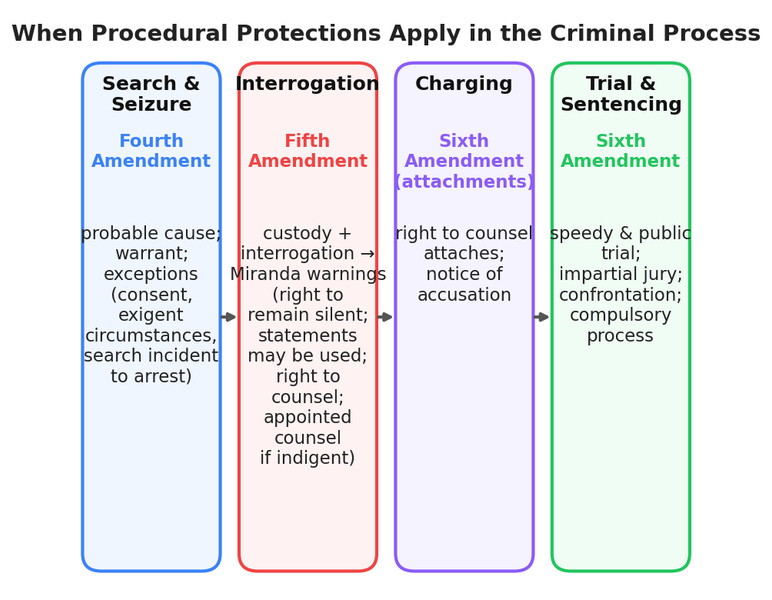
Criminal procedure timeline
Searches, Interrogation, and Trial Protections
Criminal procedure makes more sense when you see it as a sequence.
Searches and seizures
A search looks into a protected privacy interest. A seizure takes control of a person or property. An arrest is a seizure of a person.
Probable cause is the key standard for warrants and arrests.
Riley v. California
That distinction matters in cases involving smartphones and other digital devices.
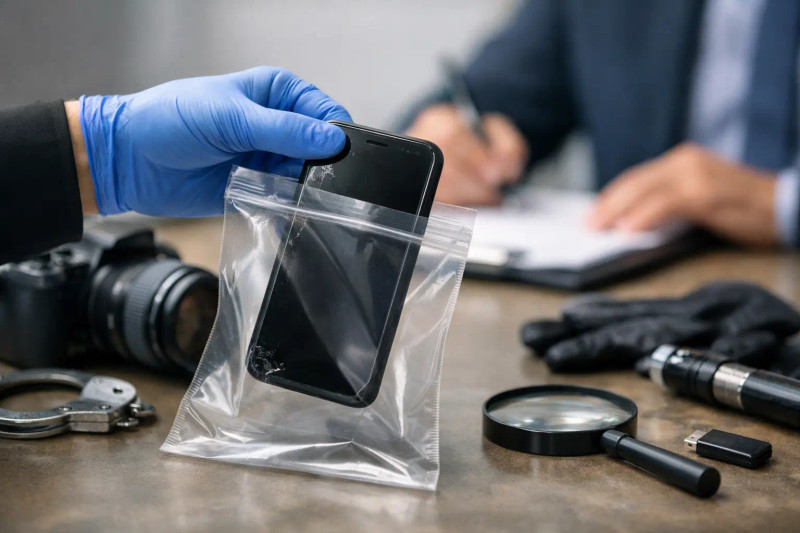
Cell phone seized as evidence
In Riley v. California (2014), the Court said police usually need a warrant to search digital data on a cell phone seized during an arrest.
- Police may seize the phone.
- Police usually may not search its contents without a warrant.
- The reason matters. Phones hold huge amounts of private information, so searching one is far more revealing than checking a wallet.
Custodial interrogation and Miranda
In Miranda v. Arizona (1966), police must give warnings before custodial interrogation.
That means both must be present:
- custody
- interrogation
Required warnings include:
- right to remain silent
- statements can be used against the suspect
- right to an attorney
- appointed attorney if the suspect cannot afford one
A waiver must be knowing, voluntary, and intelligent.
Trial rights and counsel
In Gideon v. Wainwright (1963), the Court held that states must provide an attorney to indigent defendants in felony cases.
- The right to counsel comes from the Sixth Amendment.
- It applies to states through the Fourteenth Amendment.
- Justice Hugo Black wrote that counsel is fundamental to a fair trial.
- Gideon later got a new trial and was acquitted.
- The case overruled Betts v. Brady.
Limits on Government and the Key Exceptions
Rights have force because courts enforce them.
- The exclusionary rule means illegally obtained evidence generally cannot be used in a criminal prosecution.
- Weeks v. United States (1914) applied it to federal cases.
- Mapp v. Ohio (1961) applied it to the states through the Fourteenth Amendment.
- The point is to deter illegal police conduct and make the Fourth Amendment meaningful.
Public safety exception
In New York v. Quarles (1984), police asked about a missing gun in a supermarket before giving Miranda warnings. The Court allowed the unwarned statement because there was an immediate public danger.
Surveillance and metadata
AP questions may ask you to distinguish metadata from the actual content of a communication. The image highlights that difference by separating message content from details like phone numbers, time, routing, IP address, and location.
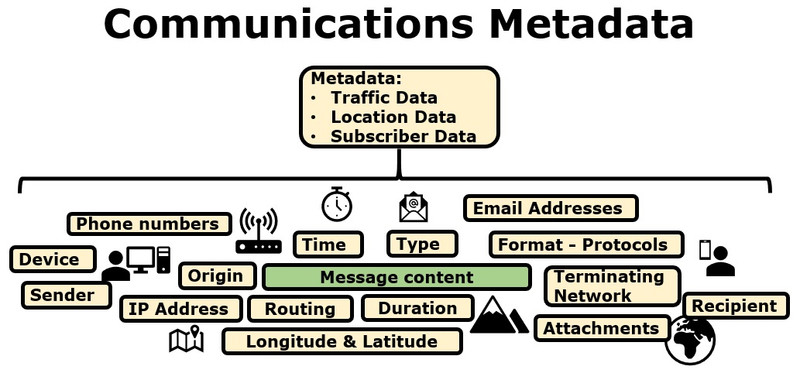
Communications metadata
After 9/11, the USA PATRIOT Act expanded surveillance powers, including bulk telecommunication metadata collection. Privacy concerns pushed Congress to pass the USA FREEDOM Act, which limited bulk collection and moved toward more targeted access under legal supervision.
Key Takeaways
Procedural Due Process
Requirement that government use lawful, fair, and nonarbitrary procedures, including notice and a meaningful opportunity to be heard, when depriving a person of life, liberty, or property
Fifth and Fourteenth Amendment Due Process Clauses
Both prohibit deprivation of life, liberty, or property without due process; the Fifth limits the national government, while the Fourteenth limits state and local governments
Fourth Amendment
Protects against unreasonable searches and seizures and requires warrants to be supported by probable cause and to describe particularly what may be searched or seized
Search
A government examination that intrudes upon a constitutionally protected privacy interest
Seizure
Government action that meaningfully interferes with a person’s freedom of movement or control of property, such as an arrest or confiscation of an object
Probable Cause
A fact-based, reasonable basis to believe that a crime occurred or that evidence will be found in the place to be searched
Warrant
A judicial authorization to search or seize, ordinarily issued by a neutral judge upon probable cause and a particular description of its scope
Particularity Requirement
The Fourth Amendment requirement that a warrant specifically identify the place to be searched and the persons or things to be seized
Warrantless Search Exceptions
Recognized circumstances in which a search may be reasonable without a warrant, including consent, exigent circumstances, and a search incident to lawful arrest
Riley v. California (2014)
Held that police generally need a warrant to search a cell phone’s digital contents after an arrest, though they may secure the phone and respond to an actual emergency
Exclusionary Rule
Judicial doctrine generally barring evidence obtained through an unconstitutional search or seizure from use against the person whose Fourth Amendment rights were violated
Mapp v. Ohio (1961)
Applied the exclusionary rule to state criminal prosecutions through the Fourteenth Amendment, making illegally seized evidence inadmissible in state courts
Fifth Amendment
Requires federal grand juries for capital or otherwise infamous crimes and protects against double jeopardy, compelled self-incrimination, deprivation without due process, and uncompensated public takings
Privilege Against Compelled Self-Incrimination
Fifth Amendment protection against being forced to provide testimonial evidence against oneself in a criminal case
Miranda Rule / Miranda v. Arizona (1966)
Before custodial interrogation, police must warn a suspect of the rights to remain silent and to counsel, that statements may be used in court, and that counsel will be appointed if needed; unwarned statements ordinarily cannot be used as direct evidence
Public Safety Exception / New York v. Quarles (1984)
Allows an unwarned response to be admitted when police questioning is reasonably prompted by an immediate threat to officers or the public
Sixth Amendment
Guarantees an accused person a speedy and public trial, an impartial jury, proper venue, notice of the accusation, confrontation of adverse witnesses, compulsory process for favorable witnesses, and assistance of counsel
Right to Counsel
Sixth Amendment right to legal assistance at critical stages of a criminal prosecution, preventing an accused person from confronting the government without representation
Gideon v. Wainwright (1963)
Unanimously held that states must provide attorneys to indigent felony defendants because the Sixth Amendment right to counsel is fundamental and applies through the Fourteenth Amendment
Right to a Speedy Trial
Sixth Amendment protection against leaving a defendant under an unresolved criminal accusation for an indefinite period
Right to a Public Trial
Sixth Amendment requirement that criminal trials ordinarily be open to public observation, discouraging secret or arbitrary prosecution
Right to an Impartial Jury
Sixth Amendment right to jurors who have not prejudged the case and decide guilt fairly from evidence presented through the legal process
Right to Notice of the Accusation
Sixth Amendment right to be informed of the nature and cause of the criminal charge so the defendant can prepare a defense
Confrontation Clause / Right of Confrontation
Sixth Amendment right to confront and challenge adverse witnesses, ordinarily through cross-examination
Compulsory Process Clause
Sixth Amendment right to use the court’s authority to obtain witnesses whose testimony may aid the defense
Telecommunications Metadata
Information about a communication—such as phone numbers, date, time, and duration—rather than the communication’s substantive content
USA PATRIOT Act
Post-9/11 law that expanded federal investigative and surveillance authority, with Section 215 associated with large-scale NSA collection of telephone metadata
USA FREEDOM Act of 2015
Limited bulk telephone-metadata collection by ending the NSA’s prior direct bulk holding program and shifting toward provider retention and targeted government access under legal supervision
Notes
Procedural Due Process
Requirement that government use lawful, fair, and nonarbitrary procedures, including notice and a meaningful opportunity to be heard, when depriving a person of life, liberty, or property
Fifth and Fourteenth Amendment Due Process Clauses
Both prohibit deprivation of life, liberty, or property without due process; the Fifth limits the national government, while the Fourteenth limits state and local governments
Fourth Amendment
Protects against unreasonable searches and seizures and requires warrants to be supported by probable cause and to describe particularly what may be searched or seized
Search
A government examination that intrudes upon a constitutionally protected privacy interest
Seizure
Government action that meaningfully interferes with a person’s freedom of movement or control of property, such as an arrest or confiscation of an object
Probable Cause
A fact-based, reasonable basis to believe that a crime occurred or that evidence will be found in the place to be searched
Warrant
A judicial authorization to search or seize, ordinarily issued by a neutral judge upon probable cause and a particular description of its scope
Particularity Requirement
The Fourth Amendment requirement that a warrant specifically identify the place to be searched and the persons or things to be seized
Warrantless Search Exceptions
Recognized circumstances in which a search may be reasonable without a warrant, including consent, exigent circumstances, and a search incident to lawful arrest
Riley v. California (2014)
Held that police generally need a warrant to search a cell phone’s digital contents after an arrest, though they may secure the phone and respond to an actual emergency
Exclusionary Rule
Judicial doctrine generally barring evidence obtained through an unconstitutional search or seizure from use against the person whose Fourth Amendment rights were violated
Mapp v. Ohio (1961)
Applied the exclusionary rule to state criminal prosecutions through the Fourteenth Amendment, making illegally seized evidence inadmissible in state courts
Fifth Amendment
Requires federal grand juries for capital or otherwise infamous crimes and protects against double jeopardy, compelled self-incrimination, deprivation without due process, and uncompensated public takings
Privilege Against Compelled Self-Incrimination
Fifth Amendment protection against being forced to provide testimonial evidence against oneself in a criminal case
Miranda Rule / Miranda v. Arizona (1966)
Before custodial interrogation, police must warn a suspect of the rights to remain silent and to counsel, that statements may be used in court, and that counsel will be appointed if needed; unwarned statements ordinarily cannot be used as direct evidence
Public Safety Exception / New York v. Quarles (1984)
Allows an unwarned response to be admitted when police questioning is reasonably prompted by an immediate threat to officers or the public
Sixth Amendment
Guarantees an accused person a speedy and public trial, an impartial jury, proper venue, notice of the accusation, confrontation of adverse witnesses, compulsory process for favorable witnesses, and assistance of counsel
Right to Counsel
Sixth Amendment right to legal assistance at critical stages of a criminal prosecution, preventing an accused person from confronting the government without representation
Gideon v. Wainwright (1963)
Unanimously held that states must provide attorneys to indigent felony defendants because the Sixth Amendment right to counsel is fundamental and applies through the Fourteenth Amendment
Right to a Speedy Trial
Sixth Amendment protection against leaving a defendant under an unresolved criminal accusation for an indefinite period
Right to a Public Trial
Sixth Amendment requirement that criminal trials ordinarily be open to public observation, discouraging secret or arbitrary prosecution
Right to an Impartial Jury
Sixth Amendment right to jurors who have not prejudged the case and decide guilt fairly from evidence presented through the legal process
Right to Notice of the Accusation
Sixth Amendment right to be informed of the nature and cause of the criminal charge so the defendant can prepare a defense
Confrontation Clause / Right of Confrontation
Sixth Amendment right to confront and challenge adverse witnesses, ordinarily through cross-examination
Compulsory Process Clause
Sixth Amendment right to use the court’s authority to obtain witnesses whose testimony may aid the defense
Telecommunications Metadata
Information about a communication—such as phone numbers, date, time, and duration—rather than the communication’s substantive content
USA PATRIOT Act
Post-9/11 law that expanded federal investigative and surveillance authority, with Section 215 associated with large-scale NSA collection of telephone metadata
USA FREEDOM Act of 2015
Limited bulk telephone-metadata collection by ending the NSA’s prior direct bulk holding program and shifting toward provider retention and targeted government access under legal supervision
