Topic 4.3 Notes – Changes in Ideology
Political Ideology Can Change Through Generations and Life Stages
Political ideology means your organized beliefs about government’s proper role. In Unit 4, this connects back to political socialization, because the people and experiences around you keep shaping those beliefs over time.
The key idea here is that age differences in ideology usually come from two different mechanisms:
- Generational effects come from when you were born. People in the same birth cohort go through adolescence and early adulthood during the same historical moment, and that can leave a lasting mark.
- Life cycle effects come from the stage of life you are in now. New responsibilities can change what issues matter most to you.
Keep the distinction clean:
- Generational = tied to formative experiences while coming of age
- Life cycle = tied to current age, role, or responsibility
Neither one controls every person’s beliefs. These are population-level patterns, not rules about individuals. That matters on tests, because a survey gap by age does not automatically prove either explanation.
The Two Main Ways Ideology Changes
Generational effects
People in the same cohort often experience the same wars, recessions, social movements, trust or distrust in government, and media environment at the same formative age. Those shared experiences can stick.
The standard AP example is the Great Depression and FDR’s New Deal. Images of breadlines from the era help show the kind of economic crisis that shaped that generation’s political outlook.
- The Depression began in 1929
- The New Deal began in 1933
- Many people who came of age during this crisis saw massive economic insecurity and a bigger federal response
- That helped many in that cohort become more supportive of government responsibility for economic security and more loyal to the Democratic Party
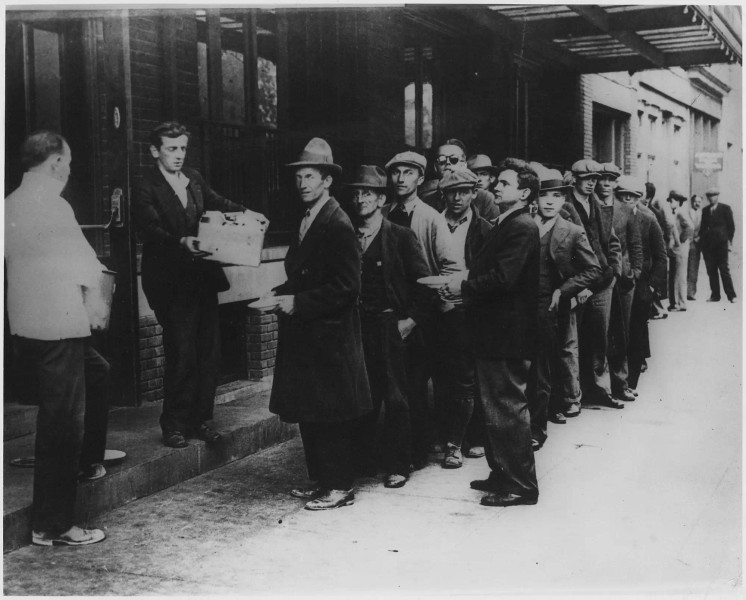
Great Depression breadline
That does not mean every person in that generation became liberal. It means the cohort, on average, developed a durable tendency.
Cohort replacement is how this can change national opinion over time. Public opinion can shift because older cohorts shrink and younger cohorts with different outlooks become a larger share of voters.
Life cycle effects
Life cycle effects happen because people’s roles change. Those new roles often change issue priorities more than they change a full ideological label.
Common life-stage experiences include:
- entering college or the workforce
- starting a career and paying more taxes
- marriage or forming a household
- parenthood or caregiving
- homeownership
- building savings or property
- illness or disability
- retirement and dependence on Social Security or Medicare
Examples help here:
- A new parent may care more about schools, childcare, and safety.
- A homeowner may pay more attention to property taxes and zoning.
- A retiree may care more about Medicare, inflation, and prescription-drug costs.
Aging does not automatically make people more conservative on every issue. That’s too broad and AP loves that trap.
How to Tell the Difference in Data
A cross-sectional survey compares different age groups at one moment. It can show a pattern like “adults 65+ are more conservative than adults 18 to 29.” It cannot prove why.
Three things can create age differences:
- Cohort effect = differences tied to birth cohort
- Life cycle effect = differences tied to age or stage of life
- Period effect = differences caused by events affecting everyone during that time
The best evidence of a generational effect comes from following the same cohorts over time. If one cohort stays distinct as it ages, that supports a cohort explanation.
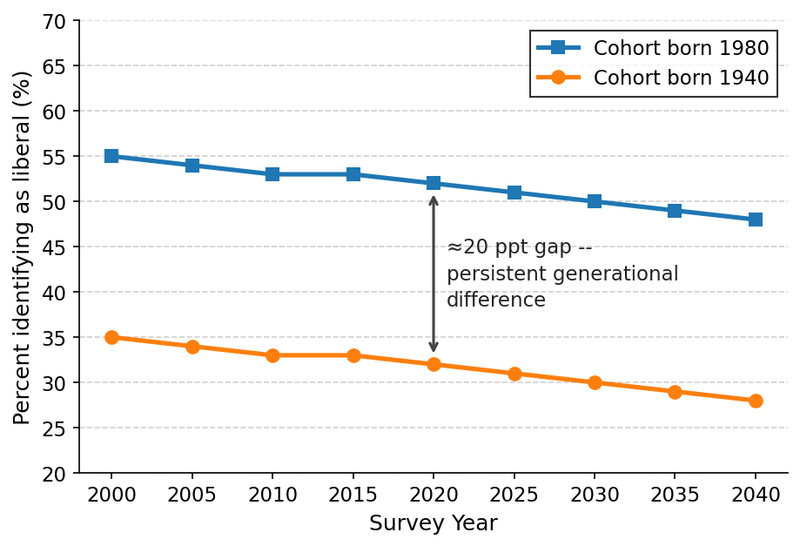
Longitudinal cohort comparison
This graph shows that kind of persistent cohort difference. Both cohorts become slightly less liberal over time, but the gap between them stays at about 20 percentage points. That points much more strongly to a cohort effect than to a simple age-based shift.
The best evidence of a life cycle effect appears when several different cohorts change in similar ways as they reach similar ages.
So longitudinal evidence is stronger than a one-time snapshot when the question is change over time.
Patterns You Should Be Able to Describe and Explain
On the exam, description comes first. A pattern is a recurring relationship in data. A trend is movement in a direction over time or across age groups.
A strong description does three things:
- names the groups being compared
- states the direction of the difference
- gives specific numbers or percentage-point gaps when possible
Recognize these two patterns:
- Generational pattern = one cohort stays more liberal or conservative than another across years, even as both age
- Life cycle pattern = several cohorts grow more similar in a predictable way as they move through life stages
Big trap: “older people are more conservative” is only a description of a current difference unless the data show change over time.
A person can show both effects at once. Someone might keep cohort-shaped beliefs about government spending but still change views on taxes, education, health care, or retirement issues as life circumstances change.
Key Takeaways
Generational Effect
A lasting influence on political ideology caused by formative experiences shared by members of the same birth cohort
Life Cycle Effect
A change in political attitudes or priorities caused by experiences, roles, and responsibilities encountered at a particular stage of life
Generation / Birth Cohort
People born during roughly the same period who pass through formative life stages under similar historical conditions
Cohort Replacement
Aggregate opinion change caused as older cohorts decline as a share of the population and younger cohorts with different views replace them
Period Effect
An attitude change caused by current events or conditions that affect many age groups at the same time
Notes
Generational Effect
A lasting influence on political ideology caused by formative experiences shared by members of the same birth cohort
Life Cycle Effect
A change in political attitudes or priorities caused by experiences, roles, and responsibilities encountered at a particular stage of life
Generation / Birth Cohort
People born during roughly the same period who pass through formative life stages under similar historical conditions
Cohort Replacement
Aggregate opinion change caused as older cohorts decline as a share of the population and younger cohorts with different views replace them
Period Effect
An attitude change caused by current events or conditions that affect many age groups at the same time
