Topic 5.4 Notes – How and Why Political Parties Change and Adapt
Why Political Parties Change
Parties are linkage institutions, which means they connect people to government by organizing elections, nominating candidates, and pushing policy ideas. They want to win across many states and districts, so they need broad coalitions. That is the main reason they change.
A party’s coalition shifts when these things shift:
- Voters change. Age, race, religion, education, region, and ideology all affect party support.
- Issues change. A party may keep its core beliefs but change which issues it emphasizes.
- Geography changes. Migration and suburban growth can turn safe states or districts into competitive ones.
- Institutions change. Primaries, campaign-finance rules, and media tools all change how parties compete.
Adaptation can mean changing:
- issue emphasis
- policy details
- tone and language
- messengers and candidates
- outreach methods
- fundraising strategies
Because parties are decentralized, the national party, state parties, and local parties do not always change in the same way or at the same speed.
Candidate-Centered Campaigns
Modern campaigns often focus on the candidate more than the party. Voters hear about personality, biography, leadership style, and personal issue positions.
Why party control weakened
- Primaries and caucuses gave voters a bigger role in picking nominees.
- After the disputed 1968 Democratic National Convention, reforms reduced old-style party boss control.
- National conventions now usually ratify the candidate who already won enough pledged delegates.
The conflict on the 1968 convention floor helped convince many Democrats that the nomination process needed to be opened up.
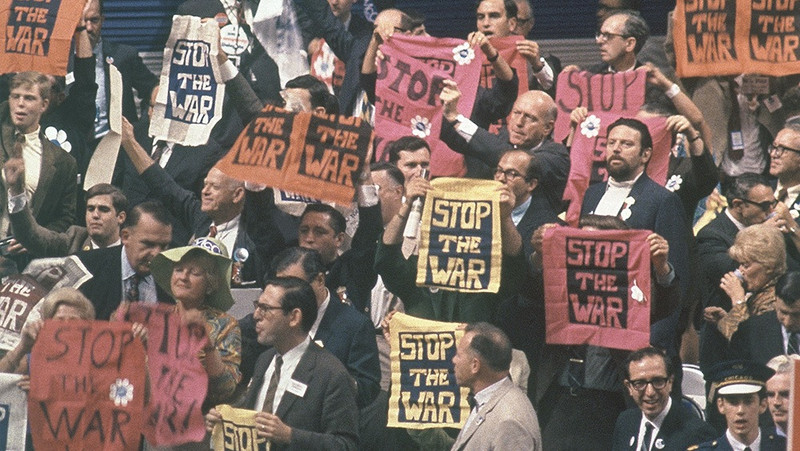
1968 Democratic National Convention protests
Other forces pushed this even further:
- Television let candidates speak directly to mass audiences.
- Social media lets candidates bypass party leaders and traditional news.
- Candidates now build their own donor lists, staff, consultants, and volunteer networks.
What parties still do
Parties still matter a lot. They provide:
- labels that tell voters the candidate’s broad views
- endorsements and nomination rules
- fundraising help
- voter data
- legal support
- GOTV operations, meaning get-out-the-vote efforts
The key idea here is easy to miss on a test. Candidate-centered politics weakened party control over nominations, but it did not make parties unimportant.
Changing Coalitions and Critical Elections
A party coalition is the mix of groups that usually support a party. These groups can be social, regional, economic, ideological, or interest-based.
Parties adapt coalitions by:
- studying polling, voter files, election returns, and demographic research
- revising platform language or issue emphasis
- tailoring outreach to different groups
- recruiting candidates who appeal to target voters
Outreach often responds to race, ethnicity, religion, age, gender, class, education, region, and ideology. Geographic change matters too, since migration and suburban growth can reshape elections.
A standard example is the Republican National Committee’s 2013 Growth and Opportunity Project, which called for stronger outreach to groups like younger voters, women, and racial and ethnic minorities, along with better digital strategy.
Critical elections and realignment
A critical election produces a lasting shift in party support. That lasting shift is called realignment.
- 1860 brought Abraham Lincoln, the collapse of the old party system, and rising Republican dominance.
- 1932 brought Franklin D. Roosevelt, the Great Depression, and the New Deal coalition, which helped Democrats dominate national politics for decades.
- 1968 is often treated as part of the longer Southern realignment, though that change took decades.
The 1932 electoral map is a classic example to remember because Roosevelt’s landslide points to a broader, longer-lasting shift in party support.
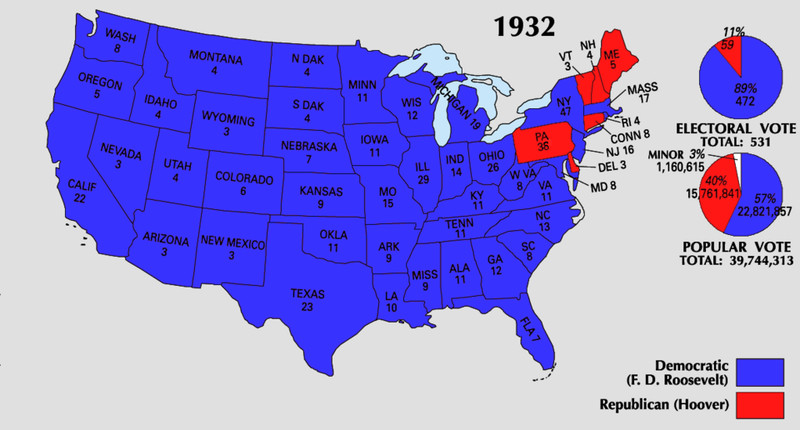
1932 presidential election map
The exam loves this distinction. A temporary electoral swing is not the same as a realignment. Realignment lasts across later elections.
Campaign Finance and Party Adaptation
Money rules shape party power because they affect who controls campaign resources and messaging.
- BCRA (McCain-Feingold), 2002 banned national party committees from raising and spending soft money. That weakened party-controlled funding and pushed money toward outside groups.
- Citizens United v. FEC (2010) protected independent expenditures by corporations and unions under the First Amendment. This helped expand super PACs.
Citizens United did not allow unlimited direct contributions to candidates. That point shows up all the time.
The result for parties:
- less centralized control over spending and messaging
- more need to rely on small-dollar fundraising, mobilization, and support functions they can still legally control
Communication Technology and Voter Data
As campaigns became more candidate-centered, parties stayed relevant by getting better at messaging, targeting, and turnout.
Parties use:
- television
- websites
- email and texts
- social media
- online ads
- rapid-response messaging
They also use voter data such as:
- registration files
- turnout history
- donation records
- volunteer activity
- survey responses
- demographic data
One very testable limit matters here. Data can show whether someone voted, but not who they voted for. Support is estimated, not known.
Microtargeting
Microtargeting divides voters into narrow groups and sends each group tailored messages for persuasion, donations, volunteering, registration, early voting, or turnout.
Data also helps parties decide where to send:
- canvassers
- field offices
- ad money
- candidate visits
Standard 2012 examples:
- Project Narwhal helped Obama integrate voter, fundraising, volunteer, and field data.
- ORCA was Romney’s turnout-tracking system, but it had major technical failures on Election Day.
Key Takeaways
Candidate-Centered Campaign
A campaign focused on a candidate’s personal characteristics, record, and positions rather than primarily on the party, weakening party control over nominations and messages
Party Coalition
The collection of social, regional, economic, ideological, and interest-based groups that regularly support a political party
Critical Election
An election in which voter support undergoes a lasting realignment between political parties
Political Realignment
A substantial, durable shift in the groups, regions, or interests supporting political parties, creating a new pattern of party competition
Voter-Data Management
Combining voter, contact, donation, survey, and demographic information to estimate support and turnout and target persuasion or mobilization efforts
Microtargeting
Using voter data to divide the electorate into narrow segments and deliver messages or requests tailored to predicted interests and behavior
Notes
Candidate-Centered Campaign
A campaign focused on a candidate’s personal characteristics, record, and positions rather than primarily on the party, weakening party control over nominations and messages
Party Coalition
The collection of social, regional, economic, ideological, and interest-based groups that regularly support a political party
Critical Election
An election in which voter support undergoes a lasting realignment between political parties
Political Realignment
A substantial, durable shift in the groups, regions, or interests supporting political parties, creating a new pattern of party competition
Voter-Data Management
Combining voter, contact, donation, survey, and demographic information to estimate support and turnout and target persuasion or mobilization efforts
Microtargeting
Using voter data to divide the electorate into narrow segments and deliver messages or requests tailored to predicted interests and behavior
