Topic 2.3 Notes – Congressional Behavior
Why Members of Congress Vote the Way They Do
Congressional behavior means how members make decisions about voting, representation, and governing. Formal powers matter, but the day-to-day choice of how to vote usually comes from political pressure.
House members and senators feel that pressure differently:
- House members run every 2 years in smaller districts, so they usually feel the sharpest and most immediate electoral pressure.
- Senators serve 6-year staggered terms and represent whole states, so they still answer to voters, but often have a little more room to think long term.
The full set of pressures usually shows up together:
- Constituents want members to reflect district or state interests.
- Reelection pushes members to avoid votes that could cost support.
- Party leaders want loyalty on major bills.
- Ideology shapes what members genuinely believe.
- District boundaries shape which voters a House member needs to please.
- Unified or divided government changes whether cooperation or conflict is more likely.
A great example of the electoral connection is casework. When a member helps a constituent with Social Security, veterans’ benefits, or immigration paperwork, that does not directly decide a legislative vote. It does build trust, visibility, and support back home.
Models of Representation
Members usually balance three role conceptions, and AP questions often ask you which one best fits a scenario.
Trustee
A trustee uses personal judgment, knowledge, and experience.
- This member may vote against current public opinion if they think it helps the district or country in the long run.
- The idea is that elected officials sometimes know more about technical policy, expert evidence, or long-term consequences than the public does.
- The risk is political. Voters may feel ignored.
Delegate
A delegate acts as an agent of the constituents.
- This member tries to vote based on what people in the district or state want.
- The emphasis is responsiveness and popular control.
- The problem is that public opinion is often mixed, unclear, or changes fast.
Politico
A politico mixes the other two.
- On a high-profile issue, the member may follow constituent opinion.
- On a technical or low-visibility issue, the same member may use independent judgment.
This is the most realistic model for most exam situations because members shift roles depending on the issue and the pressure around it.
Partisanship, Polarization, and Gridlock
Party conflict helps explain why Congress often struggles to act.
- Partisanship means loyalty to and action on behalf of a political party.
- Partisan voting means voting based on party affiliation.
- A party-line vote is the clearest example.
Why party matters:
- Members often already agree with their party’s ideology.
- Party leaders push unity.
- Members care about the national party’s reputation.
- Primary voters and activists may punish compromise.
- Members may want to deny the other party a political win.
Polarization means the parties are moving farther apart ideologically, with fewer moderates in the middle. The graph compares the ideological spread of the entire U.S., voters, the House, and the Senate, which helps show how elected officials can be more sorted into opposing camps than the broader public.
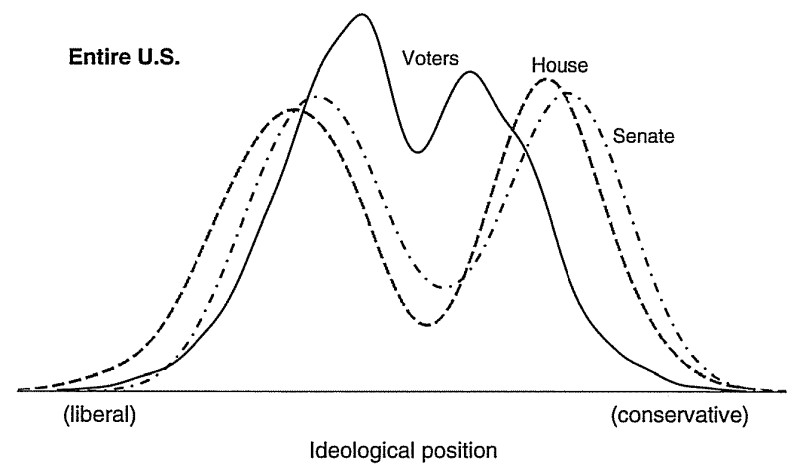
Ideological polarization in the U.S. public and Congress
Keep this distinction clear:
- Polarization = ideological distance between parties
- Partisan voting = actual voting behavior on bills
How gridlock happens:
- Parties become more polarized.
- Compromise gets harder.
- Party-line voting increases.
- Cross-party coalitions shrink.
- Congress may fail to pass legislation.
Gridlock means no congressional action on a legislative issue because consensus is missing. It does not mean Congress stops doing everything.
Elections, Districts, and Unequal Representation
Election rules shape who members answer to, especially in the House.
- Reapportionment redistributes the 435 House seats among states after the census.
- Redistricting redraws district boundaries within a state.
- Gerrymandering draws districts to benefit a party, racial group, incumbent, or another interest.
Two common methods:
- Packing puts many opposing voters into a few districts.
- Cracking splits opposing voters across many districts so they cannot form a majority.
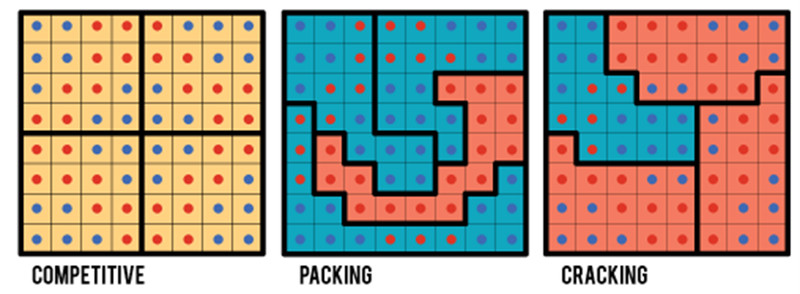
Packing and cracking
In the diagram, focus on the middle and right panels. They show how the same voters can be grouped very differently depending on district lines.
Political effects:
- Creates safe districts
- Makes primary challenges more threatening than general elections
- Can reduce moderation and increase polarization
Senators are different here because redistricting does not affect them. State boundaries stay the same.
Baker v. Carr
Baker v. Carr (1962) said Equal Protection challenges to malapportioned districts are justiciable, meaning courts can hear them.
- This opened the door to one person, one vote claims.
- The case was about unequal population, not weird district shapes.
Shaw v. Reno
Shaw v. Reno (1993) said racial gerrymandering can violate Equal Protection if race is the predominant factor in drawing a district.
- Highly irregular race-based districts trigger strict scrutiny.
- An oddly shaped district is not automatically unconstitutional. The key question is why it was drawn that way.
The North Carolina map below is the kind of example tied to this case. Notice the unusually narrow, irregular district running through the center of the state.
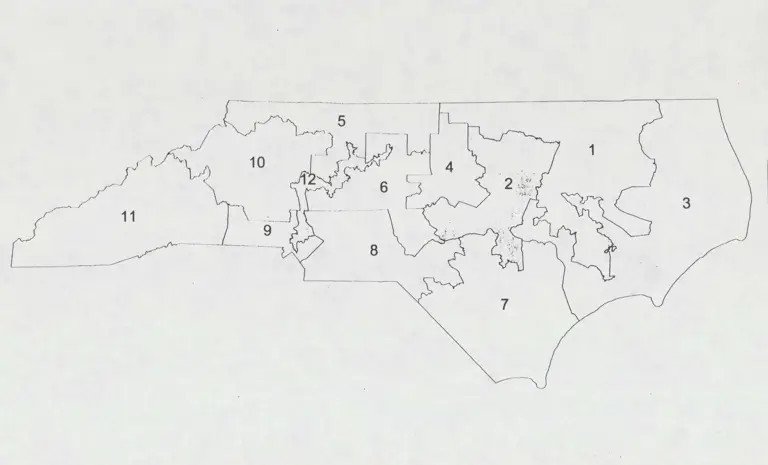
North Carolina congressional districts in Shaw v. Reno
Divided Government and Conflict with the President
Party control of government changes congressional behavior.
- Unified government means the same party controls the presidency, House, and Senate.
- Divided government means the president’s party does not control at least one chamber of Congress.
Divided government often increases partisanship because the opposition party has reason to block the president’s agenda.
That can show up in several ways:
- Members vote against presidential initiatives.
- Congress blocks or rewrites bills.
- The Senate delays or rejects nominations.
- Hearings and investigations become tools of conflict.
A lame duck president is a president near the end of office with weaker political leverage, even though formal constitutional power stays the same.
The standard example is Merrick Garland in 2016:
- President Obama nominated Garland to the Supreme Court.
- The Republican-controlled Senate refused hearings and a vote.
- That shows divided government, partisanship, and lame duck status combining to obstruct appointments.
Key Takeaways
Electoral Connection
The reelection incentive that encourages members of Congress to remain attentive and responsive to their constituents
Constituency
The body of people represented by an elected official; House members represent districts, while senators represent states
Casework
Assistance that members of Congress provide to constituents dealing with federal agencies and programs
Trustee Representation
Representation in which a legislator votes according to personal knowledge and judgment rather than treating constituent opinion as binding
Delegate Representation
Representation in which a legislator acts as an agent of constituents and votes according to their preferences
Politico Representation
Representation that combines the trustee and delegate approaches according to the issue and political circumstances
Partisanship
Attachment to and action on behalf of a political party
Partisan Voting
Voting by members of Congress according to their political party affiliation
Ideological Polarization
Movement of political attitudes and parties toward opposing ideological extremes, increasing the distance and reducing the overlap between them
Gridlock
A situation in which Congress cannot act on legislation because it lacks sufficient consensus
Unified Government
Government in which the same political party controls the presidency and both chambers of Congress
Divided Government
Government in which one party controls the presidency and the other party controls at least one chamber of Congress
Lame Duck President
A president whose successor has been chosen or who cannot or will not remain in office; the president retains full constitutional authority but often has reduced political leverage
Reapportionment
The redistribution after each census of the 435 House seats among the states according to population
Redistricting
The redrawing of electoral district boundaries within a state, generally after reapportionment
Gerrymandering
Drawing electoral district boundaries to advantage a political party, racial group, incumbent, or other interest
Packing
A gerrymandering method that concentrates opposing voters in a few districts, reducing their influence elsewhere
Cracking
A gerrymandering method that divides opposing voters among districts so they remain a minority in each
Baker v. Carr (1962)
Held that Equal Protection challenges to legislative malapportionment may be heard by federal courts, enabling later enforcement of “one person, one vote.”
Shaw v. Reno (1993)
Held that districts drawn predominantly by race are subject to strict scrutiny: they must serve a compelling interest and be narrowly tailored
Notes
Electoral Connection
The reelection incentive that encourages members of Congress to remain attentive and responsive to their constituents
Constituency
The body of people represented by an elected official; House members represent districts, while senators represent states
Casework
Assistance that members of Congress provide to constituents dealing with federal agencies and programs
Trustee Representation
Representation in which a legislator votes according to personal knowledge and judgment rather than treating constituent opinion as binding
Delegate Representation
Representation in which a legislator acts as an agent of constituents and votes according to their preferences
Politico Representation
Representation that combines the trustee and delegate approaches according to the issue and political circumstances
Partisanship
Attachment to and action on behalf of a political party
Partisan Voting
Voting by members of Congress according to their political party affiliation
Ideological Polarization
Movement of political attitudes and parties toward opposing ideological extremes, increasing the distance and reducing the overlap between them
Gridlock
A situation in which Congress cannot act on legislation because it lacks sufficient consensus
Unified Government
Government in which the same political party controls the presidency and both chambers of Congress
Divided Government
Government in which one party controls the presidency and the other party controls at least one chamber of Congress
Lame Duck President
A president whose successor has been chosen or who cannot or will not remain in office; the president retains full constitutional authority but often has reduced political leverage
Reapportionment
The redistribution after each census of the 435 House seats among the states according to population
Redistricting
The redrawing of electoral district boundaries within a state, generally after reapportionment
Gerrymandering
Drawing electoral district boundaries to advantage a political party, racial group, incumbent, or other interest
Packing
A gerrymandering method that concentrates opposing voters in a few districts, reducing their influence elsewhere
Cracking
A gerrymandering method that divides opposing voters among districts so they remain a minority in each
Baker v. Carr (1962)
Held that Equal Protection challenges to legislative malapportionment may be heard by federal courts, enabling later enforcement of “one person, one vote.”
Shaw v. Reno (1993)
Held that districts drawn predominantly by race are subject to strict scrutiny: they must serve a compelling interest and be narrowly tailored
