Topic 3.4 Notes – First Amendment: Freedom of the Press
What Freedom of the Press Protects
The First Amendment protects publishing and distributing information, criticism, opinion, and political views from unconstitutional government interference. That covers newspapers, but it also reaches journalists, publishers, and organizations engaged in publication more broadly.
Through selective incorporation under the Fourteenth Amendment, this protection limits state and local governments too. The key case for that step is Near v. Minnesota.
Press freedom matters because it helps both individual liberty and representative democracy.
- A free press can investigate government, expose corruption, and challenge abuse of power.
- It can criticize officials and policies without needing government approval first.
- It helps inform voters, which matters because democracy depends on citizens knowing what government is doing.
The press works as an informal check on government power. It is not an official branch, but it can still make it harder for officials to hide mistakes or misconduct.
One thing students mix up a lot is press freedom versus a general right to know. This topic is about protection against censorship of publication. It is not a guarantee that the public gets access to every government file or classified document.
Prior Restraint and Other Limits on the Press
The hardest line in these cases is between stopping publication beforehand and punishing it afterward. That timing difference drives the doctrine.
Prior restraint means government action that prevents expression before it is published or distributed.
Common forms include:
- Licensing systems requiring government approval before publication
- Administrative orders blocking distribution
- Statutes authorizing advance censorship
- Court injunctions ordering a publisher not to release material
- An injunction is a court order telling someone to do or not do something.
That idea is what the image captures. The publication is being blocked before it can move forward.
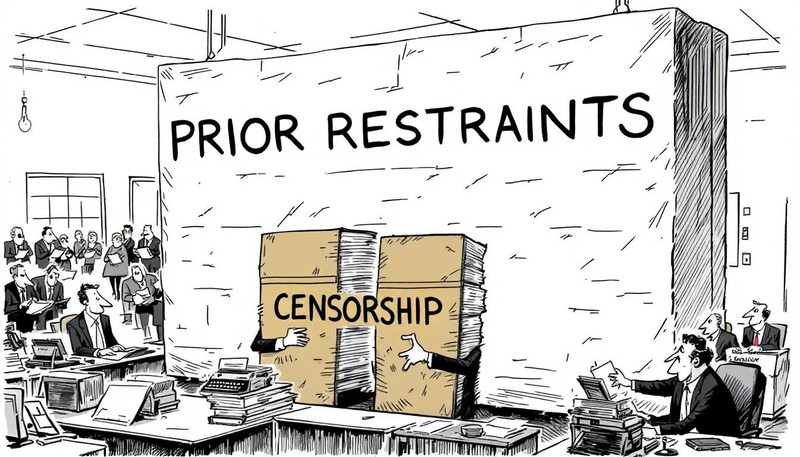
Prior restraint
Prior restraint gets the strongest First Amendment suspicion because once publication is blocked, the information may never enter public debate when it matters most. Government also has an obvious temptation to censor material that is embarrassing or politically damaging.
The rule is strict:
- Prior restraint carries a heavy presumption against constitutional validity.
- The government bears the heavy burden of justification.
- Claims like “harmful,” “embarrassing,” or “against the national interest” are not enough.
Still, prior restraint is not impossible in every case. The Court leaves room for extraordinary situations involving grave, direct, and imminent harm, like revealing troop locations during wartime.
Prior restraint and subsequent punishment
Subsequent punishment means liability after publication, such as criminal prosecution or civil damages. Striking down prior restraint does not mean every later punishment would also be unconstitutional. Press freedom does not give blanket immunity from laws on defamation, obscenity, incitement, or unlawful leaking. Those issues are mostly outside this topic’s main focus.
Near v. Minnesota
Near v. Minnesota (1931) built the modern rule against prior restraint.
Minnesota used a public nuisance law to shut down The Saturday Press as “malicious, scandalous, and defamatory.” The paper accused local officials of corruption and also published ugly anti-Semitic attacks.
The Supreme Court said the law was unconstitutional because it suppressed publication in advance. Officials usually must respond through punishment after publication, not by shutting the press down beforehand.
Its significance:
- It established the basic presumption against prior restraint.
- It applied press freedom to the states through the Fourteenth Amendment.
- It became the foundation for the Pentagon Papers case.
New York Times Co. v. United States
This is the Pentagon Papers case, and it is the clearest AP example of press freedom clashing with national security.
Facts
- In 1967, Robert McNamara commissioned a classified Vietnam study.
- Daniel Ellsberg leaked parts of it.
- The New York Times published excerpts in 1971, and The Washington Post followed.
- The Nixon administration sought injunctions to stop publication, claiming national security harm.
Ellsberg became the public face of the leak, as in the hearing photo below.
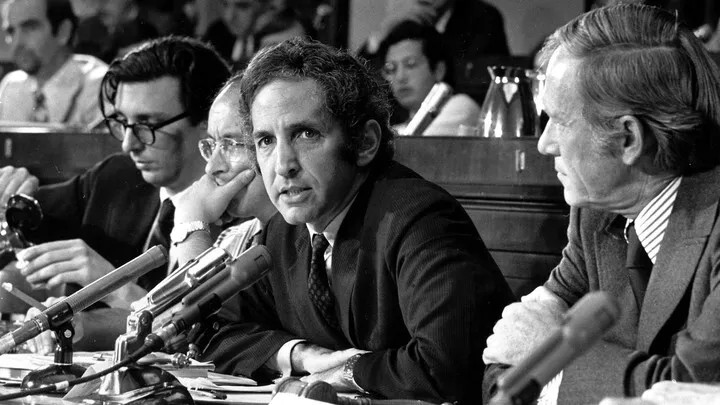
Daniel Ellsberg during a public hearing
Holding
In a 6-3 per curiam decision, the Court ruled for the newspapers. The government failed to meet the heavy burden needed to justify prior restraint.
Reasoning you should know
- Black and Douglas argued that “national security” cannot become a blank check for censorship.
- Brennan said only extraordinary, immediate, inevitable harm might justify restraint.
- Stewart and White gave some weight to executive expertise, but still found the proof too weak.
- Marshall stressed separation of powers. Courts should not create censorship power Congress did not authorize.
This case does not say press freedom is absolute, that classification alone is meaningless, or that there is a general right to access classified material.
The Main Pattern to Remember
Near and New York Times share the same key fact. In both, the government tried to stop publication before it happened. That triggers the heavy presumption against prior restraint, even when the government says national security.
The Court’s view shows a strong but qualified commitment to liberty. Strong, because advance censorship is treated as deeply suspect. Qualified, because truly immediate and grave harms might justify restraint, and later punishment raises different questions.
Key Takeaways
Freedom of the Press
First Amendment protection of publishing and distributing information, ideas, criticism, and opinions from unconstitutional government interference
Prior Restraint
Government action that prevents expression from being published or distributed, rather than imposing consequences after publication
Heavy Presumption Against Prior Restraint
The doctrine that advance censorship is presumed unconstitutional and the government bears an exceptionally heavy burden to justify it
Injunction
A court order requiring or prohibiting an action; an order blocking publication is a form of prior restraint
Near v. Minnesota (1931)
The Court struck down an injunction closing a newspaper deemed scandalous and defamatory, established the modern presumption against prior restraint, and applied press freedom to the states
New York Times Co. v. United States (1971) (Pentagon Papers Case)
The Court ruled 6–3 that the government had not met its heavy burden to stop newspapers from publishing the Pentagon Papers, despite claims of national-security harm
Notes
Freedom of the Press
First Amendment protection of publishing and distributing information, ideas, criticism, and opinions from unconstitutional government interference
Prior Restraint
Government action that prevents expression from being published or distributed, rather than imposing consequences after publication
Heavy Presumption Against Prior Restraint
The doctrine that advance censorship is presumed unconstitutional and the government bears an exceptionally heavy burden to justify it
Injunction
A court order requiring or prohibiting an action; an order blocking publication is a form of prior restraint
Near v. Minnesota (1931)
The Court struck down an injunction closing a newspaper deemed scandalous and defamatory, established the modern presumption against prior restraint, and applied press freedom to the states
New York Times Co. v. United States (1971) (Pentagon Papers Case)
The Court ruled 6–3 that the government had not met its heavy burden to stop newspapers from publishing the Pentagon Papers, despite claims of national-security harm
