Topic 2.10 Notes – The Court in Action
Life Tenure and Judicial Independence
Article III, Section 1 says federal judges serve during good Behaviour. For Supreme Court justices, that means life tenure. They do not run for reelection, they do not have fixed terms, and there is no mandatory retirement age.
A justice can leave office only a few ways:
- Retire or resign on their own.
- Be impeached by the House and convicted by the Senate.
- Stay in office for life if none of that happens.
Article III also says judicial salary cannot be reduced while judges are in office. That matters because Congress cannot punish judges financially for unpopular rulings.
The key chain is the whole point of this topic:
- Life tenure
- insulation from elections and current political pressure
- judicial independence
- ability to issue controversial decisions
Judicial independence means deciding cases based on the Constitution, laws, precedent, and facts, instead of worrying about voters, party leaders, or the next election.
That independence still exists inside a system of checks and balances. Congress confirms federal judges and can remove them through impeachment, and the courts can check the other branches by declaring laws or executive actions unconstitutional.
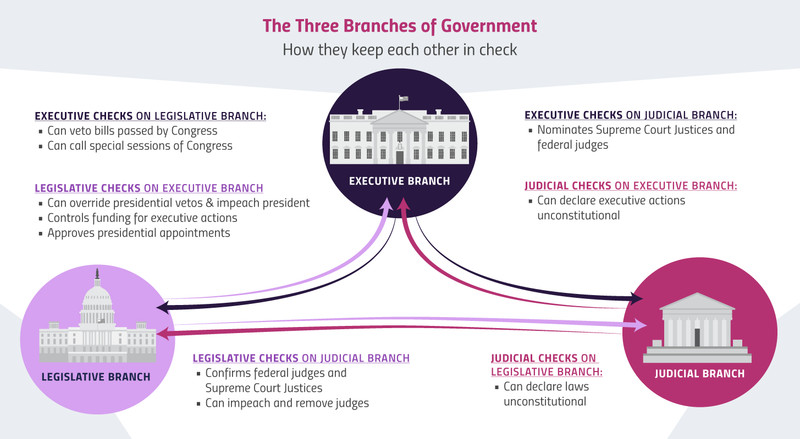
Checks and balances among the three branches
One easy AP trap is mixing up independence with judicial review. Life tenure did not create judicial review. Marbury v. Madison (1803) established judicial review, which is the power to declare government action unconstitutional.
Why the Framers Wanted an Independent Court
Hamilton explains the logic in Federalist No. 78. He called the judiciary the least dangerous branch because it has “neither FORCE nor WILL, but merely judgment.”
That quote matters because the Court does not control:
- the military like the president
- the purse like Congress
So why protect judges so strongly? Because courts sometimes have to strike down laws that are popular. The Framers did not want constitutional government to mean simple majority rule with no limits.
Life tenure supports:
- rule of law because judges can apply the Constitution even when it is unpopular
- continuity and stability because the law does not swing every election cycle
- minority rights because courts can check majority abuse
- independence from public opinion, so justices do not tailor rulings to win votes
Controversial Decisions and Debate About Court Power
An independent Court can make rulings that cause anger right away, and Brown v. Board of Education (1954) is the classic example.
Brown v. Board of Education
Brown held that school segregation violated the Equal Protection Clause of the Fourteenth Amendment. It rejected the separate-but-equal idea linked to Plessy v. Ferguson (1896) in public education.
The all-Black classroom pictured here helps ground the issue Brown addressed in everyday school life.

Segregated public school classroom
Brown faced massive resistance, especially in the South. Life tenure did not decide the constitutional reasoning, but it protected the justices from electoral punishment for making that decision.
This creates the countermajoritarian difficulty. The Court can overturn actions supported by elected officials and majorities. That produces a real debate:
- Defense: independence is necessary to protect rights and enforce constitutional limits.
- Criticism: unelected justices can serve for decades, shape national policy, and voters cannot remove them after a disliked ruling.
Vacancies also matter. One president can shape the Court long after leaving office.
What Life Tenure Does and Does Not Mean
Life tenure gives independence, not unlimited power. Justices are still constrained by:
- cases and controversies
- constitutional and statutory text
- precedent
- Court procedures
The Court is also not fully unchecked:
- president nominates
- Senate confirms
- impeachment and removal remain possible
Justices also do not always oppose public opinion. Life tenure reduces direct control by current majorities, but it does not guarantee anti-majoritarian decisions.
A useful FRQ distinction:
- Judicial review means the Court can interpret the Constitution and invalidate government action.
- Judicial independence means the justices can exercise that power without direct electoral pressure.
Comparing Cases About Rights in Controversial Settings
When you compare cases, separate the parts:
- facts = what happened
- issue = legal question
- holding = the Court’s answer
- reasoning = why it answered that way
- majority opinion = written explanation of the controlling side
Tinker v. Des Moines
Students wore black armbands to protest the Vietnam War. The Court protected this symbolic speech in public schools. Students do not lose free speech rights at the “schoolhouse gate,” and schools need a material and substantial disruption to justify suppression.
West Virginia State Board of Education v. Barnette
Students could not be forced to salute the flag or say the Pledge. The Court protected them from compelled speech. Justice Robert Jackson said no official can prescribe orthodoxy in politics, nationalism, or religion.
The comparison
Both cases involved public school students and First Amendment rights in controversial settings. Both limited school authority.
The difference is the testable part:
- Barnette = government forcing speech
- Tinker = government punishing voluntary symbolic speech
Together they show how an independent Court can protect rights even when the public strongly disagrees.
Key Takeaways
Life Tenure
Article III justices serve during good behavior without reelection, a fixed term, or mandatory retirement, though they may resign, retire, or be impeached and removed
Judicial Independence
Judges’ ability to decide cases according to law without needing reelection or satisfying current public opinion or elected officials
Federalist No. 78
Hamilton’s defense of permanent judicial tenure: an independent, “least dangerous” judiciary needs freedom from political pressure to enforce the Constitution as fundamental law
Countermajoritarian Difficulty
The democratic-accountability concern created when unelected, life-tenured justices invalidate actions taken by elected officials or supported by a majority
Notes
Life Tenure
Article III justices serve during good behavior without reelection, a fixed term, or mandatory retirement, though they may resign, retire, or be impeached and removed
Judicial Independence
Judges’ ability to decide cases according to law without needing reelection or satisfying current public opinion or elected officials
Federalist No. 78
Hamilton’s defense of permanent judicial tenure: an independent, “least dangerous” judiciary needs freedom from political pressure to enforce the Constitution as fundamental law
Countermajoritarian Difficulty
The democratic-accountability concern created when unelected, life-tenured justices invalidate actions taken by elected officials or supported by a majority
