Topic 3.11 Notes – Government Responses to Social Movements
How Government Responds to Social Movements
A social movement can’t pass laws by itself. It pushes the people and institutions that do have power.
Civil rights means protection against discrimination and unequal treatment. The key constitutional base here is the Fourteenth Amendment’s equal protection clause, which says states cannot deny equal protection of the laws. That matters because many civil rights fights involved state action, like public schools.
Government usually responds in two main ways:
- Court rulings interpret the Constitution and can strike down discriminatory government action.
- Public policy through Congress, the president, and agencies can ban discrimination and create enforcement tools.
The pattern is usually:
- A movement identifies injustice.
- Activists build pressure through protest, litigation, lobbying, media attention, and voter mobilization.
- Courts and/or elected branches respond.
- Government enforces through lawsuits, agencies, funding conditions, or executive action.
The exam loves this distinction. Winning a case is not the same as making change happen. Implementation and enforcement are often the hard part.
The Four Required Government Responses
Brown v. Board of Education
Brown v. Board of Education (1954) was the judicial response to school segregation.
- The Supreme Court held that race-based public school segregation violated the Fourteenth Amendment’s equal protection clause.
- It rejected Plessy v. Ferguson’s “separate but equal” idea in public education.
- The phrase you need is “separate educational facilities are inherently unequal.”
- This applied because public schools are run by government, so they count as state action.
Brown II (1955) told schools to desegregate with “all deliberate speed.” That wording let many states delay.
Civil Rights Act of 1964
This was the major legislative response to the civil rights movement.
- It banned discrimination in public accommodations, public facilities, schools, and employment.
- Title II banned discrimination in places like hotels and restaurants.
- Title VI banned discrimination in federally funded programs.
- Title VII banned employment discrimination based on race, color, religion, sex, or national origin.
- It strengthened federal enforcement, including the EEOC.
Voting Rights Act of 1965
This law focused on one specific area of civil rights, which was voting.
- It enforced the Fifteenth Amendment.
- It targeted literacy tests, discriminatory registration, and other barriers used against Black voters.
- It expanded federal oversight in places with a history of discrimination.
Title IX of the Education Amendments of 1972
This was a legislative response to the women’s rights movement.
- It banned sex discrimination in any education program or activity receiving federal financial assistance.
- It applies across education, not just athletics.
- It became a major tool for expanding opportunities for women and girls in schools.
How These Responses Were Enforced
A court can declare something unconstitutional, but someone still has to carry it out.
- Brown needed lower courts and the executive branch to enforce it.
- In Little Rock Central High School (1957), Arkansas resisted desegregation.
- President Eisenhower sent federal troops and federalized the National Guard to enforce the court order.
Congress can also go broader than a court case.
- Brown dealt with segregation in public schools.
- The Civil Rights Act reached private businesses and employment too.
Federal agencies and the Department of Justice help make these laws real by investigating complaints, suing violators, and threatening loss of funds. Title IX is the clearest example of funding-based enforcement since schools that take federal money must comply.
Constitutional Bases and Key Cases to Connect
One helpful way to organize this topic is to match each major law or case to the constitutional basis that supports it.
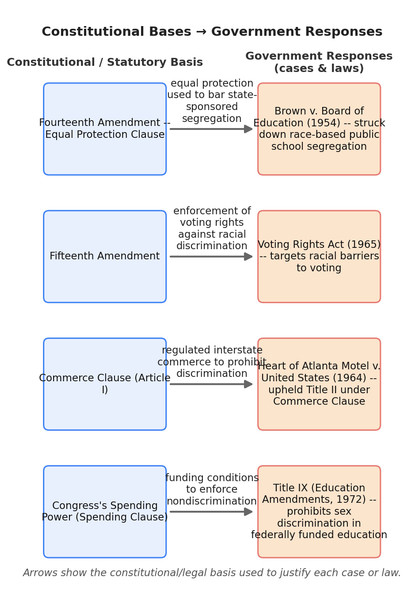
Brown and the Fourteenth Amendment
Equal protection bars states from denying equal protection of the laws. Segregated public schools were unconstitutional state action.Civil Rights Act and congressional power
Congress used the commerce clause to regulate discriminatory businesses. In Heart of Atlanta Motel v. United States (1964), the Court upheld Title II against a motel that refused Black customers. Congress also used its enforcement powers under the Fourteenth Amendment.Voting Rights Act and the Fifteenth Amendment
Congress can act against racial discrimination in voting.Title IX and the spending power
Congress can attach nondiscrimination conditions to federal funding.
The Main Comparisons to Lock In
| Item | What it is | Main focus |
|---|---|---|
| Brown | Supreme Court ruling | Race segregation in public schools |
| Civil Rights Act | Act of Congress | Broad discrimination in public accommodations, employment, schools, federally funded programs |
| Voting Rights Act | Act of Congress | Racial discrimination in voting |
| Title IX | Act of Congress | Sex discrimination in education |
The common theme is that social movements can push multiple institutions to act. Real change depends on enforcement, federal supremacy, and follow-through.
Key Takeaways
Brown v. Board of Education (1954)
Unanimous Supreme Court decision holding that state-mandated racial segregation in public schools violates the Fourteenth Amendment’s equal protection clause because separate educational facilities are inherently unequal
Civil Rights Act of 1964
Federal law prohibiting discrimination in public accommodations, promoting school and public-facility integration, barring employment discrimination, and restricting discrimination in federally funded programs
Voting Rights Act of 1965
Federal law prohibiting racial discrimination in voting and creating enforcement mechanisms such as bans on literacy tests, federal supervision, and originally preclearance
Title IX of the Education Amendments of 1972
Federal law prohibiting sex discrimination in any education program or activity receiving federal financial assistance
Notes
Brown v. Board of Education (1954)
Unanimous Supreme Court decision holding that state-mandated racial segregation in public schools violates the Fourteenth Amendment’s equal protection clause because separate educational facilities are inherently unequal
Civil Rights Act of 1964
Federal law prohibiting discrimination in public accommodations, promoting school and public-facility integration, barring employment discrimination, and restricting discrimination in federally funded programs
Voting Rights Act of 1965
Federal law prohibiting racial discrimination in voting and creating enforcement mechanisms such as bans on literacy tests, federal supervision, and originally preclearance
Title IX of the Education Amendments of 1972
Federal law prohibiting sex discrimination in any education program or activity receiving federal financial assistance
