Topic 4.1 Notes – American Attitudes About Government and Politics
How Core Values Shape Attitudes About Government
A core value is a lasting belief about how political, economic, and social life should work. An attitude is your judgment about a political issue or object, like taxes, welfare, regulation, or federal power. A policy preference is the specific action you want government to take.
The chain matters more than the vocabulary:
- You start with a value.
- You interpret what that value means.
- You judge current conditions through that interpretation.
- You form an attitude about government’s role.
- That leads to a policy preference.
So two people can agree on the value and still clash over policy. They may mean different things by the same word, or see different facts as the problem.
A common AP Gov move is this: don’t stop at naming the value. Explain how the interpretation of the value leads to support for more or less government action.
This topic is political culture. It deals with broad shared beliefs. It is not yet ideology, party ID, or public opinion polling.
The Four Core Values
Individualism
Individualism says people can shape their lives through their own choices. It emphasizes self-reliance, autonomy, and responsibility.
- Limited-government reading: government can interfere with choice and create dependency, so less government protects independence.
- Active-government reading: government can protect liberty, stop coercion or discrimination, and expand real independence through education or opportunity.
Students often mix this up with liberty. Liberty is freedom from restraint. Individualism is broader because it includes the idea that people should direct their own lives.
Equality of Opportunity
Equality of opportunity means everyone should have a fair chance to compete.
- It does not mean equality of outcome. It does not promise equal wealth, status, or success.
- Formal reading: equal rules and equal legal treatment are enough.
- Substantive reading: barriers like discrimination, weak schools, or lack of access can ruin fair competition, so government may need to act.
The classic contrast is same rules for all versus fair conditions for competition.
Free Enterprise
Free enterprise means an economy built on private ownership, voluntary exchange, competition, and limited regulation.
Adam Smith in The Wealth of Nations is the standard name here. His invisible hand idea says self-interest and competition can guide resources efficiently.
Government still has a role in free enterprise:
- enforcing contracts
- protecting property rights
- preventing fraud
- keeping public order
So AP Gov does not treat free enterprise as “government can never regulate.”
- Limited-regulation reading: regulation distorts prices, innovation, and competition.
- Guardrails reading: some rules protect fair competition and informed consumer choice.
Rule of Law
Rule of law means everyone, including public officials, is accountable under the same laws.
It rejects arbitrary government. Power has to be used through lawful authority and regular procedures. That gives both accountability and predictability.
- Restraint reading: officials must stay within constitutional and legal limits.
- Enforcement reading: government needs enough power to make powerful people and institutions obey the law.
Rule of law does not mean blind obedience to whatever government says.
Why Shared Values Still Produce Political Conflict
People usually do not fight over the name of the value. They fight over interpretation, application, and balance.
- Individualism can mean government blocks independence or makes real independence possible.
- Equality of opportunity can mean equal rules are enough or barriers must be removed too.
- Free enterprise can mean regulation hurts competition or protects fair exchange.
- Rule of law can mean limit enforcers tightly or empower them enough to enforce the law.
Values can also clash with each other.
- Regulation may increase equality of opportunity but limit free enterprise.
- Public assistance may support personal agency but require taxes and a larger federal role.
- Fast government action may seem effective but violate rule-of-law procedures.
A big exam trap is treating values like automatic party labels. The same value can support opposite positions, and the same policy can be defended with more than one value.
Applying the Values to Government Action
When you apply this on a question, the reasoning should sound like this:
- Identify the value named or implied.
- Say what the value means.
- Identify the interpretation being used.
- Explain how that interpretation shapes a view of federal action.
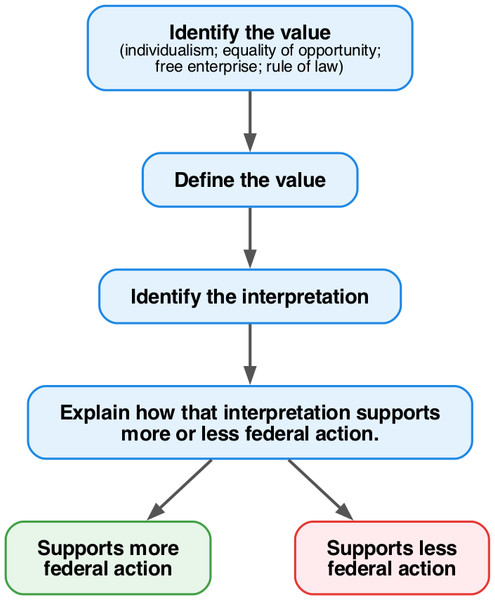
Framework for analyzing values and federal action
That four-step pattern is what the flowchart is showing, and it is a good way to structure a short-answer response.
Signal language helps:
- “personal choice,” “self-reliance,” “responsibility” = individualism
- “fair chance,” “access,” “barriers,” “compete” = equality of opportunity
- “competition,” “markets,” “consumers,” “regulation,” “private ownership” = free enterprise
- “accountability,” “same laws,” “due process,” “official limits” = rule of law
A standard example is federal job-training grants.
- Support: individualism means helping people direct their own futures, and equality of opportunity means reducing barriers to competition.
- Oppose: individualism means personal responsibility, and free enterprise means private choices and market response should handle it.
The strongest AP answer makes the full connection to the role of the federal government, not just the value word.
Key Takeaways
Core Value
An enduring normative principle about how political, economic, and social life ought to operate
Individualism
The belief that people can and should shape their lives through their own choices, agency, self-reliance, and personal responsibility
Equality of Opportunity
The belief that all people should have an equal chance to compete, not a guarantee of equal outcomes
Free Enterprise
An economic system based primarily on private ownership, voluntary exchange, self-interest, competition, and limited government regulation
Rule of Law
The principle that everyone, including government officials, is subject to the same laws and lawful procedures
Notes
Core Value
An enduring normative principle about how political, economic, and social life ought to operate
Individualism
The belief that people can and should shape their lives through their own choices, agency, self-reliance, and personal responsibility
Equality of Opportunity
The belief that all people should have an equal chance to compete, not a guarantee of equal outcomes
Free Enterprise
An economic system based primarily on private ownership, voluntary exchange, self-interest, competition, and limited government regulation
Rule of Law
The principle that everyone, including government officials, is subject to the same laws and lawful procedures
