Topic 5.8 Notes – Electing a President
How Presidential Elections Work
A presidential election is not one big national popular-vote contest. It’s a chain of events that moves from party choice to voter choice to constitutional counting.
- Invisible primary
- State primaries and caucuses
- National party conventions
- General election
- Electoral College vote and congressional count
That order matters because the first half is about who each party nominates. The second half is about which party ticket wins the presidency.
This infographic gives you the full sequence at a glance, from early party competition through the Electoral College and inauguration.
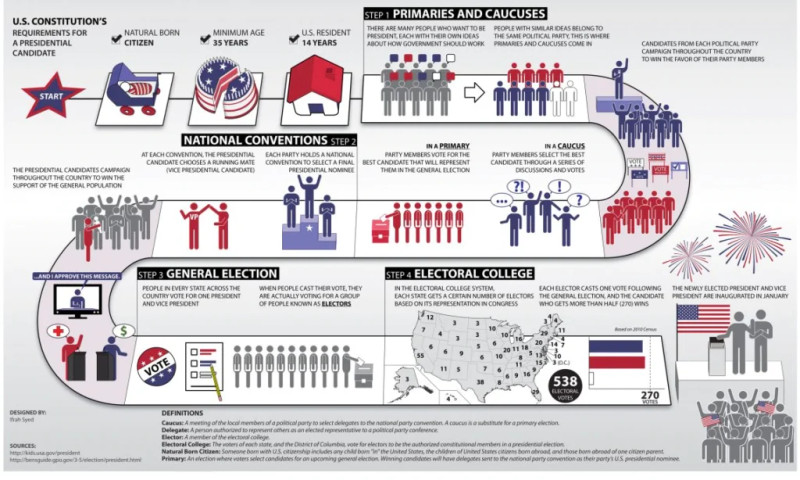
Presidential election process
A quick grounding point students mix up all the time: in November, you feel like you’re voting directly for president, but legally you’re choosing a slate of electors pledged to that ticket.
Federalism runs through this whole process. The Constitution creates the presidency and Electoral College, but states run elections and decide how electors are awarded.
The Nomination Process
Before the country chooses a president, the parties choose their candidates. That’s why nomination rules matter so much.
Invisible primary
The invisible primary is the informal stage before any votes are cast. Candidates try to prove they are serious and electable.
- Fundraising shows whether a campaign can survive.
- Endorsements from party leaders, interest groups, and activists signal support inside the party.
- Media attention and polling shape who looks viable.
- Staff-building and organization matter because modern campaigns are candidate-centered.
Early money and support often snowball. Weak candidates frequently drop out before most voters ever get a say.
Primaries and caucuses
Primaries and caucuses help parties choose nominees through delegates, not by directly electing the president.
- Open primary
Voters do not need to be registered members of the party. This can bring in independents and less partisan voters. - Closed primary
Only registered party members may vote. This gives more influence to committed party members. - Caucus
A meeting of party members at a set time and place. It takes more time than a primary, so turnout is usually lower and activists have more influence.
Delegates and momentum
Delegates go to the national convention and formally choose the nominee. Early wins can create momentum.
- More media coverage
- More donations
- More endorsements
- More “this person can win” energy
One easy AP trap is mixing up primary delegates with electoral votes. They are completely different systems.
National party conventions
Conventions usually confirm what the primaries already decided.
- Formally nominate the presidential candidate
- Confirm the vice-presidential running mate
- Adopt the party platform
- Help unify the party after the primary season
Modern conventions are usually confirmatory, not suspenseful.
The General Election and Incumbency
The general election happens every four years on the Tuesday after the first Monday in November. Voters choose among party tickets, but technically they are choosing electors.
Campaigns use:
- debates
- ads
- fundraising
- polling
- voter registration
- GOTV efforts
A sitting president running again has incumbency advantage.
- name recognition
- constant media visibility
- the bully pulpit
- existing donor and party networks
- a record of experience and accomplishments
- usually less serious primary opposition
Incumbency helps, but it can also backfire if voters dislike the economy, a war, a scandal, or the president’s approval rating. Also remember the Twenty-Second Amendment. A president elected twice cannot run again.
The Electoral College
The Electoral College is the constitutional system that formally elects the president and vice president.
- Article II creates the system
- Twelfth Amendment requires separate electoral votes for president and vice president
- Total electors = 538
- 435 House seats
- 100 senators
- 3 for D.C. from the Twenty-Third Amendment
To win, a candidate needs 270 electoral votes.
How states allocate electors
Most states use winner-take-all. Win the statewide popular vote, get all that state’s electoral votes.
Maine and Nebraska are the exceptions.
- 1 elector goes to each congressional district winner
- 2 at-large electors go to the statewide winner
The map shows the district method in those two states. Since states choose this method, the Electoral College is also a federalism issue.
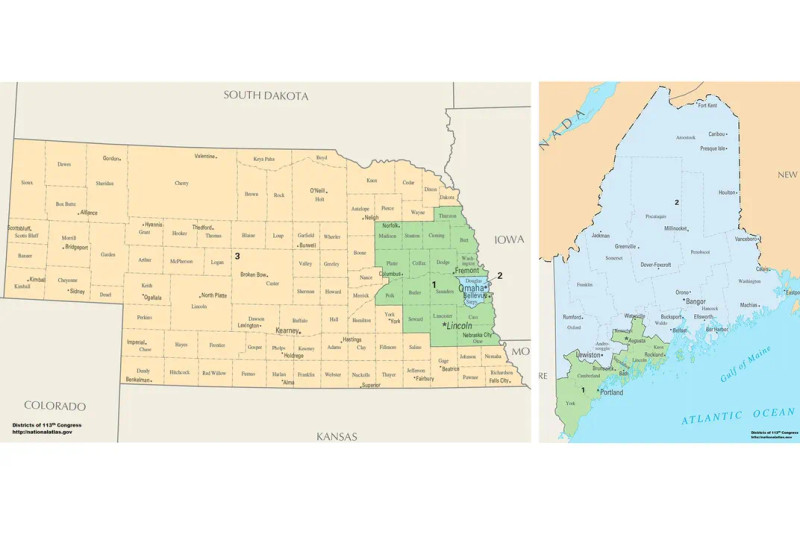
Maine and Nebraska's district-based electoral votes
How it shapes outcomes
Because of winner-take-all rules, campaigns care most about swing states.
- Battleground states get visits, ads, and organizing
- Safe states get less attention
- Narrow state wins can produce big electoral rewards
- A candidate can win the popular vote and still lose the presidency
Key examples:
- 2000: Al Gore won the national popular vote; George W. Bush won the Electoral College after Florida. Bush v. Gore ended the recount.
- 2016: Hillary Clinton won the popular vote; Donald Trump won the Electoral College.
If nobody gets a majority, the Twelfth Amendment kicks in.
- House chooses the president from the top 3, with one vote per state delegation
- Senate chooses the vice president from the top 2
The Debate Over the Electoral College
This debate is really about two values colliding.
Arguments for keeping it
- preserves federalism and states’ role
- pushes candidates to build broad geographic coalitions
- keeps huge population centers from dominating
- usually gives a clear winner
Arguments for changing or abolishing it
- can conflict with the national popular vote
- gives unequal influence across states
- overfocuses on swing states
- winner-take-all can wipe out minority votes within a state
Key Takeaways
Invisible Primary
Informal pre-primary competition in which prospective candidates build viability through fundraising, endorsements, staffing, polling, and media attention
Incumbency Advantage
Reelection benefits of holding office, including name recognition, media attention, the presidency’s prestige, established campaign networks, and a record of accomplishments
Presidential Primary
State election in which voters express a preference among candidates for a party’s nomination, determining or influencing the allocation of convention delegates
Closed Primary
Primary in which participation is restricted to voters registered with the party holding the election
Open Primary
Primary in which voters may participate without previously registering as members of the party holding the election
Caucus
Meeting in which party members discuss candidates and participate in selecting candidates, choosing delegates, or deciding party policy
Delegate
Person selected to represent a state or other party unit and vote at the party’s national convention
National Party Convention
Party meeting at which delegates formally nominate the presidential and vice-presidential candidates, promote the platform, and unite the party for the general election
Party Platform
Statement of a political party’s principles, policy goals, and positions, adopted or publicized at its national convention but not legally binding
General Election
Election between party nominees and qualifying independent candidates in which voters legally choose pledged slates of presidential electors
Electoral College
Constitutional system that formally elects the president and vice president; each state receives electors equal to its representatives plus senators, the District of Columbia receives three, and 270 of 538 votes are required when all electors are appointed
Presidential Elector
Person appointed to cast a state’s formal Electoral College votes for president and vice president
Faithless Elector
Elector who votes for someone other than the candidates the elector was pledged to support
National Popular Vote
Total presidential votes cast nationwide, which has no independent constitutional role in determining the winner
Winner-Take-All System (Unit-Rule System)
Electoral-vote allocation method in which the statewide popular-vote plurality winner receives all of the jurisdiction’s electoral votes
Congressional District Method
Method used by Maine and Nebraska that awards one elector to each congressional-district winner and two electors to the statewide winner
Popular-Vote–Electoral-Vote Divergence
Outcome in which the candidate winning the Electoral College loses the national popular vote because electoral votes are awarded state by state
Contingent Election
Procedure used when no candidate wins an electoral majority: the House chooses the president from the top three by one vote per state, and the Senate chooses the vice president from the top two
Twelfth Amendment
Amendment requiring electors to cast separate votes for president and vice president and establishing contingent-election procedures
Twenty-Third Amendment
Amendment granting the District of Columbia the same number of electors as the least populous state, currently three
2000 Presidential Election
Election in which Al Gore won the national popular vote but George W. Bush won the presidency after a 537-vote Florida victory produced a 271–266 electoral majority
Safe State
State that reliably supports one political party and therefore receives relatively little presidential campaign attention
Swing State (Battleground State)
Competitive state that either major-party presidential candidate has a realistic chance of winning
Notes
Invisible Primary
Informal pre-primary competition in which prospective candidates build viability through fundraising, endorsements, staffing, polling, and media attention
Incumbency Advantage
Reelection benefits of holding office, including name recognition, media attention, the presidency’s prestige, established campaign networks, and a record of accomplishments
Presidential Primary
State election in which voters express a preference among candidates for a party’s nomination, determining or influencing the allocation of convention delegates
Closed Primary
Primary in which participation is restricted to voters registered with the party holding the election
Open Primary
Primary in which voters may participate without previously registering as members of the party holding the election
Caucus
Meeting in which party members discuss candidates and participate in selecting candidates, choosing delegates, or deciding party policy
Delegate
Person selected to represent a state or other party unit and vote at the party’s national convention
National Party Convention
Party meeting at which delegates formally nominate the presidential and vice-presidential candidates, promote the platform, and unite the party for the general election
Party Platform
Statement of a political party’s principles, policy goals, and positions, adopted or publicized at its national convention but not legally binding
General Election
Election between party nominees and qualifying independent candidates in which voters legally choose pledged slates of presidential electors
Electoral College
Constitutional system that formally elects the president and vice president; each state receives electors equal to its representatives plus senators, the District of Columbia receives three, and 270 of 538 votes are required when all electors are appointed
Presidential Elector
Person appointed to cast a state’s formal Electoral College votes for president and vice president
Faithless Elector
Elector who votes for someone other than the candidates the elector was pledged to support
National Popular Vote
Total presidential votes cast nationwide, which has no independent constitutional role in determining the winner
Winner-Take-All System (Unit-Rule System)
Electoral-vote allocation method in which the statewide popular-vote plurality winner receives all of the jurisdiction’s electoral votes
Congressional District Method
Method used by Maine and Nebraska that awards one elector to each congressional-district winner and two electors to the statewide winner
Popular-Vote–Electoral-Vote Divergence
Outcome in which the candidate winning the Electoral College loses the national popular vote because electoral votes are awarded state by state
Contingent Election
Procedure used when no candidate wins an electoral majority: the House chooses the president from the top three by one vote per state, and the Senate chooses the vice president from the top two
Twelfth Amendment
Amendment requiring electors to cast separate votes for president and vice president and establishing contingent-election procedures
Twenty-Third Amendment
Amendment granting the District of Columbia the same number of electors as the least populous state, currently three
2000 Presidential Election
Election in which Al Gore won the national popular vote but George W. Bush won the presidency after a 537-vote Florida victory produced a 271–266 electoral majority
Safe State
State that reliably supports one political party and therefore receives relatively little presidential campaign attention
Swing State (Battleground State)
Competitive state that either major-party presidential candidate has a realistic chance of winning
