Topic 1.2 Notes – Types of Democracy
What Representative Democracy Is
The United States is a representative democracy, or republic. That means political authority comes from the people, but people usually act by electing officials who make decisions for them.
- Popular sovereignty means government gets its legitimacy from the people’s consent.
- In practice, you do not vote directly on most federal laws, executive actions, or court decisions. You vote for people who do those jobs.
- That is the key difference from direct democracy, where citizens themselves vote on policy.
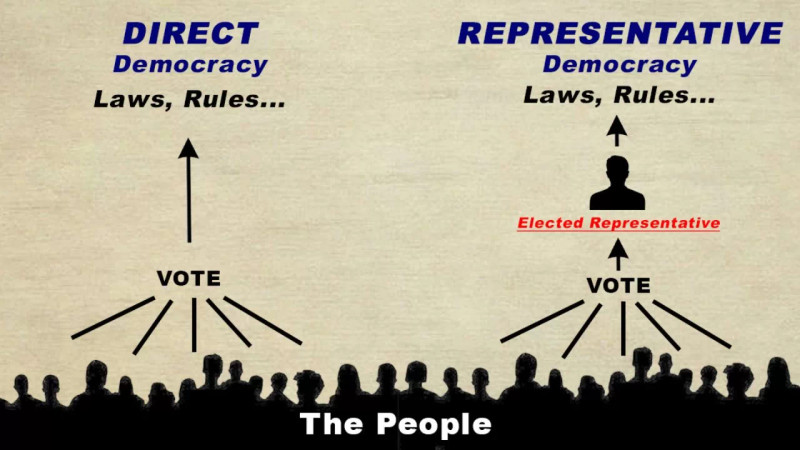
Direct democracy vs. representative democracy
This is why AP Gov keeps coming back to one tension. Democracy requires public consent, but the system also filters public power through institutions.
Direct-democratic features still exist, mostly below the national level:
- Initiatives let citizens put a proposed law or amendment on the ballot.
- Referendums let voters approve or reject a measure.
- Recalls let voters remove an official before the term ends.
- New England town meetings are the classic example of citizens debating and voting directly on local issues.
The Three Models of Democracy
These three models are lenses, not separate systems. The same event can fit more than one.
Participatory democracy
Participatory democracy says democracy works best when lots of ordinary people are actively involved.
- Participation includes voting, primaries and caucuses, town meetings, public hearings, protests, marches, petitions, grassroots organizing, and voter-registration drives.
- Civil society means voluntary groups between private life and government, like community groups, churches, and civic organizations.
- The main idea is that more participation makes government more responsive and increases political efficacy, the feeling that your actions matter.
Its weakness is unequal participation. Time, money, education, and access make it easier for some people to engage than others.
Pluralist democracy
Pluralist democracy says power often works through organized groups competing to shape policy.
| Group types | Common methods |
|---|---|
| interest groups, labor unions, business groups, civil rights groups, environmental groups, professional associations | lobbying, testimony, campaign activity, lawsuits, amicus briefs, coalition building, public campaigns |
The core idea is that many competing interests keep any one faction from dominating. The weakness is that groups do not have equal resources or access.
Elite democracy
Elite democracy says political power is concentrated in a relatively small group.
- Elites can include elected officials, judges, senior bureaucrats, party leaders, major donors, business leaders, and influential media figures.
- The idea here is that complex decisions get filtered through experienced leaders.
- The critique is that government may respond more to powerful people than to ordinary citizens.
How the Constitution Reflects All Three Models
The Constitution mixes participation with distance and filtering.
- Participatory features include “We the People,” regular elections, and rights of speech, assembly, petition, and political organizing.
- Filtered and elite features include no national direct democracy, the Electoral College, the original indirect election of senators before the Seventeenth Amendment, and appointed federal judges serving during good behavior.
- Different term lengths and staggered elections slow sudden swings in public opinion.
- Pluralist features show up because a large republic has many interests, and separation of powers plus federalism create multiple access points. Groups can target Congress, the president, courts, and state governments.
That last point is what this checks and balances diagram is helping you see. Power is split across the three branches, so political actors and interest groups have several places to press their case.
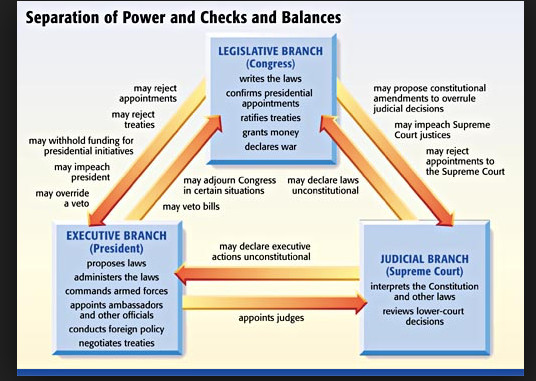
Separation of powers and checks and balances
Federalist No. 10 and Brutus No. 1
Both support republican government and liberty. They disagree about whether a large republic protects freedom or threatens it.
Federalist No. 10
James Madison argued that factions are inevitable. A faction is a group driven by interests harmful to others or the common good.
His argument works like this:
- You cannot eliminate factions without destroying liberty.
- Government must control their effects.
- A large republic works better because many interests make majority tyranny less likely.
- Representation helps refine public views.
This connects most strongly to pluralist democracy and filtered or elite features.
Brutus No. 1
Brutus, an Anti-Federalist, argued that a free republic needs representatives close to the people.
- In a large republic, representatives become distant and less accountable.
- Fewer, farther-away representatives can turn into a governing class.
- Smaller, more local government better protects liberty and responsiveness.
This connects most strongly to participatory democracy.
How to Identify the Models in Real Examples
You can usually sort a scenario by asking who is exercising influence and how that influence reaches government.
The civil rights movement shows the overlap clearly:
- Participatory when people joined boycotts, sit-ins, marches, and voter-registration campaigns.
- Pluralist when groups like the NAACP and SCLC used litigation, lobbying, and organized advocacy.
- Elite when presidents, judges, congressional leaders, and committee chairs made final policy decisions.
Key Takeaways
Representative Democracy (Republic)
A system in which citizens elect representatives to make laws and conduct government on their behalf
Direct Democracy (Pure Democracy)
A system in which citizens themselves deliberate and vote on public policy rather than relying on representatives to decide
Participatory Democracy
A model of representative democracy emphasizing broad, active citizen involvement in politics and civil society
Pluralist Democracy
A model of representative democracy emphasizing competition among organized nongovernmental groups seeking to influence policy
Elite Democracy
A model of representative democracy emphasizing limited mass participation and disproportionate influence by a small group of leaders
Civil Society
The sphere of voluntary associations and activity between private life and formal government
Ballot Initiative
A procedure allowing citizens to gather petition signatures to place a proposed law or constitutional amendment before voters
Referendum
A procedure that places an existing or proposed government measure before voters for approval or rejection
Recall
A procedure allowing voters to decide whether to remove an elected official before the official’s term ends
New England Town Meeting
A local assembly in which eligible residents debate and vote directly on public matters such as budgets and ordinances
Faction
In Federalist No. 10, a group united by a passion or interest adverse to others’ rights or the community’s lasting interests
Federalist No. 10
Madison’s argument that a large representative republic controls faction by filtering public opinion and multiplying competing interests
Brutus No. 1
An Anti-Federalist argument that a large republic makes representatives remote and unresponsive, threatening liberty and self-government
Notes
Representative Democracy (Republic)
A system in which citizens elect representatives to make laws and conduct government on their behalf
Direct Democracy (Pure Democracy)
A system in which citizens themselves deliberate and vote on public policy rather than relying on representatives to decide
Participatory Democracy
A model of representative democracy emphasizing broad, active citizen involvement in politics and civil society
Pluralist Democracy
A model of representative democracy emphasizing competition among organized nongovernmental groups seeking to influence policy
Elite Democracy
A model of representative democracy emphasizing limited mass participation and disproportionate influence by a small group of leaders
Civil Society
The sphere of voluntary associations and activity between private life and formal government
Ballot Initiative
A procedure allowing citizens to gather petition signatures to place a proposed law or constitutional amendment before voters
Referendum
A procedure that places an existing or proposed government measure before voters for approval or rejection
Recall
A procedure allowing voters to decide whether to remove an elected official before the official’s term ends
New England Town Meeting
A local assembly in which eligible residents debate and vote directly on public matters such as budgets and ordinances
Faction
In Federalist No. 10, a group united by a passion or interest adverse to others’ rights or the community’s lasting interests
Federalist No. 10
Madison’s argument that a large representative republic controls faction by filtering public opinion and multiplying competing interests
Brutus No. 1
An Anti-Federalist argument that a large republic makes representatives remote and unresponsive, threatening liberty and self-government
