Topic 1.1 Notes – Ideals of Democracy
The Democratic Ideals Behind American Government
These four ideals are the foundation of everything else in the course, so it helps to see them as one argument instead of four vocab words.
- Natural rights are rights people have by nature, not because government gives them permission. In this tradition, rights can be violated, but they cannot be made legitimate just because a ruler says so.
- Social contract explains why government exists. People give up some freedom and agree to obey common rules so they can have order and protection.
- Popular sovereignty answers where government gets power. Its authority is legitimate only because the people consent to it.
- Limited government answers why power must have boundaries. If government gets authority from the people for a purpose, it cannot be all-powerful.
That gives you the full logic chain:
people have rights → create government to protect rights and keep order → government gets power from the people → that power must stay limited
Key distinctions
- Natural rights = what people possess
- Social contract = why government exists
- Popular sovereignty = where government gets power
- Limited government = why government cannot act absolutely
Philosophers and early examples
- John Locke, Second Treatise of Civil Government (1690) argued that people have rights to life, liberty, and property, and that government exists to secure them.
- Thomas Hobbes described the state of nature as life without government, where insecurity and violence make life unstable. AP Gov often uses Somalia as a failed-state example of that disorder.
- Mayflower Compact (1620) shows early social contract and consent-based government. The signers agreed to form a political community and obey laws for the colony’s good.
- “All men are created equal” means equal political and moral worth. It does not mean everyone has the same talents, wealth, or life outcomes.
How Limited Government Is Protected
Limited government needs structure, or else it is just a slogan. The Constitution protects it through four connected principles.
- Separation of powers divides authority among the legislative, executive, and judicial branches so one institution cannot make, enforce, and judge law all at once. This idea comes from Montesquieu’s The Spirit of the Laws (1748).
- Checks and balances lets each branch restrain the others. The diagram highlights familiar examples like presidential veto, congressional override, Senate confirmation, impeachment, and judicial review.
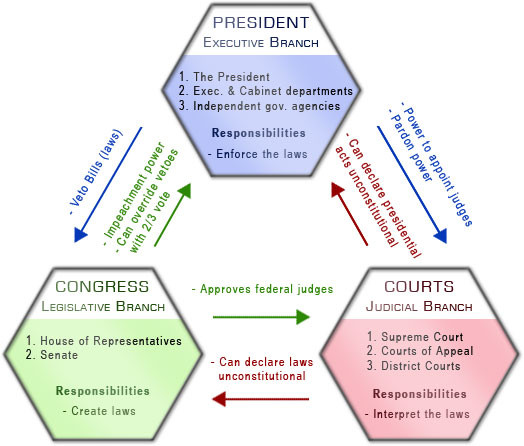
Checks and balances among the three branches
- Federalism divides power between the national and state governments, which keeps authority from piling up in one central place.
- Republicanism means people govern indirectly through elected representatives. Power is delegated by voters, not inherited.
A common trap is thinking limited government means weak government. It doesn’t. It means government with legal and constitutional boundaries.
The Declaration of Independence
The Declaration was drafted mainly by Thomas Jefferson, with help from John Adams and Benjamin Franklin. It is the clearest statement of natural rights and popular sovereignty.
Phrases you need to know
- “unalienable Rights” = natural rights
- “Life, Liberty and the pursuit of Happiness” = Locke’s idea adapted
- “consent of the governed” = popular sovereignty
- “alter or abolish” = people may replace a government that violates its purpose
The Declaration’s logic
- People have rights.
- Governments are created to protect those rights.
- Legitimate power comes from consent.
- A government that destroys rights loses legitimacy.
- Independence from Britain was justified.
It also hints at social contract and limited government, but its main emphasis is rights and consent.
The Constitution and the Gettysburg Address
The Constitution was drafted in Philadelphia in 1787. James Madison was the central architect, George Washington presided, Alexander Hamilton contributed, and the Grand Committee helped settle disputes.
- “We the People” expresses popular sovereignty.
- The Constitution acts like a social contract because it creates government, defines its powers, and sets its purposes.
- It shows limited government through branches, checks, federalism, and representation.
The Gettysburg Address came in 1863, during the Civil War. Lincoln points back to 1776, not 1787, which reconnects the nation to the Declaration’s equality principle.
- “all men are created equal” = equality as a democratic foundation
- “government of the people, by the people, for the people” = popular sovereignty
Its job was to reaffirm equality and government by the people during crisis.
How to Match Ideals to Documents and Examples
| Source or thinker | Best match | Why |
|---|---|---|
| Declaration of Independence | Natural rights and popular sovereignty | Rights + consent justify government |
| Constitution | Social contract and limited government | Creates government and limits it |
| Gettysburg Address | Equality and popular sovereignty | Reaffirms rule by the people |
| Mayflower Compact | Social contract and popular sovereignty | Agreement to form and obey government |
| Locke | Natural rights | Life, liberty, property |
| Hobbes | Reason people need government | State of nature is insecure |
| Montesquieu | Protection for liberty | Separation of powers |
When you apply this on a test, the move is simple. Identify the phrase or structure, name the ideal, then explain why it fits. These ideas are connected, but they are not interchangeable.
Key Takeaways
Natural Rights (Unalienable or Inalienable Rights)
Rights people possess by nature that government does not create and cannot legitimately take away
Social Contract
An implicit agreement in which people create and obey government, surrendering some freedom so it will maintain order and protect rights
Popular Sovereignty (Consent of the Governed)
The principle that ultimate political authority belongs to the people and legitimate government derives its power from their consent
Limited Government
Government whose power is legally and institutionally restricted rather than absolute
Separation of Powers
Division of national governmental responsibilities among the legislative, executive, and judicial branches to prevent concentrated power
Checks and Balances
Constitutional powers that allow each branch to restrain or influence the actions of the other branches
Federalism
Division of governing authority between the national government and state governments
Republicanism
Representative government in which the people elect officials to exercise delegated authority on their behalf
Equality
The principle that all people have equal political and moral standing, fundamental rights, and no natural title to rule others
Declaration of Independence
The 1776 document principally drafted by Thomas Jefferson that justifies independence through natural rights and popular sovereignty
U.S. Constitution
The 1787 governing charter that acts as a social contract and creates limited government through divided, checked, federal, and representative institutions
Gettysburg Address
Abraham Lincoln’s 1863 Civil War speech reaffirming equality and popular sovereignty as the foundations of American democracy
Notes
Natural Rights (Unalienable or Inalienable Rights)
Rights people possess by nature that government does not create and cannot legitimately take away
Social Contract
An implicit agreement in which people create and obey government, surrendering some freedom so it will maintain order and protect rights
Popular Sovereignty (Consent of the Governed)
The principle that ultimate political authority belongs to the people and legitimate government derives its power from their consent
Limited Government
Government whose power is legally and institutionally restricted rather than absolute
Separation of Powers
Division of national governmental responsibilities among the legislative, executive, and judicial branches to prevent concentrated power
Checks and Balances
Constitutional powers that allow each branch to restrain or influence the actions of the other branches
Federalism
Division of governing authority between the national government and state governments
Republicanism
Representative government in which the people elect officials to exercise delegated authority on their behalf
Equality
The principle that all people have equal political and moral standing, fundamental rights, and no natural title to rule others
Declaration of Independence
The 1776 document principally drafted by Thomas Jefferson that justifies independence through natural rights and popular sovereignty
U.S. Constitution
The 1787 governing charter that acts as a social contract and creates limited government through divided, checked, federal, and representative institutions
Gettysburg Address
Abraham Lincoln’s 1863 Civil War speech reaffirming equality and popular sovereignty as the foundations of American democracy
