Topic 2.9 Notes – The Role of the Judicial Branch
Legal Precedent and Stare Decisis
Courts do more than settle one dispute. When a court answers a legal question, that answer can guide later cases.
- Legal precedent is a rule or principle from an earlier court decision that guides later cases with the same legal question and materially similar facts.
- The holding is the actual rule the case establishes.
- The reasoning comes from the majority opinion. It explains why the Court reached that rule and helps later judges figure out how broad or narrow the rule is.
This only makes sense because of judicial review from Marbury v. Madison (1803). That case gave courts the power to interpret the Constitution and strike down laws that conflict with it. Precedent is how those interpretations carry forward over time.
Stare decisis means “let the decision stand” or “stand by things decided.” It is the doctrine that courts should follow precedent when deciding similar cases.
Why that matters:
- Consistency means similar cases get similar outcomes.
- Predictability lets people, schools, businesses, and governments rely on settled rules.
- Restraint pushes judges to start with law that already exists instead of personal preference.
- Legitimacy makes decisions look grounded in law, which matters because courts do not control the purse or the army.
- Continuity keeps law from swinging wildly every time Court membership changes.
How Courts Use Earlier Decisions
A court has several ways to deal with precedent.
Follow
The court applies the existing rule to a case with materially similar facts. Lower courts usually must do this when a higher court has already spoken.Extend
The court uses the logic of an earlier case in a new but closely related situation.Distinguish
The court says the earlier case does not control because the facts or legal issue are meaningfully different. The old precedent stays intact.Narrow
The court limits a precedent so it applies in fewer situations.Overrule
The court rejects the old legal rule entirely.
A common AP trap is mixing up overruling and reversing. Overruling kills a rule from an earlier case. Reversing changes the lower court’s decision in the case currently on appeal.
It helps to connect that idea to the court hierarchy, because precedent usually flows downward from higher courts to lower courts.
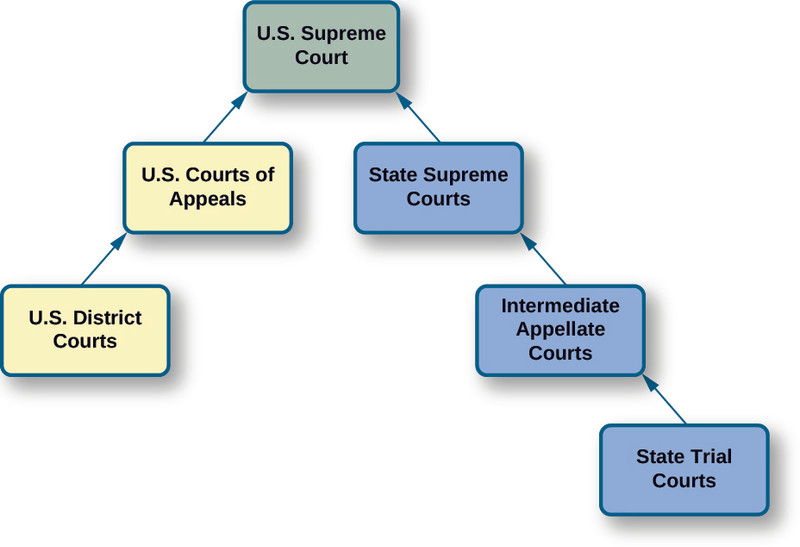
Federal and state court hierarchy
- U.S. Supreme Court precedent binds lower federal courts on the Constitution and federal law.
- State courts must also follow Supreme Court rulings on federal questions.
- State supreme courts are final only on issues of state law alone.
Supreme Court Precedent in Action
Some cases show exactly how precedent works across time.
- Marbury v. Madison (1803) established judicial review, which makes precedent in constitutional cases so powerful.
- Martin v. Hunter’s Lessee (1816) said the Supreme Court can review state-court decisions involving federal law. That keeps the Constitution, treaties, and federal statutes from meaning different things in different states.
- United States v. Nixon (1974) held that executive privilege exists, but is not absolute. Nixon had to turn over evidence in a criminal case. This showed judicial authority over a sitting president.
- Brown v. Board of Education (1954) rejected Plessy v. Ferguson (1896) in public education. “Separate but equal” schools violated the Equal Protection Clause. Brown is the classic example that precedent matters, but bad constitutional precedent can be overruled.
How New Justices Can Shift Precedent
Precedent gives stability, but justices still interpret broad constitutional language through their own judicial philosophies.
- Presidents nominate justices.
- The Senate confirms them.
- Because justices have life tenure, one appointment can shape the law for decades.
Changes in Court membership can lead the Court to:
- create new precedent
- expand older precedent
- narrow earlier precedent
- distinguish new cases from old rules
- overrule precedent
Justices are not direct agents of presidents or parties. Cases still move through briefs, oral arguments, conference votes, and written opinions.
The New Deal era shows this clearly:
- Schechter Poultry Corp. v. United States (1935) struck down parts of New Deal legislation.
- Roosevelt responded with the court-packing plan, an attempt to add justices. Congress rejected it.
- West Coast Hotel Co. v. Parrish (1937) upheld a minimum-wage law and marked a shift toward accepting more government regulation.
- Later Roosevelt appointments changed the Court’s ideological balance even more.
Why This Matters for the Judicial Branch
The core tension is stability vs. change.
- Too much respect for precedent can preserve constitutional mistakes.
- Too little respect makes law unstable and makes the Court look political.
Federalist No. 78 says the judiciary has “neither force nor will, but merely judgment.” That means courts depend heavily on legitimacy and public acceptance.
Key Takeaways
Legal Precedent
A rule or principle established by an earlier judicial decision that guides later cases involving the same legal question and materially similar facts
Stare Decisis
The doctrine that courts should follow precedent when deciding cases with similar facts and legal questions—“to stand by things decided.”
Vertical Precedent
The principle that lower courts must follow controlling decisions of higher courts, including Supreme Court rulings on federal law
Distinguishing a Precedent
Identifying a material factual or legal difference that makes an earlier rule inapplicable while leaving that precedent intact
Overruling a Precedent vs. Reversing a Judgment
Overruling rejects a rule from a previous case; reversing changes a lower court’s judgment in the same case
Judicial Ideology
A justice’s views about constitutional interpretation, governmental power, individual rights, federalism, and the proper role of courts
Ideological Composition of the Supreme Court
The Court’s balance of legal philosophies, which appointments can change and thereby influence whether precedents are created, expanded, narrowed, or overruled
Establishing a Precedent
Creating a new governing legal rule through a court’s holding, often when the legal question has not previously been resolved
Notes
Legal Precedent
A rule or principle established by an earlier judicial decision that guides later cases involving the same legal question and materially similar facts
Stare Decisis
The doctrine that courts should follow precedent when deciding cases with similar facts and legal questions—“to stand by things decided.”
Vertical Precedent
The principle that lower courts must follow controlling decisions of higher courts, including Supreme Court rulings on federal law
Distinguishing a Precedent
Identifying a material factual or legal difference that makes an earlier rule inapplicable while leaving that precedent intact
Overruling a Precedent vs. Reversing a Judgment
Overruling rejects a rule from a previous case; reversing changes a lower court’s judgment in the same case
Judicial Ideology
A justice’s views about constitutional interpretation, governmental power, individual rights, federalism, and the proper role of courts
Ideological Composition of the Supreme Court
The Court’s balance of legal philosophies, which appointments can change and thereby influence whether precedents are created, expanded, narrowed, or overruled
Establishing a Precedent
Creating a new governing legal rule through a court’s holding, often when the legal question has not previously been resolved
