Topic 1.9 Notes – Federalism in Action
How Federalism Shapes Policymaking
Federalism means power is divided and shared. In practice, that affects policy every day because authority over an issue is often split instead of sitting entirely at one level.
- Enumerated powers are powers the Constitution lists for the national government, like taxing, borrowing, and regulating interstate commerce.
- Implied powers come from the Necessary and Proper Clause. Congress can use them to carry out its enumerated powers.
- Reserved powers belong to the states under the Tenth Amendment.
- Concurrent powers are shared by both levels, like taxing, spending, and making laws.
This division is easiest to picture as overlapping authority. Some powers belong primarily to the national government, some to the states, and some are shared.
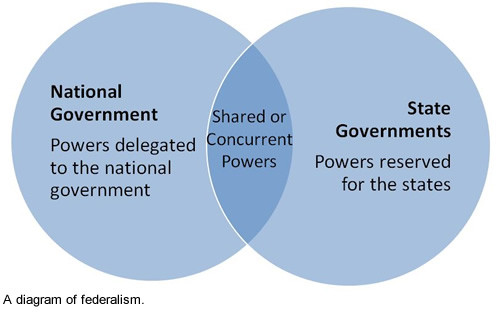
Federalism and concurrent powers
The key idea here is that policy authority is often mixed. States have broad police powers, which means they regulate health, safety, welfare, and morals. That covers areas like education, criminal law, and election administration. The national government still shapes those areas through the Commerce Clause, federal spending, civil rights enforcement, and the Supremacy Clause.
So federalism does two things at once. It creates more chances for action, and it limits any one government from acting alone.
Multiple Access Points for Stakeholders
Because authority is divided, people and groups get multiple access points for influencing policy. If one door closes, another may still be open.
Stakeholders can try to influence:
- National institutions such as Congress, the president, federal agencies, and federal courts
- State institutions such as legislatures, governors, state agencies, and state courts
- Local institutions such as city councils, county officials, and school boards
- Voters directly through initiatives and referenda in some states
This is where venue shopping comes in. A group chooses the level or institution most likely to agree with it. If it loses in Congress, it might try state legislatures. If state officials dislike a federal policy, they might lobby Congress or sue in court.
A great example is marijuana legalization. Colorado and Washington legalized recreational marijuana at the state level even though federal law still banned it. That shows how groups can win policy change in one venue even when another venue is hostile.
Advantages:
- more participation
- more routes to policy change
- easier to test ideas in friendly states
Disadvantages:
- fragmented authority
- conflicting goals across governments
- uneven policy across the country
State Policy Variation and Cooperative Federalism
States can make different choices because of reserved and concurrent powers. That is why policy varies in education, criminal law, environmental rules, elections, and health policy.
People call states laboratories of democracy because they can test policies on a smaller scale. When other states copy or adapt those policies, that is policy diffusion.
Marijuana legalization is a good example again. It shows experimentation, but it also shows conflict because state permission did not erase federal prohibition.
Some issues work through cooperative federalism, where national and state governments share responsibility. Medicaid is the classic example.
- Created in 1965
- Joint federal-state health program
- Federal government provides major funding and broad rules
- States run their own programs within those rules
That produces shared authority, bargaining, and different outcomes by state.
Fiscal Federalism and National Influence on State Policy
Fiscal federalism means using money to shape federal-state relations. The national government usually has more money, so it often influences states through grants.
| Grant type | What it means |
|---|---|
| Categorical grants | Narrow purpose, detailed rules |
| Block grants | Broad purpose, more state choice |
| Revenue sharing | Few restrictions, greatest flexibility |
The National Minimum Drinking Age Act of 1984 shows how this works:
- States normally control alcohol rules through police powers.
- Congress used its spending power instead of directly ordering states.
- States that kept the drinking age below 21 risked losing federal highway funds.
- Every state eventually adopted 21.
In South Dakota v. Dole (1987), the Court upheld this kind of conditional spending if the condition is clear, related to the program, and not too coercive.
A mandate requires states or local governments to do something. Unfunded mandates make them pay much of the cost themselves. The Americans with Disabilities Act of 1990 is a common example because compliance can require expensive changes by state and local governments.
Why National Policymaking Is Constrained
The national government cannot act wherever it wants. Congress must point to a constitutional power. It has no general police power like the states do.
That basic division of power helps explain why states still control many issues tied to health, safety, welfare, and local commerce, even though their laws cannot conflict with federal law.
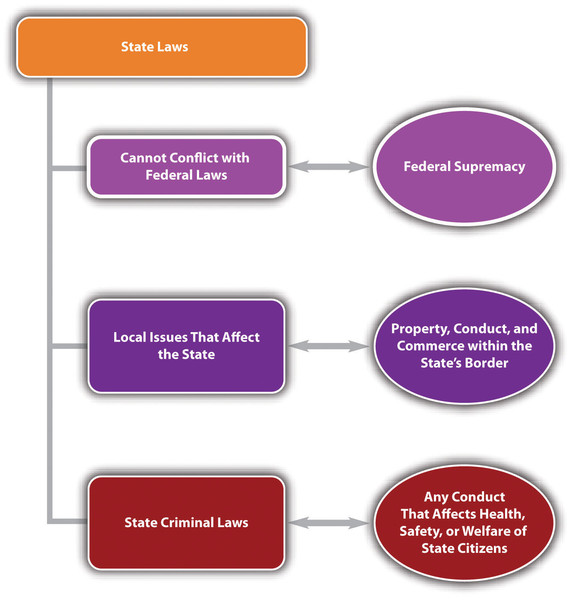
State police powers and federal supremacy
National policy often depends on:
- valid enumerated or implied powers
- state cooperation and implementation
- negotiation and compromise
- possible court review
States can resist by lobbying, seeking waivers, declining optional funding, or suing.
United States v. Lopez (1995) is the key limit case. The Court said the Gun-Free School Zones Act went beyond Congress’s Commerce Clause power. That did not mean guns near schools could not be regulated. It meant states could regulate that issue under their reserved powers.
Key Takeaways
Access Point
A governmental institution or decision-making venue through which a political actor can try to influence policy
Laboratories of Democracy
The idea that states can test policies on a smaller scale before other states or the national government adopt, adapt, or reject them
Policy Diffusion
The spread of a policy innovation from one state or jurisdiction to others
Cooperative Federalism
An arrangement in which national and state governments share responsibility for financing, administering, or enforcing policy
Fiscal Federalism
The use of taxation, spending, grants, and funding conditions to shape relationships among levels of government
Grant-in-Aid
Money provided by one level of government to another for a public purpose
Categorical Grant
A grant for a narrowly defined purpose that carries detailed requirements and gives recipients limited discretion
Block Grant
A grant for a broad policy area that gives states substantial freedom over how to spend the money
Revenue Sharing
Federal funding provided to state or local governments with few restrictions, giving recipients the greatest discretion
Conditional Spending
The use of federal funds offered on the condition that states adopt or follow specified policies
National Minimum Drinking Age Act of 1984
A law conditioning a portion of federal highway funding on states adopting a minimum drinking age of 21, which every state eventually did
Mandate
A national requirement that commands state or local governments to take specified action
Unfunded Mandate
A national requirement imposed on state or local governments without enough additional federal funding to cover compliance costs
Venue Shopping
Selecting the institution or level of government most likely to produce a favorable policy result
Preemption
Displacement of state law by valid federal law; it is express when Congress explicitly overrides state law and implied when federal law occupies the field or makes compliance with both laws impossible
Notes
Access Point
A governmental institution or decision-making venue through which a political actor can try to influence policy
Laboratories of Democracy
The idea that states can test policies on a smaller scale before other states or the national government adopt, adapt, or reject them
Policy Diffusion
The spread of a policy innovation from one state or jurisdiction to others
Cooperative Federalism
An arrangement in which national and state governments share responsibility for financing, administering, or enforcing policy
Fiscal Federalism
The use of taxation, spending, grants, and funding conditions to shape relationships among levels of government
Grant-in-Aid
Money provided by one level of government to another for a public purpose
Categorical Grant
A grant for a narrowly defined purpose that carries detailed requirements and gives recipients limited discretion
Block Grant
A grant for a broad policy area that gives states substantial freedom over how to spend the money
Revenue Sharing
Federal funding provided to state or local governments with few restrictions, giving recipients the greatest discretion
Conditional Spending
The use of federal funds offered on the condition that states adopt or follow specified policies
National Minimum Drinking Age Act of 1984
A law conditioning a portion of federal highway funding on states adopting a minimum drinking age of 21, which every state eventually did
Mandate
A national requirement that commands state or local governments to take specified action
Unfunded Mandate
A national requirement imposed on state or local governments without enough additional federal funding to cover compliance costs
Venue Shopping
Selecting the institution or level of government most likely to produce a favorable policy result
Preemption
Displacement of state law by valid federal law; it is express when Congress explicitly overrides state law and implied when federal law occupies the field or makes compliance with both laws impossible
