Topic 2.15 Notes – Policy and the Branches of Government
Public Policy and Bureaucratic Accountability
Public policy means government decisions and actions meant to solve public problems. That includes writing laws, funding them, enforcing them, interpreting them, and sometimes challenging them in court.
The bureaucracy turns broad laws into real action. Agencies do that through:
- rulemaking when they write detailed regulations
- enforcement when they make sure people follow the law
- permits and benefits when they approve licenses or distribute aid
- inspections and penalties when they check compliance and punish violations
Congress usually writes the broad goal. Agencies fill in the details. The president directs administration. Courts review whether what happened was legal.
That matters because agencies have expertise and continuity, but they are also unelected and have discretion. They make real policy choices inside the space Congress gives them.
So no branch fully controls the bureaucracy. Federalist No. 51 fits here. Madison’s idea was that “ambition counteracts ambition.” The same checks and balances that shape the three branches also shape how public policy gets carried out through the bureaucracy.
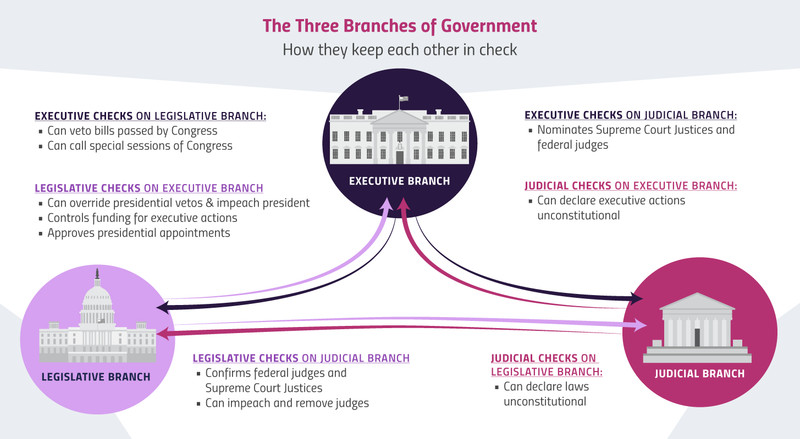
Checks and balances among the three branches
How Each Branch Controls the Bureaucracy
All three branches have tools, but they use them differently.
Congress
Congress has the widest set of tools because agencies exist under laws Congress created.
- Legislation lets Congress create, change, reorganize, narrow, expand, or abolish agencies.
- Appropriations let Congress fund, defund, or restrict what agencies can do. This is the power of the purse.
- Oversight includes hearings, investigations, subpoenas, document requests, and testimony from officials.
- Senate confirmation gives Congress a role in approving top executive officials.
- Informal influence includes committee pressure, member contacts, casework, and publicity.
Two oversight patterns show up a lot:
- Police-patrol oversight means active, regular monitoring.
- Fire-alarm oversight means Congress responds after complaints from citizens, groups, or the media.
The biggest limit is that Congress is not one actor. The House, Senate, parties, and committees often want different things.
The president
The president controls administration most directly.
- Appointments shape agency leadership.
- Removal power gives control over many executive officials.
- Executive orders and directives push agencies toward the president’s priorities.
- Administrative supervision happens through the Executive Office of the President.
- Budget proposals and the bully pulpit pressure agencies and Congress.
Presidential control is stronger over executive departments than over independent regulatory commissions, which have more insulation.
Limits matter here. The president cannot ignore statutes, cannot spend money Congress did not approve, and can be blocked by courts.
The courts
Courts use judicial review to check agency action.
They ask whether an agency:
- exceeded delegated authority
- violated the Constitution
- ignored required procedure
- denied due process
Courts can block enforcement, invalidate actions, or send issues back to agencies. Their power is reactive. They need standing and a real case, and they do not run agencies or fund policy.
Legislative Veto and Chadha
A legislative veto let Congress delegate power, then cancel an agency or executive action later without passing a new law.
Congress liked it because it was fast. The Supreme Court rejected it in INS v. Chadha (1983).
The rule from Chadha is simple. If Congress changes legal rights or duties, it must use the full lawmaking process:
- bicameralism means both House and Senate pass it
- presentment means the president gets it for signature or veto
So Congress can still control agencies, but it must do so constitutionally.
Multiple Access Points and Constraints on Policymaking
Because power is shared, lots of people can influence policy at lots of stages.
- lobby Congress
- testify at hearings
- push appropriations changes
- influence appointments
- join agency rulemaking
- mobilize public opinion
- sue in court
That creates venue shopping. If a group loses in one place, it tries another. A common example is EPA regulation challenged by industry, environmental groups, states, or individuals through Congress, agencies, and courts.
The same system creates veto points too. Policy can be blocked in the House, Senate, by presidential veto, by funding fights, by weak implementation, or by court challenges. Divided government raises conflict. Unified government lowers some conflict, but checks still remain. Budget fights and partial government shutdowns show that shared power requires cooperation.
Why Shared Power Both Helps and Hurts Policymaking
Shared power brings real benefits:
- accountability
- pluralism
- deliberation and compromise
- stability
- protection against concentrated power
It also brings costs:
- delay and gridlock
- contradictory signals to agencies
- weaker policy durability when presidents rely on executive action
- possible agency capture, when agencies become too responsive to the interests they regulate
Key Takeaways
Public Policy
Government decisions and actions intended to address public issues
Congressional Oversight
Committee review, monitoring, investigation, and supervision of executive agencies, including hearings, testimony, and document requests
Power of the Purse
Congress’s authority to fund agencies and restrict how appropriated money may be used
Legislative Veto
A mechanism allowing one or both chambers or a committee to reject an executive action without completing the ordinary lawmaking process
Immigration and Naturalization Service v. Chadha (1983)
The Supreme Court invalidated the one-house legislative veto because congressional actions changing legal rights require bicameralism and presentment
Multiple Access Points
Distinct institutions and stages through which stakeholders can influence policy, including Congress, executive agencies, and the courts
Venue Shopping
Pursuing a preferred policy result through different branches or institutional settings
Veto Points
Stages or institutions within the policymaking process where a proposal can be blocked or altered
Police-Patrol Oversight
Active, routine congressional monitoring of agency behavior
Fire-Alarm Oversight
Congressional oversight triggered by complaints or reports of agency problems from outside Congress
Notes
Public Policy
Government decisions and actions intended to address public issues
Congressional Oversight
Committee review, monitoring, investigation, and supervision of executive agencies, including hearings, testimony, and document requests
Power of the Purse
Congress’s authority to fund agencies and restrict how appropriated money may be used
Legislative Veto
A mechanism allowing one or both chambers or a committee to reject an executive action without completing the ordinary lawmaking process
Immigration and Naturalization Service v. Chadha (1983)
The Supreme Court invalidated the one-house legislative veto because congressional actions changing legal rights require bicameralism and presentment
Multiple Access Points
Distinct institutions and stages through which stakeholders can influence policy, including Congress, executive agencies, and the courts
Venue Shopping
Pursuing a preferred policy result through different branches or institutional settings
Veto Points
Stages or institutions within the policymaking process where a proposal can be blocked or altered
Police-Patrol Oversight
Active, routine congressional monitoring of agency behavior
Fire-Alarm Oversight
Congressional oversight triggered by complaints or reports of agency problems from outside Congress
