Topic 3.5 Notes – Second Amendment: Right to Bear Arms
What the Second Amendment Protects
The text matters here because the whole fight comes from its wording:
“A well regulated Militia, being necessary to the security of a free State, the right of the people to keep and bear Arms, shall not be infringed.”
The amendment has two clauses:
- Prefatory clause: “A well regulated Militia...”
- Operative clause: “the right of the people...”
The basic split is shown below, along with the two main ways people have read the amendment.
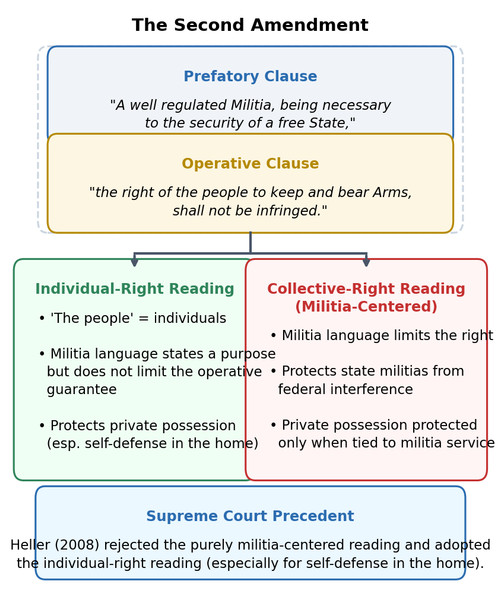
Second Amendment clauses and competing interpretations
The argument is about how those clauses fit together. Does the militia part limit the right, or does it just explain one reason the right exists?
Also, this is a civil liberty, so it protects you from government action. It does not mean every private rule about firearms becomes a constitutional violation.
The Two Interpretations of the Amendment
This section matters because it sets up the exact constitutional question the Court had to answer.
Individual-right reading
- “The right of the people” is read the same way it is elsewhere in the Bill of Rights. It belongs to individuals.
- The militia language gives one purpose for protecting the right. It does not confine the right to militia service.
- This view says armed citizens helped make militias possible, but a person’s right to possess a firearm still exists even when that person is not serving in a militia.
- The protected use the Court emphasized most was lawful self-defense, especially in the home.
Collective-right reading
- This reading gives more weight to the militia language.
- It treats the amendment as protecting state militias from federal interference.
- In the narrower version, firearm possession is protected only when tied to organized militia service, not as a general private right.
What you need to remember for the exam is simple. The Court rejected the purely militia-centered interpretation.
District of Columbia v. Heller
Heller answered what the Second Amendment protects.
- Facts: Washington, D.C. effectively banned handguns and required lawful guns in the home to be unloaded, disassembled, or trigger-locked. Dick Heller wanted a handgun at home for self-defense.
- Issue: Does the Second Amendment protect an individual right for lawful private use, or only a militia-related right?
- Holding: In a 5-4 decision in 2008, the Court said the amendment protects an individual right independent of militia service.
- Core protected use: Self-defense in the home.
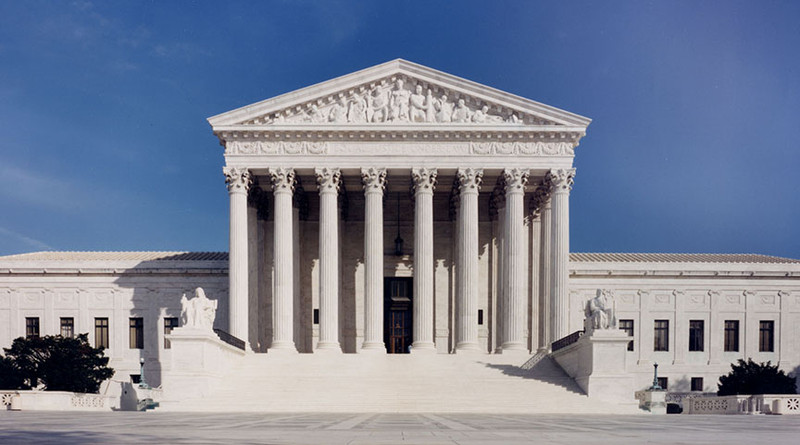
U.S. Supreme Court building
Majority reasoning
Justice Antonin Scalia wrote that:
- “The people” means individuals.
- “Keep” means possess.
- “Bear” does not only refer to military service.
- The militia clause announces a purpose, but it does not limit the operative guarantee.
- Historically, militias were made of ordinary citizens who brought their own weapons.
Dissent
Justice John Paul Stevens argued the amendment was mainly about militias, not a broad private self-defense right.
One detail students miss all the time: Heller involved federal authority, because D.C. is under federal jurisdiction.
McDonald v. Chicago
McDonald answered which governments must obey that right.
- Facts: Chicago laws effectively prohibited most handgun possession. Otis McDonald challenged them after Heller.
- Issue: Does the Second Amendment apply to state and local governments through the Fourteenth Amendment?
- Holding: In a 5-4 decision in 2010, the Court said yes.
Reasoning
Justice Samuel Alito used the Due Process Clause of the Fourteenth Amendment. Under selective incorporation, the Court applies fundamental Bill of Rights protections to the states.
The Court said the right to possess arms for self-defense is:
- fundamental
- deeply rooted in American history and tradition
The Reconstruction context mattered too, especially concern about disarming formerly enslaved people.
Why the Right Matters and Why It Is Not Absolute
These cases show a strong judicial commitment to individual liberty:
- gun possession is a personal constitutional right
- handgun possession for self-defense in the home is protected
- federal, state, and local governments all must respect that right
But the Court did not ban all regulation. Heller said longstanding rules can still be constitutional, including:
- bans on possession by felons
- bans on possession by the mentally ill
- restrictions in sensitive places like schools and government buildings
- conditions on commercial gun sales
- limits on dangerous and unusual weapons
Key Takeaways
Second Amendment (Right to Keep and Bear Arms)
Protects an individual right to possess firearms independent of militia service, especially for lawful self-defense in the home; the right applies against all levels of government but is not absolute
Individual-Right vs. Collective-Right Interpretations of the Second Amendment
The individual-right interpretation protects personal firearm possession independent of militia service; the collective-right interpretation ties the protection primarily or exclusively to organized militia purposes
McDonald v. Chicago (2010)
Held that the Fourteenth Amendment’s Due Process Clause incorporates the individual Second Amendment right recognized in Heller, making it enforceable against state and local governments
Notes
Second Amendment (Right to Keep and Bear Arms)
Protects an individual right to possess firearms independent of militia service, especially for lawful self-defense in the home; the right applies against all levels of government but is not absolute
Individual-Right vs. Collective-Right Interpretations of the Second Amendment
The individual-right interpretation protects personal firearm possession independent of militia service; the collective-right interpretation ties the protection primarily or exclusively to organized militia purposes
McDonald v. Chicago (2010)
Held that the Fourteenth Amendment’s Due Process Clause incorporates the individual Second Amendment right recognized in Heller, making it enforceable against state and local governments
