Topic 2.6 Notes – Expansion of Presidential Power
What Expansion of Presidential Power Means
The Constitution gives the president formal powers, but the office has grown through broad readings of Article II, political habits, and powers Congress hands to the executive branch. Expansion means presidents now have more practical ability to shape policy, lead in crises, direct administration, and dominate foreign affairs.
One useful way to organize that growth is to separate formal powers from the informal powers presidents use to persuade Congress and the public.
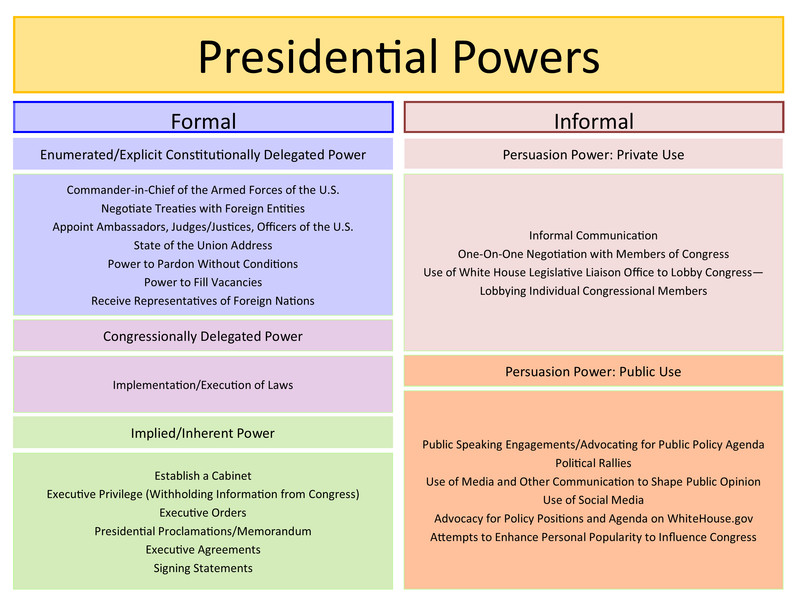
Formal and informal presidential powers
Key constitutional grounding in Article II includes:
- Vesting clause gives “the executive power” to one president, which leaves room for argument about implied powers.
- Commander in chief makes the president head of the military.
- Veto lets the president block legislation.
- Pardon power covers federal offenses.
- Appointments and treaty negotiation connect the president to staffing and foreign policy.
- Take Care Clause requires the president to faithfully execute the laws.
This power grows because one executive can act with speed, secrecy, unity, and accountability in a way Congress usually cannot. Congress also often delegates broad discretion to agencies, which gives presidents more room to shape policy through the bureaucracy.
Expansion still has limits. Congress, courts, elections, and later presidents can block, reverse, or narrow presidential action.
Formal and Informal Powers Presidents Use
Presidents use both constitutional tools and powers built by practice.
Formal constitutional powers
- Veto rejects a bill. A pocket veto happens when Congress adjourns during the 10-day review period.
- Commander in chief has often been read broadly, especially when presidents use military force without a formal declaration of war.
- Treaties are negotiated by the president but need Senate ratification by a two-thirds vote.
- Appointments need Senate confirmation for major executive and judicial posts.
- Pardons apply to federal crimes.
- Faithful execution means the president runs the executive branch and carries out laws.
Informal powers
- Executive orders direct executive agencies. They must rest on constitutional or statutory authority, and courts, Congress, or future presidents can limit them.
- Executive agreements are international deals made without Senate treaty ratification.
- Signing statements explain how the president interprets a law when signing it. They can shape enforcement, but they do not rewrite the statute.
- Bargaining and persuasion help presidents win support from Congress, party leaders, and interest groups.
- Directives to the bureaucracy shape how agencies enforce laws Congress already passed.
- Public appeals and the bully pulpit let presidents pressure Congress and define the national agenda.
How Presidents Justify Their Power
When presidents defend an action, they usually point to Article II, implied powers, congressional delegation, precedent, or emergency necessity. The strongest claims usually come when Congress authorized the action. The weakest come when the president acts against Congress’s clear will.
Federalist No. 70
Alexander Hamilton defended a single energetic executive. He argued that unity gives the president speed, secrecy, decisiveness, and accountability, and that this is essential for security and steady law enforcement. That supports a strong executive, but still inside the law.
Theodore Roosevelt’s stewardship theory
Roosevelt took an expansive view. He argued the president may do anything needed for the public good unless the Constitution or a law forbids it.
William Howard Taft’s limited view
Taft took a limited view. He argued the president can act only when authority can be traced to the Constitution or a statute, including reasonable implied powers. Silence does not equal permission.
Crises, Precedents, and Limits
Crises often expand presidential power because the public expects fast action.
- Abraham Lincoln suspended habeas corpus, expanded forces, and spent money before full congressional approval during the Civil War. He justified this as necessary to save the Union.
- Franklin D. Roosevelt led during the Great Depression and World War II, which expanded executive leadership and administration. His Four Freedoms speech and his radio addresses helped show how presidents can shape the national agenda beyond listed constitutional powers. His four elections also showed how central the presidency had become.
- Harry Truman tried to seize steel mills during the Korean War. In Youngstown Sheet & Tube Co. v. Sawyer, the Supreme Court said no because he lacked constitutional or statutory authority.
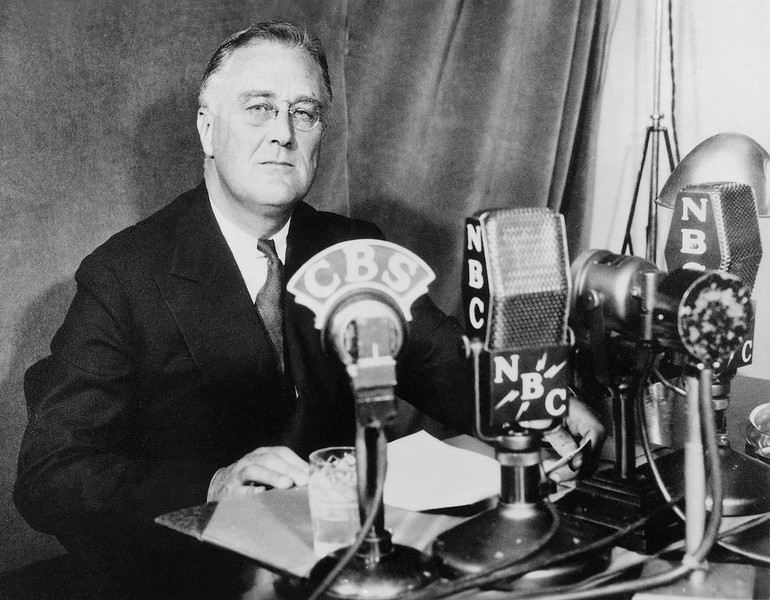
Franklin D. Roosevelt delivering a radio address
Youngstown is the key reminder here. A crisis does not automatically create presidential power.
The Twenty-Second Amendment and the Ongoing Debate
The Twenty-Second Amendment, ratified in 1951 after FDR’s four elections, limits a president to two elected terms. The maximum possible service is ten years under the succession rule.
This amendment shows concern about too much executive power in one person for too long. It limits tenure, not the president’s day-to-day constitutional powers.
The debate keeps going:
- The expansive side says modern government needs fast, unified leadership.
- The limited side says separation of powers requires presidents to stay tied to constitutional and statutory authority.
Key Takeaways
Formal vs. Informal Presidential Powers
Formal powers are granted by the Constitution; informal powers develop through statutes, precedent, and practice but still require a lawful basis
Executive Order
A presidential directive managing executive officers or agencies under constitutional or congressionally delegated authority; it is not a statute and may be checked or reversed
Executive Agreement
An international agreement made by the president without the two-thirds Senate vote required to ratify a treaty
Signing Statement
A statement issued when signing a law that explains how the president interprets or intends to administer it without amending the statute
Bargaining and Persuasion
The president’s use of political influence, party leadership, access, appointments, and negotiation to gain support from Congress and other officials
Federalist No. 70
Hamilton’s defense of a single energetic executive whose unity permits decisive action, steady administration, national protection, and clear accountability
Stewardship Theory
Theodore Roosevelt’s expansive view that the president may act for the national interest unless the Constitution or federal law forbids the action
Limited Presidency
William Howard Taft’s view that presidential action must be reasonably traced to a constitutional or statutory grant or a power properly implied from one
Four Freedoms Speech
FDR’s 1941 State of the Union address promoting freedom of speech, freedom of worship, freedom from want, and freedom from fear as national and global goals
Twenty-Second Amendment
The 1951 amendment limiting a person to two presidential elections, or one if the person served more than two years of another’s term, allowing at most ten years in office
Congressional Delegation
Congress’s grant of broad statutory authority and discretion to the executive branch, increasing presidential capacity to pursue policy priorities
Directives to the Bureaucracy
Presidential instructions intended to align executive agencies’ implementation of laws with the administration’s policy agenda
Notes
Formal vs. Informal Presidential Powers
Formal powers are granted by the Constitution; informal powers develop through statutes, precedent, and practice but still require a lawful basis
Executive Order
A presidential directive managing executive officers or agencies under constitutional or congressionally delegated authority; it is not a statute and may be checked or reversed
Executive Agreement
An international agreement made by the president without the two-thirds Senate vote required to ratify a treaty
Signing Statement
A statement issued when signing a law that explains how the president interprets or intends to administer it without amending the statute
Bargaining and Persuasion
The president’s use of political influence, party leadership, access, appointments, and negotiation to gain support from Congress and other officials
Federalist No. 70
Hamilton’s defense of a single energetic executive whose unity permits decisive action, steady administration, national protection, and clear accountability
Stewardship Theory
Theodore Roosevelt’s expansive view that the president may act for the national interest unless the Constitution or federal law forbids the action
Limited Presidency
William Howard Taft’s view that presidential action must be reasonably traced to a constitutional or statutory grant or a power properly implied from one
Four Freedoms Speech
FDR’s 1941 State of the Union address promoting freedom of speech, freedom of worship, freedom from want, and freedom from fear as national and global goals
Twenty-Second Amendment
The 1951 amendment limiting a person to two presidential elections, or one if the person served more than two years of another’s term, allowing at most ten years in office
Congressional Delegation
Congress’s grant of broad statutory authority and discretion to the executive branch, increasing presidential capacity to pursue policy priorities
Directives to the Bureaucracy
Presidential instructions intended to align executive agencies’ implementation of laws with the administration’s policy agenda
