Topic 5.2 Notes – Voter Turnout
What Voter Turnout Is
Voter turnout means the percentage of a population that casts ballots in an election. The core idea is simple. Having the legal right to vote does not guarantee participation.
Turnout depends on two things working together:
- Opportunity comes from election rules. States control registration, ID rules, polling access, and voting methods.
- Willingness comes from the person. Interest, confidence, time, habits, and life circumstances all matter.
Turnout is also different from voter choice:
- Turnout asks whether someone voted at all.
- Voter choice asks which candidate or party they chose.
The number can change a lot depending on the denominator:
- VAP means voting-age population. This includes all residents 18+, even some who cannot legally vote, so turnout looks lower.
- VEP means voting-eligible population. This includes only people legally allowed to vote. This is usually the best measure.
- Registered voters includes only people already registered. Turnout looks higher here, but this can hide registration barriers.
The chart puts those three denominators side by side for the same election, which is why the turnout rate rises from VAP to VEP to registered voters.
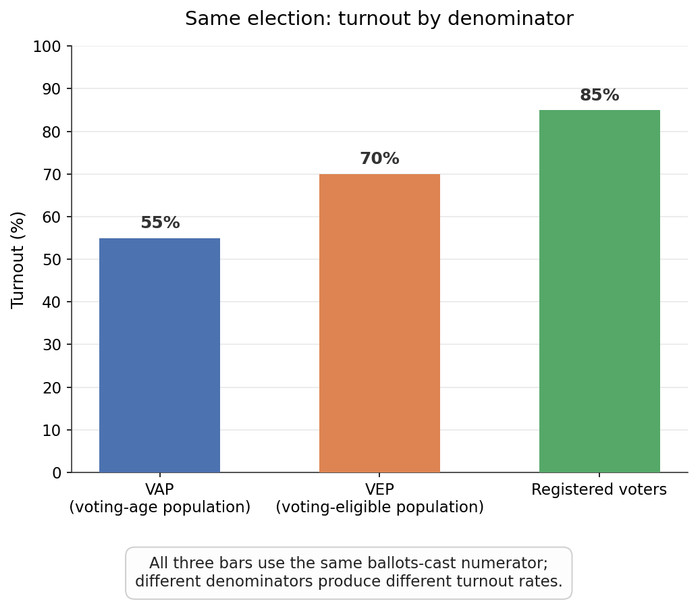
Turnout measured with different denominators
A graph question can become a trap if you miss the denominator. Always check who is being counted.
What Affects Turnout
The main predictors fall into two groups because voting depends on both the system and the person inside it.
Structural factors
- Registration requirements can add or remove steps before voting even starts.
- Voter ID laws can make voting easier or harder depending on whether voters have the required documents.
- Polling access includes hours, locations, staffing, machines, and wait times. Long lines can cut turnout.
- Early voting, absentee voting, and mail voting expand access, but deadlines and procedure still matter.
- Election type matters a lot. Presidential elections get more turnout than midterms.
Individual factors
- Political efficacy means believing your participation matters.
- Engagement and mobilization mean following politics, caring about issues, identifying with a party, or being contacted by campaigns.
- Demographics such as age, education, income, race and ethnicity, and gender help predict turnout patterns.
These factors interact. The same rule can hit groups differently depending on money, transportation, work schedule, housing stability, or experience with voting.
State Laws and Structural Barriers
States run elections, so turnout varies because election systems are not uniform.
Registration rules
- Most states require registration. North Dakota is the major exception.
- Same-day registration usually raises access because people can register and vote in one trip.
- Online registration reduces paperwork and travel.
- Automatic voter registration shifts the burden from the voter to the state.
- Early deadlines and complicated procedures can lower turnout.
- The National Voter Registration Act of 1993, or Motor Voter Act, expanded registration through DMVs and public agencies.
Voter ID laws
Supporters say ID laws protect election integrity and public confidence. Critics say strict ID rules burden people without the right documents, especially older voters, lower-income voters, students, people with disabilities, and nondrivers.
Poll access and election administration
Tuesday elections can conflict with work, school, childcare, and transportation. Fewer polling places, less funding, fewer workers, or long lines can discourage voting.
Early, absentee, and mail voting
- Early in-person voting gives more time options.
- Absentee voting can be excuse-required or no-excuse.
- Vote-by-mail can be request-based or universal.
Small rules matter here too, including signature checks, deadlines, drop boxes, and postage.
Election type
Presidential elections have higher turnout because they get more media attention, feel higher-stakes, and bring stronger party mobilization. Midterms are lower, and local, primary, runoff, and special elections are usually even lower.
Political Efficacy, Engagement, and Demographics
People vote more when they believe voting matters.
- Internal efficacy means you feel capable of understanding politics and participating.
- External efficacy means you believe government responds to citizens.
Low efficacy often reduces turnout.
Mobilization matters because campaigns and organizations give reminders, information, and help with procedures. A lot of people vote partly because someone asked them to.
Demographic patterns show broad tendencies:
- Age: older citizens usually vote more.
- Education: one of the strongest predictors.
- Income: higher-income citizens generally vote more.
- Race and ethnicity: patterns vary by barriers, citizenship, outreach, and context.
- Gender: women have generally voted somewhat more than men in recent national elections.
Demographics predict likelihood. They do not determine what any one person will do.
What Influences Voter Choice After Someone Turns Out
Once someone votes, a different set of factors helps explain the ballot choice.
- Party identification and ideology are among the strongest predictors.
- Candidate characteristics matter, including experience, honesty, competence, and leadership style.
- Contemporary issues can shift priorities in a given election.
- Religion and demographic traits can shape policy preferences and party support.
Lock in this distinction:
- Registration rules, ID laws, and polling access mainly affect turnout.
- Party ID, ideology, candidate evaluations, and issues mainly affect vote choice.
Key Takeaways
Voter Turnout
The extent to which people entitled or able to participate in an election actually cast ballots
Turnout Rate
Ballots cast ÷ the specified population denominator × 100
Voting-Age Population (VAP)
Everyone age 18 or older, including people ineligible to vote; using it as the turnout denominator generally produces a lower percentage
Voting-Eligible Population (VEP)
People legally eligible to vote, excluding noncitizens and others barred by law; usually the best denominator for participation among eligible voters
Registered-Voter Turnout
Ballots cast as a percentage of registered voters; usually higher because eligible people who never registered are excluded
Institutional vs. Individual Explanations of Turnout
Institutional explanations emphasize election rules and access, while individual explanations emphasize voters’ characteristics, resources, attitudes, and choices
State Administration of Elections
States set many registration and voting procedures while local governments commonly operate polling places and count ballots, producing policy variation among states
Structural Barrier
An institutional rule or practical condition that increases the time, effort, uncertainty, or expense required to vote
Same-Day Registration / Election Day Registration
A procedure allowing an eligible citizen to register and vote during the voting period rather than meeting an earlier deadline
Automatic Voter Registration
A system using information already given to a government agency to register eligible citizens unless they decline
National Voter Registration Act of 1993 / Motor Voter Act
Federal law requiring covered states to offer registration through driver’s-license and certain public-agency transactions and to provide mail registration for federal elections
Voter Identification Laws
State requirements that voters present specified identification, potentially increasing voting costs for eligible people who lack acceptable documents
Early In-Person Voting
Casting a ballot at a designated location before Election Day, expanding the available times for voting
Absentee Voting
Receiving and returning a ballot without appearing at an Election Day polling place
Voting by Mail / Vote-by-Mail
Casting and returning a ballot by mail rather than voting at an Election Day polling place
Presidential-Election vs. Midterm-Election Turnout
Turnout is generally higher in presidential elections because they receive more attention, mobilization, and perceived importance than midterms
Political Efficacy
The belief that political participation can matter
Internal Political Efficacy
Confidence in one’s own ability to understand politics and participate effectively
External Political Efficacy
The belief that government officials and institutions are responsive to ordinary citizens
Political Engagement
Attention to and involvement in public affairs, such as following politics, discussing issues, or caring strongly about parties or policies
Voter Mobilization
Campaign or organizational efforts that increase participation by supplying information, reminders, encouragement, or help with voting procedures
Voter Turnout vs. Voter Choice
Turnout asks whether a person votes; voter choice asks which candidate or party the voter supports
Party Identification
A person’s psychological attachment to a political party and one of the strongest predictors of candidate choice
Ideological Orientation
A voter’s general liberal, conservative, or moderate outlook, used to compare candidates and platforms with the voter’s own views
Age and Voter Turnout
Turnout generally rises with age and is lowest among young adults
Education and Voter Turnout
Higher educational attainment is strongly associated with higher voter turnout
Income and Voter Turnout
Higher-income citizens generally vote at higher rates because they tend to have more resources that reduce participation costs
Race and Ethnicity and Voter Turnout
Turnout differences vary across elections and reflect eligibility, barriers, resources, political context, and mobilization rather than race or ethnicity alone
Gender and Voter Turnout
Women have generally voted at somewhat higher rates than men in recent national elections
Candidate Characteristics
Qualities such as experience, competence, character, leadership style, communication ability, background, and identity that can influence voter choice
Contemporary Political Issues
Current issues and events that shape voter priorities and influence candidate choice
Religious Beliefs or Affiliation
Religious beliefs and group affiliations can shape policy views, political information, mobilization, and voter choice
Demographic Characteristics and Voter Choice
Age, gender, race, ethnicity, education, income, region, and related characteristics predict patterns of candidate and party support without determining an individual’s vote
Notes
Voter Turnout
The extent to which people entitled or able to participate in an election actually cast ballots
Turnout Rate
Ballots cast ÷ the specified population denominator × 100
Voting-Age Population (VAP)
Everyone age 18 or older, including people ineligible to vote; using it as the turnout denominator generally produces a lower percentage
Voting-Eligible Population (VEP)
People legally eligible to vote, excluding noncitizens and others barred by law; usually the best denominator for participation among eligible voters
Registered-Voter Turnout
Ballots cast as a percentage of registered voters; usually higher because eligible people who never registered are excluded
Institutional vs. Individual Explanations of Turnout
Institutional explanations emphasize election rules and access, while individual explanations emphasize voters’ characteristics, resources, attitudes, and choices
State Administration of Elections
States set many registration and voting procedures while local governments commonly operate polling places and count ballots, producing policy variation among states
Structural Barrier
An institutional rule or practical condition that increases the time, effort, uncertainty, or expense required to vote
Same-Day Registration / Election Day Registration
A procedure allowing an eligible citizen to register and vote during the voting period rather than meeting an earlier deadline
Automatic Voter Registration
A system using information already given to a government agency to register eligible citizens unless they decline
National Voter Registration Act of 1993 / Motor Voter Act
Federal law requiring covered states to offer registration through driver’s-license and certain public-agency transactions and to provide mail registration for federal elections
Voter Identification Laws
State requirements that voters present specified identification, potentially increasing voting costs for eligible people who lack acceptable documents
Early In-Person Voting
Casting a ballot at a designated location before Election Day, expanding the available times for voting
Absentee Voting
Receiving and returning a ballot without appearing at an Election Day polling place
Voting by Mail / Vote-by-Mail
Casting and returning a ballot by mail rather than voting at an Election Day polling place
Presidential-Election vs. Midterm-Election Turnout
Turnout is generally higher in presidential elections because they receive more attention, mobilization, and perceived importance than midterms
Political Efficacy
The belief that political participation can matter
Internal Political Efficacy
Confidence in one’s own ability to understand politics and participate effectively
External Political Efficacy
The belief that government officials and institutions are responsive to ordinary citizens
Political Engagement
Attention to and involvement in public affairs, such as following politics, discussing issues, or caring strongly about parties or policies
Voter Mobilization
Campaign or organizational efforts that increase participation by supplying information, reminders, encouragement, or help with voting procedures
Voter Turnout vs. Voter Choice
Turnout asks whether a person votes; voter choice asks which candidate or party the voter supports
Party Identification
A person’s psychological attachment to a political party and one of the strongest predictors of candidate choice
Ideological Orientation
A voter’s general liberal, conservative, or moderate outlook, used to compare candidates and platforms with the voter’s own views
Age and Voter Turnout
Turnout generally rises with age and is lowest among young adults
Education and Voter Turnout
Higher educational attainment is strongly associated with higher voter turnout
Income and Voter Turnout
Higher-income citizens generally vote at higher rates because they tend to have more resources that reduce participation costs
Race and Ethnicity and Voter Turnout
Turnout differences vary across elections and reflect eligibility, barriers, resources, political context, and mobilization rather than race or ethnicity alone
Gender and Voter Turnout
Women have generally voted at somewhat higher rates than men in recent national elections
Candidate Characteristics
Qualities such as experience, competence, character, leadership style, communication ability, background, and identity that can influence voter choice
Contemporary Political Issues
Current issues and events that shape voter priorities and influence candidate choice
Religious Beliefs or Affiliation
Religious beliefs and group affiliations can shape policy views, political information, mobilization, and voter choice
Demographic Characteristics and Voter Choice
Age, gender, race, ethnicity, education, income, region, and related characteristics predict patterns of candidate and party support without determining an individual’s vote
