Topic 1.3 Notes – Government Power and Individual Rights
The Ratification Debate Over Liberty and Power
In 1787, the Constitution went to state ratifying conventions. It needed approval from 9 of 13 states to take effect. That set off a public argument about power, liberty, and how a republic should work.
Both sides believed in republican government and rule by consent. The disagreement was over protection. Does liberty survive better when government is strong enough to govern, or when power stays close to the states and the people?
- Federalists supported ratification and wanted a stronger national government than the Articles of Confederation had created.
- Anti-Federalists opposed the Constitution as written and wanted more power kept in the states.
- These were ratification-era coalitions, not the same as today’s Democrats and Republicans.
Two required documents carry this debate:
- Federalist No. 10 by James Madison
- Brutus No. 1 by “Brutus,” commonly linked to Robert Yates
The broader Federalist Papers were written under the name “Publius” by Alexander Hamilton, James Madison, and John Jay.
This debate grew out of the same founding moment that produced the Constitution. Keep that setting in mind as you move into the arguments each side made about liberty and power.
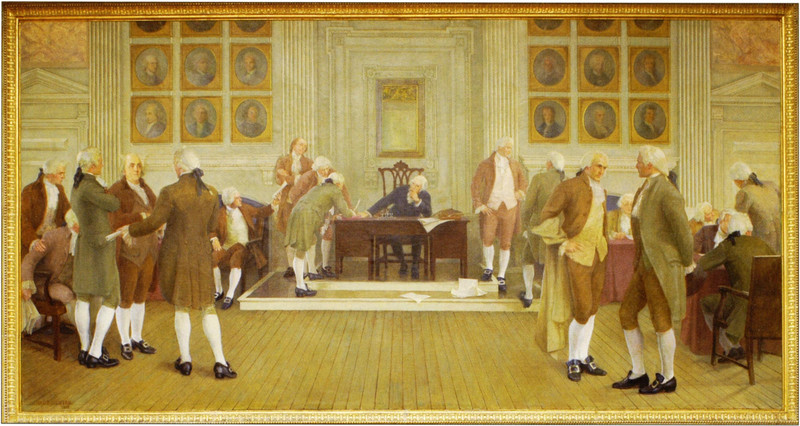
Founding-era debate over the Constitution
Federalist and Anti-Federalist Views
The Constitution did not create one simple argument over “more democracy” or “less democracy.” It created two different ideas about how democracy stays free.
Federalists
Federalists thought the Articles were too weak. A government that cannot tax effectively, act decisively, or solve national problems leaves the country unstable.
- They wanted a strong but limited national government.
- They trusted structure to protect liberty.
- Separation of powers keeps one branch from dominating.
- Federalism shares power between national and state governments.
- Representation filters public opinion through elected officials.
- A large republic makes domination by one faction harder.
Anti-Federalists
Anti-Federalists feared that national power, once created, would grow.
- They preferred decentralization and stronger state power.
- They believed small republics gave people more real self-government.
- They wanted an explicit Bill of Rights because structure alone did not seem safe enough.
Two different fears
- Federalists feared majority faction and political disorder.
- Anti-Federalists feared consolidated national power and loss of personal liberty.
Federalist No. 10 and How a Large Republic Controls Faction
Madison’s key word is faction. A faction is a majority or minority group united by an interest that harms others’ rights or the common good.
A major source of faction, Madison says, is the unequal distribution of property. People with different wealth and economic interests will clash.
His reasoning moves in a chain:
- Factions are inevitable because liberty and human differences create competing interests.
- You cannot remove factions without destroying liberty or forcing impossible sameness.
- Minority factions can usually be defeated by voting.
- Majority factions are more dangerous because they can oppress through legal democratic power.
- The answer is a republic, not a pure democracy.
- In a republic, elected officials can refine and enlarge public views.
- In a large republic, many interests compete, so one unjust majority is harder to form and coordinate.
Pure democracy and republic
- Pure democracy means citizens govern directly. Madison thinks that makes majority tyranny easier.
- Republic means citizens govern through elected representatives.
This is one of the biggest AP ideas in Unit 1. Madison argues that pluralism and a large republic protect liberty better than a small, unified community.
Brutus No. 1 and Why Anti-Federalists Wanted a Small Republic
Brutus reaches the opposite conclusion. He thinks the Constitution will lead to consolidation, meaning power gathering in the national government.
The powers he finds dangerous:
- Taxing power
- Power to raise and support armies
- Necessary and Proper Clause
- Supremacy Clause
- National judiciary
His logic also moves step by step:
- Broad national powers will be interpreted broadly.
- The national government will become less dependent on the states.
- State authority will shrink in practice.
- Distant officials will not know local needs.
- Representatives in a huge republic will become elites, not true mirrors of the people.
Why a small republic seems safer to Brutus
- Representatives stay closer to constituents.
- Accountability is stronger.
- Local interests are easier to understand.
- Liberty is better protected through local control.
Brutus also warns that a large republic may need coercion, even standing armies, to govern a vast territory. His historical claim is simple. Free republics work best in small territories, not huge diverse nations.
The Main Contrast and Why the Bill of Rights Matters
Madison and Brutus disagree about the same facts. The country is large and diverse. Madison says that diversity is protection because interests check one another. Brutus says diversity and distance weaken representation and accountability.
- Madison fears citizens oppressing other citizens through majority tyranny.
- Brutus fears government oppressing citizens and states through centralized power.
The original Constitution had no Bill of Rights. Federalists leaned on structure and limited powers. Anti-Federalists demanded written protections for speech, religion, press, and due process.
The result matters. The Constitution was ratified on Federalist terms, but the Bill of Rights was added because Anti-Federalist concerns had real force.
Key Takeaways
Federalists
Ratification-era coalition that supported the Constitution and a stronger but constitutionally limited national government with divided power
Anti-Federalists
Ratification-era coalition that opposed the Constitution’s concentration of national power and favored state authority, smaller republics, and explicit protections for rights
The Federalist Papers
A series of 85 essays by Alexander Hamilton, James Madison, and John Jay, writing as Publius, that defended ratification of the Constitution
Federalist No. 10
Madison’s argument that representation and the many competing interests of a large republic best control faction and protect minority rights
Brutus No. 1
Anti-Federalist essay arguing that the Constitution would produce consolidated national power and that liberty requires smaller, decentralized republics
Faction
A majority or minority united by a passion or interest adverse to others’ rights or the community’s lasting common interest
Majority Tyranny
The use of political power by a numerical majority to violate minority rights or the common good
Republic vs. Pure Democracy
In a republic, citizens govern through elected representatives; in a pure democracy, citizens assemble and administer government directly
Extended Republic (Large Republic)
A republic covering a broad territory with a large, diverse population whose competing interests make an oppressive majority harder to form
Small Republic
A limited political community in which representatives can remain familiar with, responsive to, and accountable to their constituents
Popular Democratic Theory
The view that republican government requires close, continuing connections between citizens and representatives who understand their circumstances
Delegated Authority
Governmental power entrusted by the people to elected representatives, who may refine public opinion while remaining accountable to the people
Decentralization
The distribution of political authority among smaller or more local governments rather than its concentration at the national level
Consolidation (Consolidated National Government)
The concentration of governing authority in one national government, reducing the practical power of state governments
Bill of Rights
An explicit statement of liberties that government may not violate, demanded by Anti-Federalists as a safeguard against national power
Notes
Federalists
Ratification-era coalition that supported the Constitution and a stronger but constitutionally limited national government with divided power
Anti-Federalists
Ratification-era coalition that opposed the Constitution’s concentration of national power and favored state authority, smaller republics, and explicit protections for rights
The Federalist Papers
A series of 85 essays by Alexander Hamilton, James Madison, and John Jay, writing as Publius, that defended ratification of the Constitution
Federalist No. 10
Madison’s argument that representation and the many competing interests of a large republic best control faction and protect minority rights
Brutus No. 1
Anti-Federalist essay arguing that the Constitution would produce consolidated national power and that liberty requires smaller, decentralized republics
Faction
A majority or minority united by a passion or interest adverse to others’ rights or the community’s lasting common interest
Majority Tyranny
The use of political power by a numerical majority to violate minority rights or the common good
Republic vs. Pure Democracy
In a republic, citizens govern through elected representatives; in a pure democracy, citizens assemble and administer government directly
Extended Republic (Large Republic)
A republic covering a broad territory with a large, diverse population whose competing interests make an oppressive majority harder to form
Small Republic
A limited political community in which representatives can remain familiar with, responsive to, and accountable to their constituents
Popular Democratic Theory
The view that republican government requires close, continuing connections between citizens and representatives who understand their circumstances
Delegated Authority
Governmental power entrusted by the people to elected representatives, who may refine public opinion while remaining accountable to the people
Decentralization
The distribution of political authority among smaller or more local governments rather than its concentration at the national level
Consolidation (Consolidated National Government)
The concentration of governing authority in one national government, reducing the practical power of state governments
Bill of Rights
An explicit statement of liberties that government may not violate, demanded by Anti-Federalists as a safeguard against national power
