Topic 2.8 Notes – The Judicial Branch
Judicial Review and Why It Matters
Judicial review means courts decide whether a law or executive action conflicts with the Constitution. If it does, the court can declare it unconstitutional and refuse to give it legal effect.
That power matters because the Constitution is higher law. Congress passes ordinary laws, and the president takes executive actions, but neither can override the Constitution.
This basic checks-and-balances diagram helps place judicial review in the bigger system. Focus on the Supreme Court’s role in ruling on legislation and executive action.
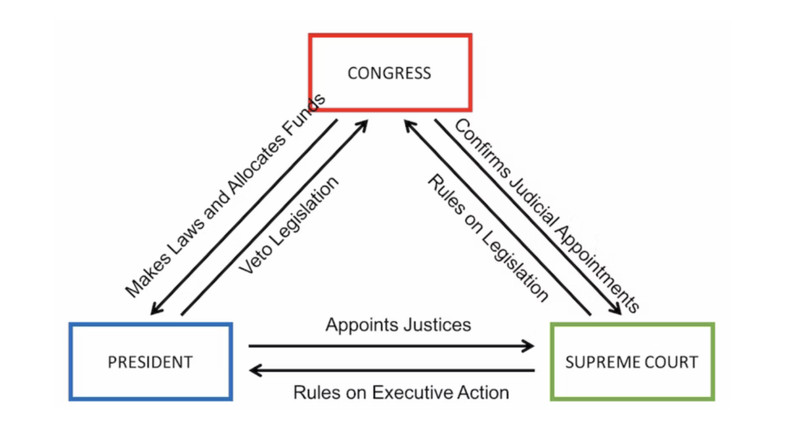
Checks and balances among the branches
A few distinctions get mixed up a lot:
- Judicial review checks constitutionality. It asks whether government action violates the Constitution.
- Appellate review means a higher court reviews a lower court’s decision. A case can involve appellate review without raising a constitutional issue.
- Statutory interpretation means figuring out what a law means. Courts do this all the time without striking the law down.
- Judicial invalidation means a court says a law cannot be enforced because it violates the Constitution.
- Legislative repeal means Congress removes a law by passing a new one.
Courts also do not give advisory opinions. They act through real cases and controversies, not general policy advice.
Article III and Judicial Independence
Article III gives the federal judiciary its constitutional place by vesting the judicial Power of the United States in one Supreme Court and any lower federal courts Congress chooses to create. The Supreme Court must exist. Lower federal courts exist because Congress established them.
Article III also does not set the number of justices. Congress sets the Court’s size by law.
Federal jurisdiction
Federal courts can hear cases arising under:
- the Constitution
- federal laws
- treaties
They also hear cases involving ambassadors, admiralty and maritime law, the U.S. as a party, disputes between states, and certain disputes between citizens of different states.
Original and appellate jurisdiction
- Original jurisdiction means the case begins in the Supreme Court.
- Appellate jurisdiction means the Supreme Court reviews a lower court decision.
- Most Supreme Court cases are appellate.
Independence protections
- Judges serve during good Behaviour, which means life tenure unless they resign, retire, die, or are impeached and removed.
- Their salaries cannot be reduced while in office.
These protections free judges from reelection pressure and direct punishment by elected branches, which lets them make unpopular constitutional decisions.
Federalist No. 78
Hamilton explains why an independent judiciary fits the Constitution.
Least dangerous branch
The judiciary is the least dangerous branch because it has neither the sword nor the purse. The executive has force. The legislature has money. Courts have judgment.
Constitution as fundamental law
Hamilton argues the Constitution expresses the will of the people at a higher level than ordinary laws. So if a statute conflicts with the Constitution, judges must follow the Constitution.
Independence and tenure
Judges need independence to strike down unconstitutional acts without fear of retaliation. Long tenure also builds expertise and stability.
The key point is easy to miss. Judges are not superior to Congress. The Constitution is superior to both.
Marbury v. Madison
This case turns the theory into actual judicial power, and it is closely tied to Chief Justice John Marshall.
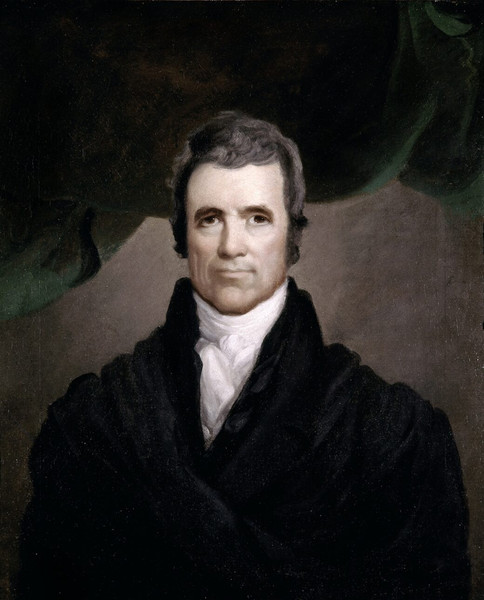
Chief Justice John Marshall
Facts
- Outgoing President John Adams appointed William Marbury as justice of the peace.
- Marbury’s commission was signed and sealed but never delivered.
- Incoming President Thomas Jefferson told Secretary of State James Madison not to deliver it.
- Marbury asked the Supreme Court for a writ of mandamus ordering delivery.
Holding and reasoning
- Marbury had a right to the commission.
- A remedy would normally exist.
- Article III lists the Supreme Court’s original jurisdiction.
- Marbury’s case did not fit that list.
- Congress, through Section 13 of the Judiciary Act of 1789, could not expand original jurisdiction beyond Article III.
- That part of the law was unconstitutional, so the Court could not issue the writ.
Marshall’s famous line was that it is the judiciary’s duty “to say what the law is.”
Significance
This was the first Supreme Court case striking down part of a federal law as unconstitutional. It denied Marbury relief but strengthened the Court by establishing judicial review.
How the Judicial Branch Checks the Other Branches
Courts check Congress by invalidating unconstitutional laws. They check the president by invalidating unconstitutional executive actions.
This power rests on all three foundations together:
- Article III gives the judiciary constitutional status and independence.
- Federalist No. 78 gives the argument for why independent courts must enforce the Constitution.
- Marbury v. Madison gives the precedent.
That is how the judiciary helps preserve limited government, the rule of law, and protection for minorities and individual rights against unconstitutional majorities.
Key Takeaways
Article III of the U.S. Constitution
Creates the Supreme Court, permits Congress to establish lower federal courts, defines federal jurisdiction, and protects judges through tenure during good behavior and undiminished compensation
Cases and Controversies Requirement
Article III limitation requiring federal courts to decide actual legal disputes rather than issue general policy recommendations or advisory opinions
Original Jurisdiction vs. Appellate Jurisdiction
Original jurisdiction means a case begins in the Supreme Court; appellate jurisdiction means the Court reviews a lower court’s decision
Judicial Independence
Judges’ ability to decide cases without immediate political retaliation, protected chiefly by tenure during good behavior and undiminished compensation
Federalist No. 78
Hamilton’s defense of an independent, “least dangerous” judiciary that exercises judgment and must prefer the higher authority of the Constitution to conflicting statutes
Judicial Review
The power of courts to determine whether government action conforms to the Constitution and to deny legal effect to unconstitutional laws or executive actions
Marbury v. Madison (1803)
Supreme Court decision that invalidated part of the Judiciary Act of 1789 for conflicting with Article III, thereby establishing judicial review of federal laws
Notes
Article III of the U.S. Constitution
Creates the Supreme Court, permits Congress to establish lower federal courts, defines federal jurisdiction, and protects judges through tenure during good behavior and undiminished compensation
Cases and Controversies Requirement
Article III limitation requiring federal courts to decide actual legal disputes rather than issue general policy recommendations or advisory opinions
Original Jurisdiction vs. Appellate Jurisdiction
Original jurisdiction means a case begins in the Supreme Court; appellate jurisdiction means the Court reviews a lower court’s decision
Judicial Independence
Judges’ ability to decide cases without immediate political retaliation, protected chiefly by tenure during good behavior and undiminished compensation
Federalist No. 78
Hamilton’s defense of an independent, “least dangerous” judiciary that exercises judgment and must prefer the higher authority of the Constitution to conflicting statutes
Judicial Review
The power of courts to determine whether government action conforms to the Constitution and to deny legal effect to unconstitutional laws or executive actions
Marbury v. Madison (1803)
Supreme Court decision that invalidated part of the Judiciary Act of 1789 for conflicting with Article III, thereby establishing judicial review of federal laws
