Topic 3.6 Notes – Amendments: Balancing Individual Freedom with Public Order and Safety
Balancing Individual Freedom with Public Order and Safety
The Court does not decide these cases by asking which side sounds more important. It asks whether the government acted in a way the Constitution allows under the specific amendment involved.
- Rights are not absolute. The Constitution protects liberty, but government can still punish crime, regulate guns, and investigate threats.
- Safety is not an automatic trump card. A law can aim at public safety and still be unconstitutional.
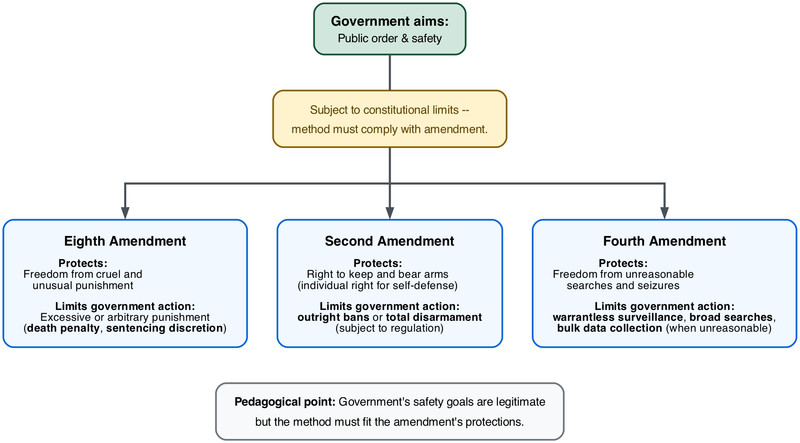
- The same pattern shows up in all three amendment areas. Government has a legitimate goal, but the method it uses must stay within constitutional limits.
- Many of these rules bind states and cities because of selective incorporation through the Fourteenth Amendment. You do not need the full incorporation doctrine here, just the reminder that state and local governments are often bound too.
- On the AP exam, avoid vague claims like “rights win” or “safety wins.” Use the amendment, the constitutional rule, and the case.
The Three Amendment Areas in One Place
These three amendments protect different kinds of liberty, so the Court asks different questions in each one. This quick comparison pulls the core idea together before you move into the cases and rules for each amendment.
| Amendment | Protects | Main conflict |
|---|---|---|
| Eighth | Freedom from cruel and unusual punishment | How far punishment can go, especially the death penalty |
| Second | Right to keep and bear arms | When gun regulation becomes an unconstitutional restriction |
| Fourth | Freedom from unreasonable searches and seizures | When surveillance or data collection becomes an unconstitutional search |
- Under the Eighth Amendment, the death penalty is not automatically unconstitutional. The fight is usually about procedure, proportionality, and who may be executed.
- Under the Second Amendment, the Court recognizes an individual gun right, especially for self-defense, but that right has limits.
- Under the Fourth Amendment, the key word is unreasonable. Some searches are allowed, but warrants, probable cause, and particularity matter when required.
Comparing Eighth, Second, and Fourth Amendment limits
Death Penalty Limits Under the Eighth Amendment
The Eighth Amendment limits punishment even after a person is convicted.
Furman v. Georgia
In Furman v. Georgia (1972), the Court struck down death penalty systems that gave juries too much unguided discretion. The problem was arbitrariness. Death sentences were too unpredictable and could be discriminatory. Furman did not abolish the death penalty itself.
Gregg v. Georgia
States rewrote their laws, and Gregg v. Georgia (1976) upheld a revised system.
- Bifurcated trial means guilt and punishment are decided separately.
- Aggravating circumstances guide when death is allowed.
- Automatic appellate review adds oversight.
The rule from Gregg is that capital punishment can be constitutional if procedures guide discretion.
Categorical limits
- Atkins v. Virginia (2002) barred execution of people with intellectual disabilities.
- Roper v. Simmons (2005) barred execution for crimes committed under age 18.
- Kennedy v. Louisiana (2008) said the death penalty generally cannot be used for child rape when the victim did not die.
The Court uses evolving standards of decency. Harsh punishment alone is not enough. The issue is whether the punishment or its use is cruel and unusual.
Gun Rights and Gun Regulation Under the Second Amendment
The Second Amendment debate is about where regulation ends and violation begins.
District of Columbia v. Heller
In Heller (2008), the Court said the Second Amendment protects an individual right to possess a firearm, especially for lawful self-defense in the home. It struck down D.C.’s handgun ban and a rule that made home firearms inoperable.
McDonald v. Chicago
In McDonald v. Chicago (2010), the Court applied that right to state and local governments through the Fourteenth Amendment and struck down Chicago’s handgun ban.
That helps explain why public debate often centers on how far regulation can go without crossing the constitutional line.

Competing views on gun rights and gun regulation
Governments can still regulate:
- possession by felons
- guns in sensitive places like schools and government buildings
- commercial sale conditions
Privacy and Public Safety Under the Fourth Amendment
The Fourth Amendment blocks unreasonable searches, not all searches.
- Traditional protections include warrants, probable cause, and particularity.
- Those rules guard against broad, open-ended general searches.
Smith v. Maryland
In Smith v. Maryland (1979), using a pen register to record dialed phone numbers was not treated as a search. That fits the third-party doctrine because the numbers were shared with the phone company.
Carpenter v. United States
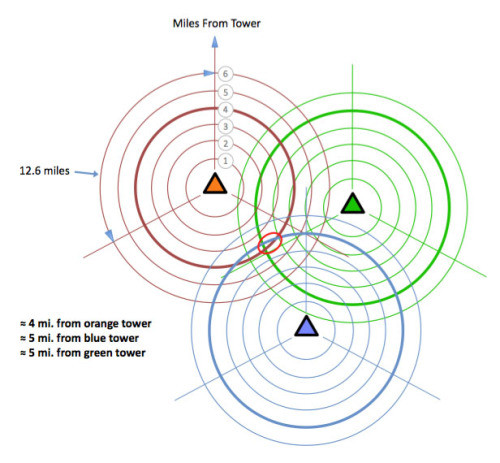
In Carpenter v. United States (2018), the Court said collecting extensive cell-site location data was a search and generally requires a warrant. Long-term location tracking can reveal intimate details about a person’s life and movement.
Cell-site location tracking
Digital metadata and policy
Metadata can show time, duration, routing, and location-related records. The tower overlap point here is the basic idea behind how location can be inferred from cell data. Collected in bulk, it can expose habits, relationships, religion, and politics.
- The USA PATRIOT Act expanded surveillance tools after 9/11.
- The USA FREEDOM Act (2015) limited bulk telephone metadata collection.
Key Takeaways
Cruel and Unusual Punishments Clause (Eighth Amendment)
Prohibits punishments that are cruel and unusual, including penalties or sentencing practices the Supreme Court finds impermissible in type, proportionality, application, or administration
Evolving Standards of Decency
The principle that the Eighth Amendment may be interpreted according to contemporary standards of acceptable punishment rather than only standards at ratification
Furman v. Georgia (1972)
Invalidated the death sentences before the Court amid concerns that broad, unguided discretion made capital punishment arbitrary, unpredictable, and discriminatory, temporarily halting executions without declaring the death penalty inherently unconstitutional
Gregg v. Georgia (1976)
Upheld a revised death penalty law using separate guilt and sentencing proceedings, aggravating circumstances, and automatic review, allowing executions to resume
Atkins v. Virginia (2002)
Held that executing people with intellectual disabilities violates the Eighth Amendment
Roper v. Simmons (2005)
Held that a person may not be executed for a crime committed before age 18
Kennedy v. Louisiana (2008)
Held the death penalty disproportionate for the rape of a child when the victim did not die and death was not intended
Second Amendment
Protects an individual right to keep and bear arms, especially for lawful self-defense, while permitting some government firearm regulation
District of Columbia v. Heller (2008)
Held that the Second Amendment protects an individual right, independent of militia service, to possess an operable handgun for lawful self-defense in the home
McDonald v. Chicago (2010)
Applied the individual Second Amendment right to state and local governments through the Fourteenth Amendment and invalidated Chicago’s handgun ban
Fourth Amendment
Protects against unreasonable government searches and seizures and requires warrants to rest on probable cause and particularly describe what may be searched or seized
Reasonable Expectation of Privacy
A privacy interest whose government violation can constitute a Fourth Amendment search even without physical trespass
Digital Metadata
Information about communications, such as participants, time, duration, routing, location, or associations, rather than necessarily their substantive content
Smith v. Maryland (1979)
Held that recording dialed telephone numbers with a pen register was not a Fourth Amendment search because the caller conveyed them to the phone company
Carpenter v. United States (2018)
Held that obtaining extensive historical cell-site location records is a Fourth Amendment search that generally requires a warrant supported by probable cause
Notes
Cruel and Unusual Punishments Clause (Eighth Amendment)
Prohibits punishments that are cruel and unusual, including penalties or sentencing practices the Supreme Court finds impermissible in type, proportionality, application, or administration
Evolving Standards of Decency
The principle that the Eighth Amendment may be interpreted according to contemporary standards of acceptable punishment rather than only standards at ratification
Furman v. Georgia (1972)
Invalidated the death sentences before the Court amid concerns that broad, unguided discretion made capital punishment arbitrary, unpredictable, and discriminatory, temporarily halting executions without declaring the death penalty inherently unconstitutional
Gregg v. Georgia (1976)
Upheld a revised death penalty law using separate guilt and sentencing proceedings, aggravating circumstances, and automatic review, allowing executions to resume
Atkins v. Virginia (2002)
Held that executing people with intellectual disabilities violates the Eighth Amendment
Roper v. Simmons (2005)
Held that a person may not be executed for a crime committed before age 18
Kennedy v. Louisiana (2008)
Held the death penalty disproportionate for the rape of a child when the victim did not die and death was not intended
Second Amendment
Protects an individual right to keep and bear arms, especially for lawful self-defense, while permitting some government firearm regulation
District of Columbia v. Heller (2008)
Held that the Second Amendment protects an individual right, independent of militia service, to possess an operable handgun for lawful self-defense in the home
McDonald v. Chicago (2010)
Applied the individual Second Amendment right to state and local governments through the Fourteenth Amendment and invalidated Chicago’s handgun ban
Fourth Amendment
Protects against unreasonable government searches and seizures and requires warrants to rest on probable cause and particularly describe what may be searched or seized
Reasonable Expectation of Privacy
A privacy interest whose government violation can constitute a Fourth Amendment search even without physical trespass
Digital Metadata
Information about communications, such as participants, time, duration, routing, location, or associations, rather than necessarily their substantive content
Smith v. Maryland (1979)
Held that recording dialed telephone numbers with a pen register was not a Fourth Amendment search because the caller conveyed them to the phone company
Carpenter v. United States (2018)
Held that obtaining extensive historical cell-site location records is a Fourth Amendment search that generally requires a warrant supported by probable cause
