Topic 3.3 Notes – First Amendment: Freedom of Speech
What Freedom of Speech Protects
The First Amendment says government cannot abridge freedom of speech. Through the Fourteenth Amendment, that protection also applies to state and local governments, not just Congress.
A civil liberty is freedom from government interference. In this topic, that matters most for political expression. The Court is especially protective when people criticize public officials, protest government policy, or express unpopular views.
One easy AP Gov trap is this. The First Amendment usually limits government action, not private choices.
- A public school disciplining a student raises a First Amendment issue because it is part of the government.
- A private employer, private school, or private social media platform usually can set its own speech rules.
Speech includes more than talking.
- Spoken and written expression
- Symbolic speech or expressive conduct, when actions communicate an idea
- examples include armbands, flags, signs, clothing, and protest displays
A classic AP Gov example is student protest through black armbands, like the image here.
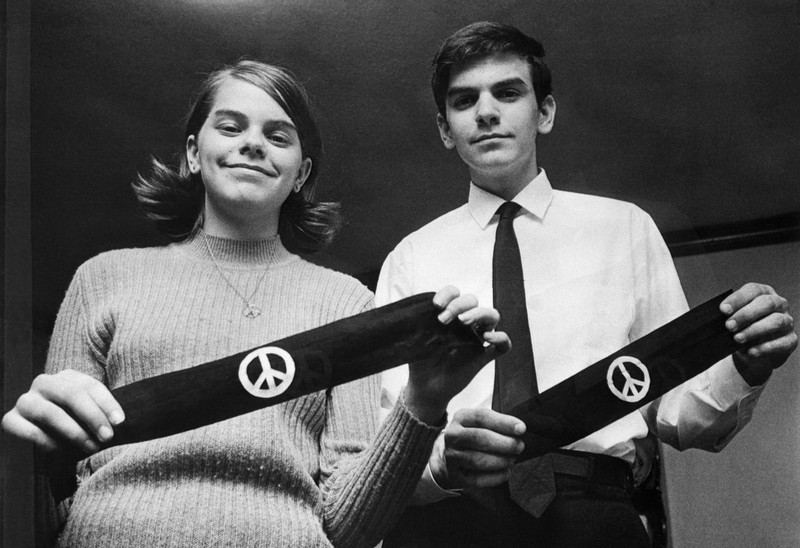
Black armbands in the Tinker student protest
The First Amendment also protects against compelled speech. Government usually cannot force you to say the government’s message.
Barnette
In West Virginia State Board of Education v. Barnette (1943), public school students could not be forced to salute the flag or say the Pledge. The core idea is bigger than the flag salute. Government cannot impose political orthodoxy and make people affirm it.
The rule you want in your head is simple. Offensive, unpopular, and even unpatriotic ideas are usually protected when government is suppressing them because of the message.
When Government Can and Cannot Regulate Speech
A lot of confusion disappears if you keep two categories separate.
Content and viewpoint based restrictions
A content-based restriction depends on what is being said. Those laws are generally presumed unconstitutional.
Viewpoint discrimination is even worse. That happens when government allows debate on an issue but favors one side. A city cannot allow pro-mayor signs and ban anti-mayor signs.
Time, place, and manner regulations
Government can regulate when, where, and how speech happens if it is not targeting the message itself.
Common examples include:
- permit requirements for marches
- parade routes
- noise limits
- event hours
- rules against blocking entrances
In public forums like streets, sidewalks, and parks, those rules must be:
- content neutral
- narrowly tailored to a significant government interest
- leave open ample alternative channels for communication
A good contrast:
- Valid: the same sound limit for every demonstration
- Invalid: stricter sound limits only for protests criticizing the mayor
Student Speech and Symbolic Speech
The Court protects symbolic speech when conduct communicates an idea.
In Texas v. Johnson (1989), flag burning as political protest counted as protected symbolic speech. The government could not ban it just because people found it offensive.
Tinker v. Des Moines
In Tinker v. Des Moines (1969), students wore black armbands to protest the Vietnam War. The Court said students do not “shed their constitutional rights to freedom of speech or expression at the schoolhouse gate.”
Schools can regulate student speech only if it would materially and substantially disrupt school operations or interfere with the rights of others. A vague fear of disruption is not enough.
Morse v. Frederick
In Morse v. Frederick (2007), a school could restrict a banner reasonably seen as promoting illegal drug use. This narrowed student speech rights in a specific school context.
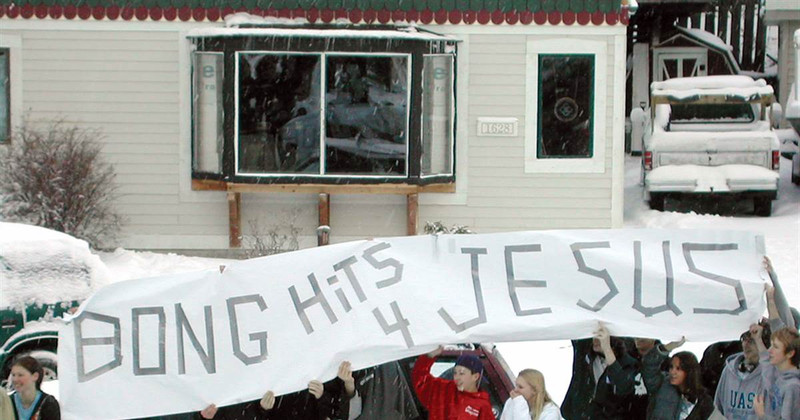
“BONG HiTS 4 JESUS” banner from Morse v. Frederick
Limits on Speech
Speech is broad, but it is not absolute.
- Schenck v. United States (1919) upheld punishment for anti-draft leaflets during World War I under the clear and present danger idea.
- Brandenburg v. Ohio (1969) created the modern rule. Government can punish advocacy only if it is directed to inciting imminent lawless action and likely to produce it.
That means abstract advocacy is protected. Immediate incitement is not.
Other limits:
- Obscenity can be restricted. In Miller v. California (1973), the Court used a narrow obscenity test.
- Offensive speech is still often protected. Offensive does not automatically mean obscene.
- Fighting words and true threats can be restricted, but those categories are narrow.
- Defamation is a false statement of fact that harms reputation.
- Libel = written
- Slander = spoken
- In New York Times Co. v. Sullivan (1964), public officials had to prove actual malice, which protects strong criticism of government.
The Overall Balance the Court Tries to Strike
The Supreme Court strongly protects:
- political speech
- symbolic speech
- refusal to speak
- unpopular and offensive viewpoints
The Court allows more regulation of:
- neutral time, place, and manner issues
- incitement of imminent lawless action
- obscenity
- defamation
- some school speech
The usual rule is this. The Court protects expression unless government is addressing a specific legally recognized harm or regulating the circumstances of speech in a content-neutral way.
Key Takeaways
Freedom of Speech
First Amendment protection against government suppression of expression, especially political expression, subject to limited, defined restrictions
Symbolic Speech
Nonverbal conduct intended to communicate an idea or belief, such as wearing an armband or burning a flag in protest
Compelled Expression
Government coercion requiring a person to affirm or communicate an official message, generally prohibited by the First Amendment
West Virginia State Board of Education v. Barnette (1943)
The Supreme Court held that public schools cannot compel students to salute the flag or recite the Pledge of Allegiance
Tinker v. Des Moines Independent Community School District (1969)
The Supreme Court protected students' antiwar armbands as symbolic speech because they did not materially and substantially disrupt school
Substantial-Disruption Standard
Public schools may restrict student expression when officials can reasonably forecast material and substantial disruption or interference with others' rights
Morse v. Frederick (2007)
The Supreme Court held that a public school may restrict student expression reasonably understood as encouraging illegal drug use
Content-Based Restriction
A speech restriction that depends on the subject or message being communicated and is generally presumptively unconstitutional
Viewpoint Discrimination
Government restriction that permits discussion of a subject but favors or suppresses a particular side of the debate
Time, Place, and Manner Regulations
Content-neutral limits on when, where, or how expression occurs; in a traditional public forum, they generally must be narrowly tailored to a significant government interest and leave ample alternative channels
Traditional Public Forum
Government property historically open to public expression, such as streets, sidewalks, and parks, where speech receives strong protection
Schenck v. United States (1919)
The Supreme Court upheld Schenck's wartime conviction for anti-draft leaflets, ruling that speech creating a clear and present danger could be restricted
Clear and Present Danger Test
Schenck's historical standard asking whether speech in its circumstances creates a clear and present danger of harms government may prevent
Brandenburg v. Ohio (1969) / Imminent Lawless Action Test
Government may punish advocacy of unlawful conduct only when it is directed to producing imminent lawless action and is likely to produce it
True Threat
A serious communication of intent to commit unlawful violence against a person or group, rather than joking, exaggeration, or abstract advocacy
Fighting Words
Personally abusive face-to-face words likely to provoke an immediate violent reaction, a narrowly interpreted category subject to regulation
Defamation
A false statement of fact communicated about another person that harms that person's reputation
New York Times Co. v. Sullivan (1964)
The Supreme Court required public officials suing over statements about public affairs to prove actual malice
Actual Malice
Knowledge that a defamatory statement was false or reckless disregard for whether it was true, not ordinary hostility or ill will
Obscenity
A narrow category of sexually explicit expression that satisfies the Miller test and receives no First Amendment protection
Miller Test
Material is obscene if, under contemporary community standards, it appeals to a prurient interest; depicts legally defined sexual conduct in a patently offensive way; and, taken as a whole, lacks serious literary, artistic, political, or scientific value
Libel
Written defamation
Slander
Spoken defamation
Notes
Freedom of Speech
First Amendment protection against government suppression of expression, especially political expression, subject to limited, defined restrictions
Symbolic Speech
Nonverbal conduct intended to communicate an idea or belief, such as wearing an armband or burning a flag in protest
Compelled Expression
Government coercion requiring a person to affirm or communicate an official message, generally prohibited by the First Amendment
West Virginia State Board of Education v. Barnette (1943)
The Supreme Court held that public schools cannot compel students to salute the flag or recite the Pledge of Allegiance
Tinker v. Des Moines Independent Community School District (1969)
The Supreme Court protected students' antiwar armbands as symbolic speech because they did not materially and substantially disrupt school
Substantial-Disruption Standard
Public schools may restrict student expression when officials can reasonably forecast material and substantial disruption or interference with others' rights
Morse v. Frederick (2007)
The Supreme Court held that a public school may restrict student expression reasonably understood as encouraging illegal drug use
Content-Based Restriction
A speech restriction that depends on the subject or message being communicated and is generally presumptively unconstitutional
Viewpoint Discrimination
Government restriction that permits discussion of a subject but favors or suppresses a particular side of the debate
Time, Place, and Manner Regulations
Content-neutral limits on when, where, or how expression occurs; in a traditional public forum, they generally must be narrowly tailored to a significant government interest and leave ample alternative channels
Traditional Public Forum
Government property historically open to public expression, such as streets, sidewalks, and parks, where speech receives strong protection
Schenck v. United States (1919)
The Supreme Court upheld Schenck's wartime conviction for anti-draft leaflets, ruling that speech creating a clear and present danger could be restricted
Clear and Present Danger Test
Schenck's historical standard asking whether speech in its circumstances creates a clear and present danger of harms government may prevent
Brandenburg v. Ohio (1969) / Imminent Lawless Action Test
Government may punish advocacy of unlawful conduct only when it is directed to producing imminent lawless action and is likely to produce it
True Threat
A serious communication of intent to commit unlawful violence against a person or group, rather than joking, exaggeration, or abstract advocacy
Fighting Words
Personally abusive face-to-face words likely to provoke an immediate violent reaction, a narrowly interpreted category subject to regulation
Defamation
A false statement of fact communicated about another person that harms that person's reputation
New York Times Co. v. Sullivan (1964)
The Supreme Court required public officials suing over statements about public affairs to prove actual malice
Actual Malice
Knowledge that a defamatory statement was false or reckless disregard for whether it was true, not ordinary hostility or ill will
Obscenity
A narrow category of sexually explicit expression that satisfies the Miller test and receives no First Amendment protection
Miller Test
Material is obscene if, under contemporary community standards, it appeals to a prurient interest; depicts legally defined sexual conduct in a patently offensive way; and, taken as a whole, lacks serious literary, artistic, political, or scientific value
Libel
Written defamation
Slander
Spoken defamation
