Topic 4.9 Notes – Ideology and Economic Policy
How Ideology Shapes Economic Policy
Economic policy arguments usually come down to one fight. How active should government be in the economy?
All three ideologies here accept private property and markets. Nobody in this topic is arguing for total government control of the economy. The disagreement is about how much government should step in when markets create unfairness, danger, instability, or inequality.
- Liberals want more government regulation and intervention.
- They see government as a way to protect workers, consumers, and the environment.
- They also connect policy to equality of opportunity, because markets alone can leave people with unequal starting points.
- Conservatives want fewer regulations, lower taxes, and more reliance on private enterprise.
- They trust competition more and worry that regulation can slow growth, raise costs, and weaken individual responsibility.
- Libertarians want little or no regulation beyond protecting property rights, enforcing contracts, and stopping fraud or theft.
- They treat voluntary economic choice as a major form of liberty.
The values underneath the argument stay pretty consistent:
- Economic freedom vs. equality, security, and opportunity
- Efficiency vs. government correction of harmful market outcomes
Regulation can cover a lot of things, including wages, workplace safety, financial markets, corporate behavior, consumer products, and pollution. The triangle below is a quick way to picture the three broad positions, with a centrist space in the middle.
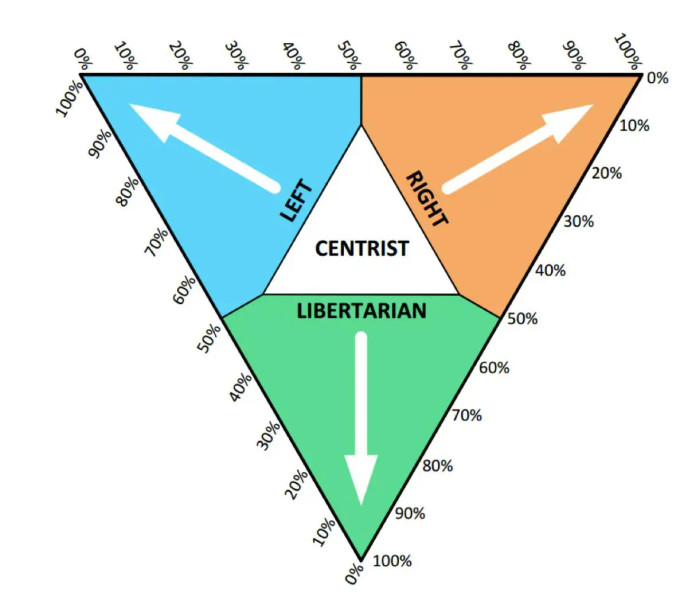
Political ideology triangle
Ideology in Marketplace Debates
These ideas get tested through policy examples, especially estate tax and minimum wage. The exam usually wants the reasoning, not just the side.
Estate tax
- Liberals tend to support it because inherited wealth can concentrate power across generations and weaken equality of opportunity.
- Conservatives tend to oppose it because they see it as double taxation, a violation of property rights, and a disincentive to save or invest.
- Libertarians generally oppose it because government should not interfere with voluntary transfer of private property.
Minimum wage
- Liberals support it or support raising it because workers often have weaker bargaining power and need protection from exploitative wages.
- Conservatives prefer a lower minimum wage or market wages because wage floors can reduce hiring, cut hours, or raise prices.
- Libertarians oppose it because government should not block a voluntary agreement between employer and worker.
Fiscal Policy
Fiscal policy means taxing and spending decisions made by Congress and the president.
Two directions
- Expansionary fiscal policy
- Government increases spending and/or cuts taxes.
- The goal is to boost demand, growth, and employment during recession or high unemployment.
- Contractionary fiscal policy
- Government decreases spending and/or raises taxes.
- The goal is to slow demand and reduce inflation.
A budget deficit is when government spends more than it collects in one year. The national debt is the total accumulated borrowing over time.
Two major approaches
| Approach | Main idea | Usually linked to | Example |
|---|---|---|---|
| Keynesian | Use government spending and tax policy to increase demand, especially in downturns | Liberals | American Recovery and Reinvestment Act of 2009 |
| Supply-side | Use lower taxes and deregulation to increase work, investment, and production | Conservatives | Economic Recovery Tax Act of 1981 |
The easy mistake here is thinking tax cuts always mean the same thing. They don’t.
- Keynesian tax cuts aim to get people spending now.
- Supply-side tax cuts aim to increase production and investment.
Monetary Policy and the Federal Reserve
Monetary policy means actions by the Federal Reserve to influence interest rates and wider economic conditions.
The Fed is the nation’s central bank and an independent agency. It has a dual mandate:
- maximum employment
- price stability
Two directions
- Expansionary monetary policy
- Lower interest rates
- More borrowing, spending, investment, hiring
- Contractionary monetary policy
- Raise interest rates
- Less borrowing and spending, slower inflation
Open market operations are one tool:
- Fed buys government securities → rates tend to go down
- Fed sells government securities → rates tend to go up
The standard example is the 2008 financial crisis, when the Fed pushed rates near zero and used quantitative easing.
The basic sequence is straightforward. The Fed acts, financial conditions change, and that affects demand in the broader economy.
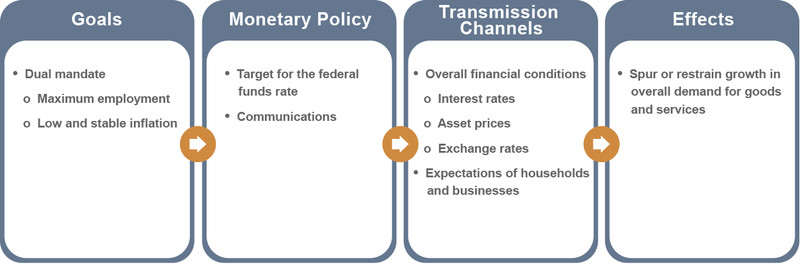
How monetary policy affects the economy
The chain matters:
Fed changes rates → borrowing costs change → spending and investment change → employment, output, and prices change
Those effects are indirect and often delayed.
Fiscal vs. Monetary Policy and Reading Data
Students mix these up all the time.
- Fiscal = Congress + president + taxes/spending
- Monetary = Fed + interest rates/money/credit
Keynesian and supply-side are fiscal approaches, not monetary policy.
Both fiscal and monetary policy can fight recession or inflation. The difference is the institution and the tool.
When you read graphs or economic data:
- describe the trend before explaining it
- correlation does not prove causation
- check whether the graph uses totals or percentages, nominal or inflation-adjusted numbers, short-term or long-term data
- watch for limits like inflation, population growth, regional differences, time lags, and omitted variables
The same graph can support different ideological arguments because ideology comes from the reasoning, not just the data.
Key Takeaways
Marketplace Regulation
Laws and administrative rules that limit or require economic activity, such as wage, safety, consumer, financial, competition, and environmental rules
Liberal Economic Ideology
Favors comparatively more regulation, progressive taxation, government spending, and intervention to promote fairness, security, and equality of opportunity
Conservative Economic Ideology
Favors fewer regulations, lower taxes, less government spending, and greater reliance on private enterprise, incentives, and individual responsibility
Libertarian Economic Ideology
Favors little or no economic regulation beyond protecting property rights, enforcing contracts, preventing force or fraud, and enabling voluntary trade
Estate Tax (Inheritance Tax or “Death Tax”)
A federal tax on the transfer of a qualifying estate before distribution to heirs; liberals more often support it, while conservatives and libertarians more often oppose it
Minimum-Wage Law
A wage floor below which covered employers may not pay workers; liberals generally support it more strongly than conservatives or libertarians
Fiscal Policy
Actions by Congress and the president that use government taxing and spending to influence economic conditions
Expansionary Fiscal Policy
Increased government spending or tax cuts intended to raise demand, output, and employment, usually during a recession
Contractionary Fiscal Policy
Reduced government spending or higher taxes intended to restrain demand and inflation, though potentially slowing growth and employment
Budget Deficit
The amount by which federal spending exceeds federal revenue during a single fiscal year
National Debt
The accumulated total of past federal borrowing, rather than the deficit from a single year
Keynesian Fiscal Policy
Using government spending or tax cuts to increase aggregate demand during downturns, with reduced spending or higher taxes available to restrain inflation
Supply-Side Economics (Supply-Side Fiscal Policy)
Tax cuts, deregulation, and related policies intended to strengthen incentives to work, save, invest, produce, and expand economic growth
Monetary Policy
Federal Reserve actions that influence interest rates, credit, and the money supply to affect broader economic conditions
Federal Reserve (Fed)
The nation’s independent central bank, which conducts monetary policy to pursue maximum employment and price stability
Federal Reserve Dual Mandate
The Fed’s two central goals of maximum employment and price stability
Expansionary Monetary Policy
Fed actions such as lowering interest rates or buying government securities to encourage borrowing, spending, investment, output, and employment
Contractionary Monetary Policy
Fed actions such as raising interest rates or selling government securities to reduce borrowing and spending and restrain inflation
Notes
Marketplace Regulation
Laws and administrative rules that limit or require economic activity, such as wage, safety, consumer, financial, competition, and environmental rules
Liberal Economic Ideology
Favors comparatively more regulation, progressive taxation, government spending, and intervention to promote fairness, security, and equality of opportunity
Conservative Economic Ideology
Favors fewer regulations, lower taxes, less government spending, and greater reliance on private enterprise, incentives, and individual responsibility
Libertarian Economic Ideology
Favors little or no economic regulation beyond protecting property rights, enforcing contracts, preventing force or fraud, and enabling voluntary trade
Estate Tax (Inheritance Tax or “Death Tax”)
A federal tax on the transfer of a qualifying estate before distribution to heirs; liberals more often support it, while conservatives and libertarians more often oppose it
Minimum-Wage Law
A wage floor below which covered employers may not pay workers; liberals generally support it more strongly than conservatives or libertarians
Fiscal Policy
Actions by Congress and the president that use government taxing and spending to influence economic conditions
Expansionary Fiscal Policy
Increased government spending or tax cuts intended to raise demand, output, and employment, usually during a recession
Contractionary Fiscal Policy
Reduced government spending or higher taxes intended to restrain demand and inflation, though potentially slowing growth and employment
Budget Deficit
The amount by which federal spending exceeds federal revenue during a single fiscal year
National Debt
The accumulated total of past federal borrowing, rather than the deficit from a single year
Keynesian Fiscal Policy
Using government spending or tax cuts to increase aggregate demand during downturns, with reduced spending or higher taxes available to restrain inflation
Supply-Side Economics (Supply-Side Fiscal Policy)
Tax cuts, deregulation, and related policies intended to strengthen incentives to work, save, invest, produce, and expand economic growth
Monetary Policy
Federal Reserve actions that influence interest rates, credit, and the money supply to affect broader economic conditions
Federal Reserve (Fed)
The nation’s independent central bank, which conducts monetary policy to pursue maximum employment and price stability
Federal Reserve Dual Mandate
The Fed’s two central goals of maximum employment and price stability
Expansionary Monetary Policy
Fed actions such as lowering interest rates or buying government securities to encourage borrowing, spending, investment, output, and employment
Contractionary Monetary Policy
Fed actions such as raising interest rates or selling government securities to reduce borrowing and spending and restrain inflation
