Topic 5.6 Notes – Interest Groups Influencing Policymaking
What Interest Groups Are
Interest groups connect people to government, which is why they’re called linkage institutions. They give citizens, industries, professions, and causes a way to press their goals on policymakers.
- They are organized groups that try to influence policy without nominating candidates or directly running the government.
- Their work is tied to the First Amendment. Speech, assembly, and petition protect lobbying and organized advocacy.
- They are different from political parties. Parties want to win offices and govern with broad platforms. Interest groups care more about specific policies, even if they support candidates.
- They are different from social movements. Social movements are broader and often less formal. Interest groups usually have leadership, staff, money, and a long-term strategy.
Madison’s idea of factions in Federalist No. 10 fits here. He thought lots of competing groups could keep any one group from dominating. That still matters, but the competition is uneven because some groups have far more money and access than others.
Types of Interest Groups and Their Resources
Different groups organize around different kinds of interests, and that shapes how powerful they can be.
Major types
| Type | What they represent | Example |
|---|---|---|
| Economic and occupational | Business, labor, professions, agriculture | trade associations, labor unions |
| Membership or constituency | Shared traits or concerns | AARP for older Americans |
| Public-interest and ideological | Broader goals they say help society | environmental or civil liberties groups |
| Single-issue | One policy area with intense focus | gun rights or abortion groups |
AARP is the classic AP example because it combines huge membership, money, expertise, and a group that votes at high rates.
Resources that matter
- Money pays for lobbying, ads, research, lawsuits, and PAC activity.
- Membership size matters, but only if members can be mobilized.
- Expertise gives lawmakers and agencies information they often need.
- Leadership and staff keep the group active and organized.
- Access means direct contact with legislators, staff, and agencies.
- Intensity and geographic concentration matter because small groups with a lot at stake often push harder than a huge public with only mild interest.
That’s a pattern you should remember. Unequal resources create unequal influence.
How Interest Groups Influence Elections and Policymaking
Interest groups don’t just donate money. They work at many points in the process.
The big methods you need to know are lobbying, drafting legislation, grassroots pressure, campaign activity, and the revolving door.
- Educating voters and officials through policy reports, voter guides, ratings, and hearing testimony. The information can be useful, but it is usually selective and persuasive.
- Lobbying means direct contact with lawmakers, staff, agencies, and executive officials. Good lobbyists bring expertise, relationships, and procedural knowledge.
- The revolving door happens when former officials become lobbyists. That raises concerns about insider access and conflict of interest.
- Drafting legislation lets groups shape bills early by writing definitions, rules, and enforcement language.
- Mobilizing members includes grassroots lobbying, where regular members contact officials, and grasstops strategies, where influential local leaders or donors apply pressure.
- Influencing elections includes endorsements, PAC money, ads, voter registration, GOTV, and candidate scorecards.
- Working with agencies and courts matters after elections too. Groups comment on regulations, pressure agencies during implementation, and file amicus curiae briefs, or “friend of the court” briefs. In McDonald v. Chicago, interest groups were involved through litigation and court advocacy.
Iron Triangles and Issue Networks
Some influence happens through lasting policy relationships, not just party politics.
Iron triangles
An iron triangle is a stable relationship among:
- an interest group
- a congressional committee
- a bureaucratic agency
Each helps the others with information, support, laws, or implementation. Tobacco subsidies are the classic example, involving tobacco interests, agriculture committees, and the Department of Agriculture.
Issue networks
An issue network is broader and looser. It can include legislators, staff, agencies, experts, think tanks, journalists, and multiple interest groups. Environmental policy often works this way.
This comparison is worth seeing side by side because the structure is the whole point.
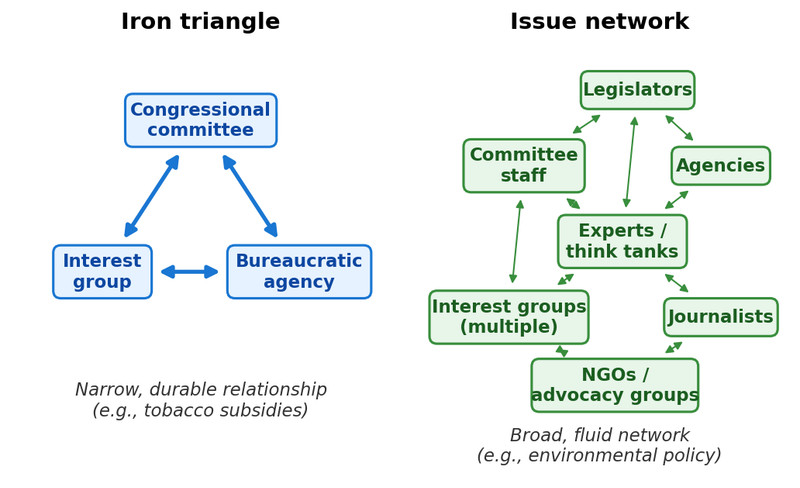
Iron triangles and issue networks
The exam distinction is simple. Iron triangle = narrow and durable. Issue network = broad and fluid.
Why Interest Group Influence Helps and Hurts Democracy
Interest groups expand participation beyond voting. They give people more voice, provide expertise, educate citizens, monitor government, and support pluralism, where many groups compete.
The problems come from inequality.
- Unequal resources mean some voices get far more access.
- The free rider problem happens when people benefit without joining or paying.
- Groups answer that with selective benefits, like discounts, publications, or services only members get.
- Narrow groups can win benefits that spread costs across the public.
- Close ties can create regulatory capture, revolving-door problems, and weak transparency.
- Many competing groups can also create delay or gridlock.
The George W. Bush tax cuts show groups reinforcing a party coalition, not acting alone. The tobacco subsidy system shows how concentrated interests can keep influence for a long time.
Key Takeaways
Interest Group
An organized association that seeks to influence public policy without trying to control government by electing candidates under its own label
Lobbying (Direct Lobbying or Insider Strategy)
Direct communication with legislators, staff, executive officials, or agencies to influence public policy through information and persuasion
Grassroots Lobbying (Outside Strategy)
Mobilizing constituents or the public to contact officials and create political pressure for a policy position
Grasstops Strategy
Mobilizing prominent community leaders, donors, or local officials to contact policymakers personally
Revolving Door
Movement between government employment and lobbying that provides contacts and expertise but can create privileged access or conflicts of interest
Regulatory Capture
A condition in which a government agency becomes too responsive to the interests it is responsible for regulating
Amicus Curiae Brief
A written submission by a nonparty, or “friend of the court,” offering arguments or information for judges to consider
Iron Triangle
A stable, mutually beneficial relationship among an interest group, a congressional committee or subcommittee, and a bureaucratic agency
Issue Network
A broad, fluid collection of officials, interest groups, researchers, experts, and others who cooperate or compete over a policy area
Collective-Action Problem
The difficulty of organizing people who share a goal because each has an incentive to let others bear the costs of pursuing it
Free Rider
An individual who benefits from an interest group’s work without providing financial or organizational support
Selective Benefits
Goods or services available only to members, offered to encourage people to join and support an interest group
Notes
Interest Group
An organized association that seeks to influence public policy without trying to control government by electing candidates under its own label
Lobbying (Direct Lobbying or Insider Strategy)
Direct communication with legislators, staff, executive officials, or agencies to influence public policy through information and persuasion
Grassroots Lobbying (Outside Strategy)
Mobilizing constituents or the public to contact officials and create political pressure for a policy position
Grasstops Strategy
Mobilizing prominent community leaders, donors, or local officials to contact policymakers personally
Revolving Door
Movement between government employment and lobbying that provides contacts and expertise but can create privileged access or conflicts of interest
Regulatory Capture
A condition in which a government agency becomes too responsive to the interests it is responsible for regulating
Amicus Curiae Brief
A written submission by a nonparty, or “friend of the court,” offering arguments or information for judges to consider
Iron Triangle
A stable, mutually beneficial relationship among an interest group, a congressional committee or subcommittee, and a bureaucratic agency
Issue Network
A broad, fluid collection of officials, interest groups, researchers, experts, and others who cooperate or compete over a policy area
Collective-Action Problem
The difficulty of organizing people who share a goal because each has an incentive to let others bear the costs of pursuing it
Free Rider
An individual who benefits from an interest group’s work without providing financial or organizational support
Selective Benefits
Goods or services available only to members, offered to encourage people to join and support an interest group
