Topic 2.11 Notes – Checks on the Judicial Branch
Judicial Review and Why Supreme Court Power Is Debated
Judicial review means courts can rule that a law or executive action violates the Constitution and refuse to uphold it. Marbury v. Madison (1803) established that power for the Supreme Court.
Article III creates the federal judiciary, and Federalist No. 78 explains why courts need independence. Hamilton’s point was that judges must be able to use their judgment to defend the Constitution, even when elected officials want something else.
That lets the Court invalidate:
- acts of Congress if a federal law violates the Constitution
- state laws if they conflict with the Constitution
- executive actions if the president or agencies go beyond constitutional limits
This broader checks-and-balances diagram is a good reminder of where judicial review fits. For this section, focus on the judicial branch checks that let courts declare laws and executive actions unconstitutional.
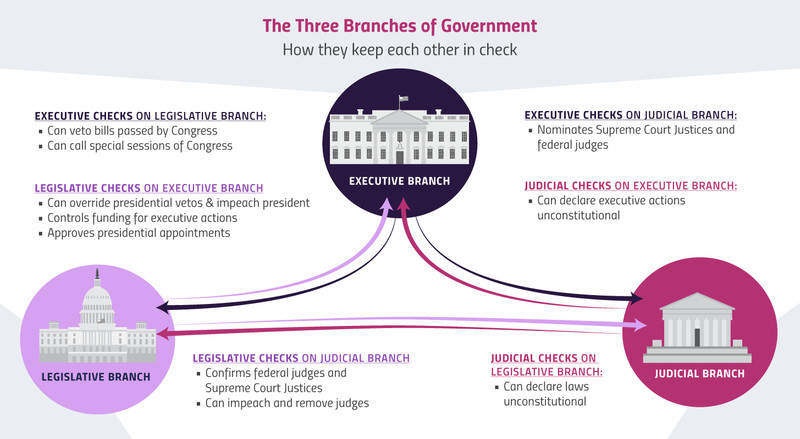
The argument starts here. Justices are unelected and serve for life during good behavior, so they can block policies chosen by elected majorities. That is the countermajoritarian difficulty. A small group of judges can override what most voters, through their representatives, wanted.
The defense of strong judicial review is that the Constitution outranks temporary majorities. Courts can protect individual rights, constitutional limits, and political minorities when elected branches will not. On the AP exam, the debate is usually about how aggressively judicial review should be used, not whether it exists.
Judicial Activism and Judicial Restraint
These are the two main ways people describe the Court’s use of judicial review.
Judicial activism
Judicial activism means the Court uses its power more assertively. It is more willing to:
- strike down laws
- invalidate executive actions
- broaden constitutional meaning
- overturn precedent
A classic example is Brown v. Board of Education (1954). The Court rejected school segregation and broke from the logic tied to Plessy v. Ferguson. That is activist in AP Gov terms because the Court overturned old precedent and intervened strongly.
Judicial restraint
Judicial restraint means the Court uses judicial review more cautiously. It usually defers to elected branches and follows precedent unless a law clearly violates the Constitution.
This is tied to stare decisis, which means following precedent for stability and predictability. Restraint does not mean the Court never overturns precedent. It means it does so carefully.
How they compare
- Activism = assertive use of judicial power
- Restraint = cautious use of judicial power
Neither one is automatically liberal or conservative. AP questions often test this by asking whether the Court is overturning precedent or deferring to elected institutions.
Formal Checks by Congress, the President, and the States
The Court is powerful, but the other branches still have real tools.
| Check | How it works | Example |
|---|---|---|
| Changing law | Congress can amend a statute after the Court interprets it | Ledbetter v. Goodyear (2007) led to the Lilly Ledbetter Fair Pay Act (2009) |
| Constitutional amendment | Only an amendment can clearly override a constitutional ruling | Pollock (1895) led to the 16th Amendment |
| Appointments | President nominates, Senate confirms, shifting ideology over time | Vacancies matter because justices serve for life |
| Jurisdiction stripping | Congress can limit appellate cases the Court hears | Ex parte McCardle (1869) |
The biggest distinction here is this. Congress can respond more easily when the Court interpreted a federal statute. Congress cannot simply pass a normal law to erase a constitutional interpretation.
Limits on the Court’s Practical Power
The Court has judgment, but it does not have its own army or bureaucracy to carry decisions out.
Delayed or resisted implementation
Brown v. Board declared segregation unconstitutional in 1954, but change came slowly. Brown II (1955) used the phrase “with all deliberate speed,” which gave room for delay. In Little Rock in 1957, Governor Orval Faubus resisted desegregation, and President Eisenhower sent federal troops to enforce the ruling.
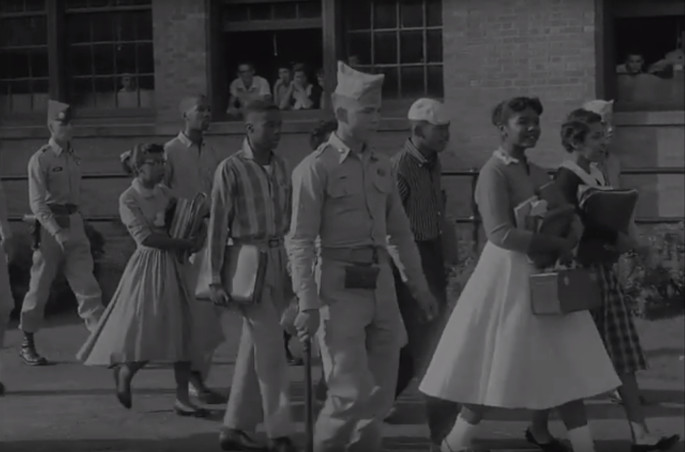
Little Rock school desegregation, 1957
Remedies affect real impact
The Court’s power also depends on the remedy it allows.
- Swann v. Charlotte-Mecklenburg (1971) allowed stronger desegregation remedies like busing
- Milliken v. Bradley (1974) limited interdistrict remedies unless multiple districts caused the violation
Other institutional checks
- Congress sets the size of the Court by statute.
- FDR’s 1937 court-packing plan failed, but it showed Congress could try to reshape the Court.
- Impeachment exists for misconduct, not disagreement with rulings.
- Samuel Chase was impeached in 1804 and acquitted in 1805. No Supreme Court justice has been removed that way.
The Big Pattern
The Court checks the other branches through judicial review. The other branches check the Court through legislation, amendments, appointments, jurisdiction, structure, and enforcement.
Supreme Court power is strongest in constitutional interpretation. It is weaker in enforcement, because other officials often decide how fast and how fully a ruling becomes reality.
Key Takeaways
Countermajoritarian Difficulty
The concern that unelected, life-tenured judges can use judicial review to override policies supported by elected majorities
Judicial Activism
An approach favoring assertive judicial review to invalidate government actions, establish new constitutional interpretations, or overturn precedent
Judicial Restraint
An approach favoring limited judicial review, adherence to precedent, and deference to elected institutions unless the Constitution clearly requires intervention
Stare Decisis
The doctrine of following precedent in cases with similar facts, promoting stability and predictability in the law
Congressional Legislation Modifying a Supreme Court Decision
Congress may amend a federal statute to change a Court interpretation prospectively, but an ordinary law cannot override the Court’s interpretation of the Constitution
Constitutional Amendment as a Check on the Supreme Court
An amendment changes the Constitution the Court must interpret and can therefore supersede a Supreme Court constitutional ruling
Judicial Appointments and Senate Confirmations
The president nominates justices and the Senate confirms or rejects them, allowing the elected branches to shape the Court’s future ideological balance
Court Packing (Altering the Size of the Supreme Court)
Using Congress’s statutory power over the Court’s size to change its membership and potentially shift its ideological direction
Jurisdiction Stripping
Congress’s use of its Article III authority to remove categories of cases from the Supreme Court’s appellate jurisdiction
Delayed Implementation of Supreme Court Decisions
Presidents, states, or other implementing institutions can resist, delay, or narrowly enforce a ruling, reducing its immediate practical effect
Impeachment and Removal of Federal Judges
The House may impeach a federal judge by majority vote; the Senate may convict and remove the judge by a two-thirds vote of senators present for treason, bribery, or other high crimes and misdemeanors
Notes
Countermajoritarian Difficulty
The concern that unelected, life-tenured judges can use judicial review to override policies supported by elected majorities
Judicial Activism
An approach favoring assertive judicial review to invalidate government actions, establish new constitutional interpretations, or overturn precedent
Judicial Restraint
An approach favoring limited judicial review, adherence to precedent, and deference to elected institutions unless the Constitution clearly requires intervention
Stare Decisis
The doctrine of following precedent in cases with similar facts, promoting stability and predictability in the law
Congressional Legislation Modifying a Supreme Court Decision
Congress may amend a federal statute to change a Court interpretation prospectively, but an ordinary law cannot override the Court’s interpretation of the Constitution
Constitutional Amendment as a Check on the Supreme Court
An amendment changes the Constitution the Court must interpret and can therefore supersede a Supreme Court constitutional ruling
Judicial Appointments and Senate Confirmations
The president nominates justices and the Senate confirms or rejects them, allowing the elected branches to shape the Court’s future ideological balance
Court Packing (Altering the Size of the Supreme Court)
Using Congress’s statutory power over the Court’s size to change its membership and potentially shift its ideological direction
Jurisdiction Stripping
Congress’s use of its Article III authority to remove categories of cases from the Supreme Court’s appellate jurisdiction
Delayed Implementation of Supreme Court Decisions
Presidents, states, or other implementing institutions can resist, delay, or narrowly enforce a ruling, reducing its immediate practical effect
Impeachment and Removal of Federal Judges
The House may impeach a federal judge by majority vote; the Senate may convict and remove the judge by a two-thirds vote of senators present for treason, bribery, or other high crimes and misdemeanors
