Topic 3.1 Notes – The Bill of Rights
What the Bill of Rights Is
The Bill of Rights is the first ten amendments, ratified in 1791. These amendments enumerate rights, which means the rights are actually listed in the constitutional text.
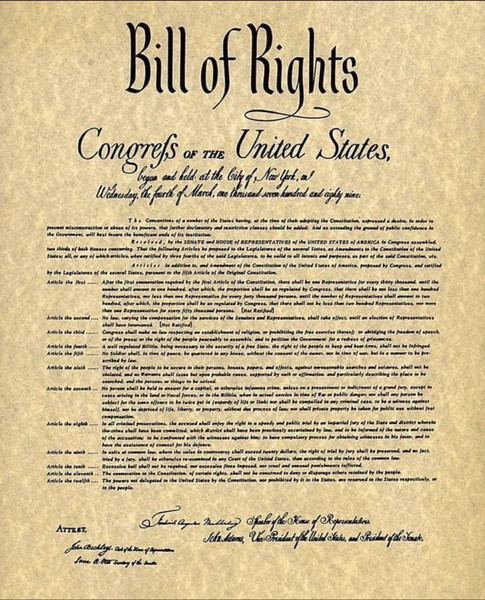
Bill of Rights
That matters because the Constitution is the supreme law of the land. If a law, court action, or executive action conflicts with one of these rights, courts can strike it down.
- Civil liberties protect you from arbitrary government interference with beliefs, speech, property, and fair legal treatment.
- The core idea is limited government. Government has power, but the Constitution draws lines it cannot cross.
- Rights are not absolute. Courts have to interpret broad phrases like free speech, due process, unreasonable searches, and cruel and unusual punishment.
- Lock in this distinction:
- Civil liberties = freedom from government interference
- Civil rights = equal treatment and protection against discrimination
- The Bill of Rights mainly limits government action, not purely private conduct.
Why the Bill of Rights Was Added
The original 1787 Constitution did not include a separate bill of rights. That became a major fight during ratification.
- Anti-Federalists feared the new national government would be too powerful. Brutus No. 1 warned that distant national power could threaten liberty.
- Federalists answered that the national government had only enumerated powers, so it was already limited.
- Some Federalists worried that listing rights could be dangerous. If some rights were written down, people might assume unlisted rights did not exist.
- The Ninth Amendment later addressed that by saying people retain rights beyond those specifically listed.
Politics pushed this issue over the line. Supporters of the Constitution promised amendments protecting liberty. James Madison proposed them in the First Congress in 1789. Congress sent 12 amendments to the states, and 10 were ratified in 1791.
The Ten Amendments
The amendments protect different kinds of freedom, so you need to know what each one covers.
| Amendment | Main protection |
|---|---|
| First | Religion, speech, press, assembly, petition |
| Second | Keep and bear arms; militia wording causes debate |
| Third | No quartering soldiers in homes in peacetime without consent |
| Fourth | No unreasonable searches and seizures; warrants need probable cause, oath, and particularity |
| Fifth | Grand jury, double jeopardy, self-incrimination, due process, takings with just compensation |
| Sixth | Speedy public trial, impartial jury, notice, confrontation, witnesses, counsel |
| Seventh | Jury trial in federal civil cases |
| Eighth | No excessive bail, excessive fines, cruel and unusual punishment |
| Ninth | Unenumerated rights retained by the people |
| Tenth | Powers not delegated to national government reserved to states or the people |
How the Bill of Rights Applies
Originally, the Bill of Rights limited only the national government. In Barron v. Baltimore (1833), the Supreme Court said it did not apply to the states at first.
Later, most protections were applied to state and local governments through selective incorporation under the Fourteenth Amendment due process clause. The diagram below captures that shift from federal-only limits to rights that now also restrict state and local governments.
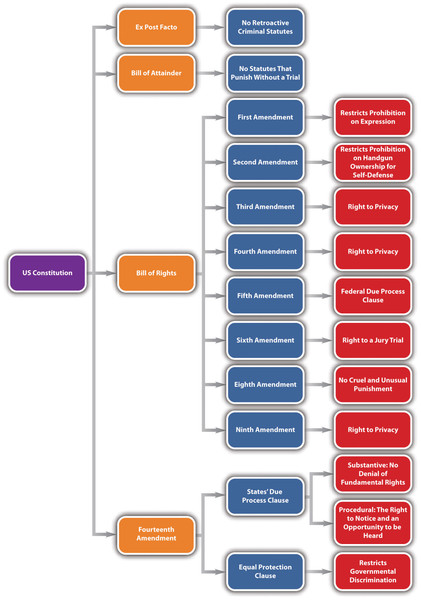
Selective incorporation through the Fourteenth Amendment
For this topic, you just need the shift: federal only at first, now mostly federal plus state/local.
When you see a scenario, walk it through in this order:
- Identify the government actor
- Identify the liberty, property, or procedure affected
- Match it to the specific amendment
- Explain how that amendment limits government action
Quick matches:
- Censorship of protest = First Amendment
- Gun regulation = Second Amendment
- Warrantless home search = Fourth Amendment
- Forced confession = Fifth Amendment
- Denied a lawyer in a criminal case = Sixth Amendment
- Extreme bail or punishment = Eighth Amendment
Why Judicial Interpretation Matters
The Bill of Rights works in practice because courts give broad words concrete meaning. The text says free speech and unreasonable searches, but real cases decide what those phrases cover.
- The Supreme Court turns general language into usable rules through precedent.
- Later cases can expand, narrow, or clarify rights without changing the text.
- Technology keeps creating new questions. The Fourth Amendment now has to be applied to phones, data, and digital privacy.
- This is why you should never write only “my rights were violated.” On a test, name the exact amendment and the specific protection.
Key Takeaways
Bill of Rights
The first ten amendments, ratified in 1791, that enumerate individual liberties and legal protections and limit government power
Enumerated Rights
Rights expressly identified or listed in the constitutional text
Civil Liberties vs. Civil Rights
Civil liberties protect freedom from arbitrary government interference; civil rights protect equal treatment and guard against discrimination
First Amendment
Protects religious liberty and the freedoms of speech, press, peaceful assembly, and petition
Establishment Clause
The First Amendment restriction on government support for or establishment of religion
Free Exercise Clause
The First Amendment protection for religious belief and, subject to constitutional limits, religious practice
Freedom of Speech
The First Amendment protection for many forms of verbal and expressive communication
Freedom of the Press
The First Amendment protection for publishing and circulating information and opinion
Freedom of Assembly
The First Amendment protection for peaceful collective expression and association
Right to Petition
The First Amendment protection for asking government to change policies or remedy grievances
Second Amendment
Protects the right of the people to keep and bear arms while referring to the necessity of a well-regulated militia
Third Amendment
Prohibits quartering soldiers in private homes during peacetime without consent and permits wartime quartering only as prescribed by law
Fourth Amendment
Protects persons, houses, papers, and effects against unreasonable searches and seizures and establishes warrant requirements
Search
A government effort to obtain information in an area or interest protected by the Fourth Amendment
Seizure
Government control over a person or property under the Fourth Amendment
Probable Cause
The Fourth Amendment standard that must support the issuance of a warrant
Fourth Amendment Warrant Requirements
A warrant must be supported by probable cause and oath or affirmation and particularly describe the place to be searched and the persons or things to be seized
Fifth Amendment
Generally requires a grand-jury indictment for federal capital or infamous crimes, with military exceptions, and protects against double jeopardy, compelled self-incrimination, deprivation without due process, and uncompensated takings
Double Jeopardy
The Fifth Amendment protection against being placed twice in jeopardy for the same offense
Self-Incrimination
The Fifth Amendment protection against being compelled in a criminal case to be a witness against oneself
Due Process of Law
The constitutional requirement that government act lawfully and nonarbitrarily when depriving a person of life, liberty, or property
Procedural Due Process vs. Substantive Due Process
Procedural due process concerns the methods government uses; substantive due process concerns whether government has adequate constitutional justification for the deprivation
Takings Clause
The Fifth Amendment rule that private property may not be taken for public use without just compensation
Sixth Amendment
Guarantees criminal defendants a speedy public trial by an impartial local jury, notice of the accusation, confrontation of opposing witnesses, compulsory process for favorable witnesses, and assistance of counsel
Seventh Amendment
Preserves a jury trial in federal civil cases at common law involving more than twenty dollars and limits reexamination of jury-found facts
Eighth Amendment
Prohibits excessive bail, excessive fines, and cruel and unusual punishments
Ninth Amendment
Provides that listing certain constitutional rights must not be interpreted to deny or disparage other rights retained by the people
Unenumerated Rights
Rights retained by the people even though they are not expressly listed in the constitutional text
Tenth Amendment
Reserves powers neither delegated to the United States nor prohibited to the states to the states or the people
Government-Action Requirement
A Bill of Rights claim ordinarily requires action by government or someone legally acting on its behalf, not purely private conduct
Continuous Judicial Interpretation
Courts give practical meaning to the Bill of Rights’ broad language by applying constitutional text and precedent to concrete facts
Notes
Bill of Rights
The first ten amendments, ratified in 1791, that enumerate individual liberties and legal protections and limit government power
Enumerated Rights
Rights expressly identified or listed in the constitutional text
Civil Liberties vs. Civil Rights
Civil liberties protect freedom from arbitrary government interference; civil rights protect equal treatment and guard against discrimination
First Amendment
Protects religious liberty and the freedoms of speech, press, peaceful assembly, and petition
Establishment Clause
The First Amendment restriction on government support for or establishment of religion
Free Exercise Clause
The First Amendment protection for religious belief and, subject to constitutional limits, religious practice
Freedom of Speech
The First Amendment protection for many forms of verbal and expressive communication
Freedom of the Press
The First Amendment protection for publishing and circulating information and opinion
Freedom of Assembly
The First Amendment protection for peaceful collective expression and association
Right to Petition
The First Amendment protection for asking government to change policies or remedy grievances
Second Amendment
Protects the right of the people to keep and bear arms while referring to the necessity of a well-regulated militia
Third Amendment
Prohibits quartering soldiers in private homes during peacetime without consent and permits wartime quartering only as prescribed by law
Fourth Amendment
Protects persons, houses, papers, and effects against unreasonable searches and seizures and establishes warrant requirements
Search
A government effort to obtain information in an area or interest protected by the Fourth Amendment
Seizure
Government control over a person or property under the Fourth Amendment
Probable Cause
The Fourth Amendment standard that must support the issuance of a warrant
Fourth Amendment Warrant Requirements
A warrant must be supported by probable cause and oath or affirmation and particularly describe the place to be searched and the persons or things to be seized
Fifth Amendment
Generally requires a grand-jury indictment for federal capital or infamous crimes, with military exceptions, and protects against double jeopardy, compelled self-incrimination, deprivation without due process, and uncompensated takings
Double Jeopardy
The Fifth Amendment protection against being placed twice in jeopardy for the same offense
Self-Incrimination
The Fifth Amendment protection against being compelled in a criminal case to be a witness against oneself
Due Process of Law
The constitutional requirement that government act lawfully and nonarbitrarily when depriving a person of life, liberty, or property
Procedural Due Process vs. Substantive Due Process
Procedural due process concerns the methods government uses; substantive due process concerns whether government has adequate constitutional justification for the deprivation
Takings Clause
The Fifth Amendment rule that private property may not be taken for public use without just compensation
Sixth Amendment
Guarantees criminal defendants a speedy public trial by an impartial local jury, notice of the accusation, confrontation of opposing witnesses, compulsory process for favorable witnesses, and assistance of counsel
Seventh Amendment
Preserves a jury trial in federal civil cases at common law involving more than twenty dollars and limits reexamination of jury-found facts
Eighth Amendment
Prohibits excessive bail, excessive fines, and cruel and unusual punishments
Ninth Amendment
Provides that listing certain constitutional rights must not be interpreted to deny or disparage other rights retained by the people
Unenumerated Rights
Rights retained by the people even though they are not expressly listed in the constitutional text
Tenth Amendment
Reserves powers neither delegated to the United States nor prohibited to the states to the states or the people
Government-Action Requirement
A Bill of Rights claim ordinarily requires action by government or someone legally acting on its behalf, not purely private conduct
Continuous Judicial Interpretation
Courts give practical meaning to the Bill of Rights’ broad language by applying constitutional text and precedent to concrete facts
